How Boston's Brownfields Redevelopment Unlocks PM Lessons for Every Team
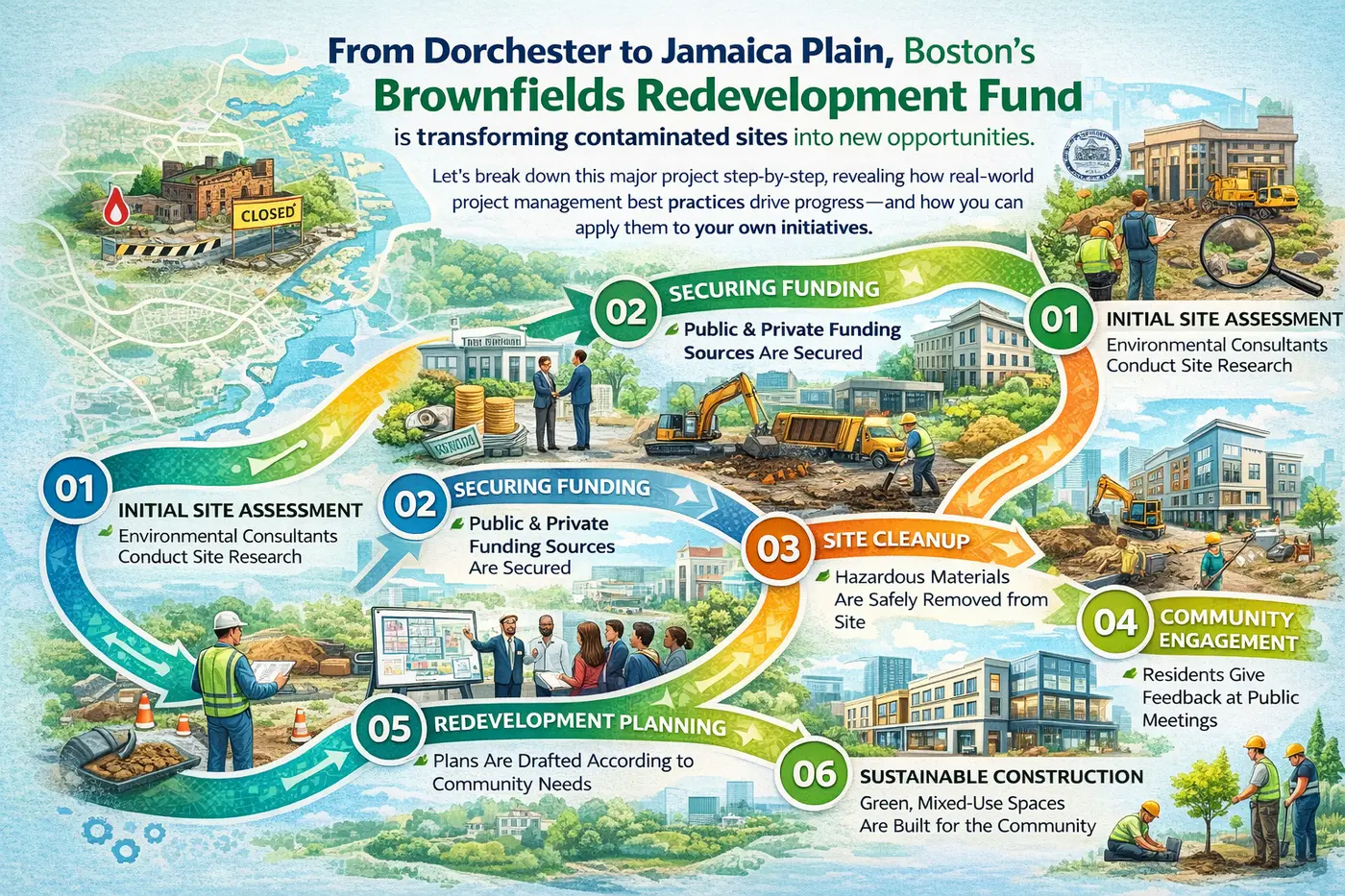
From Dorchester to Jamaica Plain, Boston’s Brownfields Redevelopment Fund is transforming contaminated sites into new opportunities. Let’s break down this major project step-by-step, revealing how real-world project management best practices drive progress—and how you can apply them to your own initiatives.
What’s happening in Boston: the project in plain English
On July 30, 2025, the Massachusetts Executive Office of Economic Development and MassDevelopment announced over $6.5 million in awards to assess and clean up contaminated ("brownfield") sites in Boston’s neighborhoods—Dorchester, Mattapan, Roxbury, and Jamaica Plain. This project aims to unlock land for housing and redevelopment that’s been off-limits due to environmental risks.
The work involves both environmental assessment (testing and planning) and actual site remediation (cleanup). Multiple locations are funded, with awards ranging from around $118,000 up to $750,000 each. The specifics for some vendors, timelines, and site-by-site outcomes are still being finalized, but the overall structure offers rich lessons in managing complex, multi-deliverable urban projects.
- Total budget: $6,519,000
- Individual awards: $118,000—$750,000 per site
- Project locations: Multiple Boston neighborhoods
- Current milestone: Awards announced July 30, 2025; redevelopment ongoing
- Project: Brownfields Redevelopment Fund Awards (Boston)
- Owner: MassDevelopment & Executive Office of Economic Development
- Status: Awards announced July 30, 2025
- PM Practice: Scope management and WBS decomposition
- What to watch next: Site remediation progress and visible land reuse
Scope and WBS: turning deliverables into work packages
Project managers know that clearly defining scope is the bedrock of success—especially for complex efforts like brownfield cleanup. Here, deliverables include site-specific assessments, remediation plans, and finally making those sites ready for housing or other uses. The Work Breakdown Structure (WBS) helps map these deliverables into actionable chunks.
Below is an illustrative WBS for the Boston Brownfields project, organized from the highest (project) level down to actionable tasks. Use this as a model for breaking down multi-location or multi-phase projects, whether in biotech, tech, or operations.
- 1. Brownfields Redevelopment (Overall Project)
- 1.1 Environmental Site Assessment
- 1.1.1 Site selection & prioritization
- 1.1.2 Historical records review
- 1.1.3 Soil & groundwater testing
- 1.2 Remediation Planning
- 1.2.1 Cleanup strategy development
- 1.2.2 Regulatory coordination
- 1.2.3 Permitting
- 1.3 Site Cleanup Execution
- 1.3.1 Contractor mobilization
- 1.3.2 Remediation work
- 1.3.3 Post-cleanup verification/reporting
- 1.4 Site Redevelopment Handover
- 1.4.1 Final inspections
- 1.4.2 Documentation transfer
- 1.1 Environmental Site Assessment
- Project: Brownfields Redevelopment Fund Awards (Boston)
- Owner: MassDevelopment & Executive Office of Economic Development
- Status: Redevelopment ongoing
- PM Practice: Cross-site WBS and multi-location coordination
- What to watch next: Project progress reports and handover to redevelopment teams
Schedule thinking: Gantt, dependencies, and the critical path
With award funding in place (July 30, 2025), the clock is ticking: multiple sites must move from assessment to cleanup to ready-for-redevelopment. A Gantt chart, even a simple spreadsheet version, is invaluable for tracking milestones, task durations, and overlapping workstreams.
Key is mapping dependencies: for example, you cannot start remediation until site assessments are complete, and you cannot begin redevelopment until both cleanup and regulatory sign-off are finished. This chain of tasks forms your critical path—the sequence that determines the shortest possible project duration. Delays on these tasks delay the whole project.
Here’s a simplified dependency chain:
- Site Assessment (A) → Remediation Planning (B) → Cleanup Execution (C) → Regulatory Signoff (D) → Redevelopment Handover (E)
If any activity on this line slips, so does your project’s end date. Knowing this, experienced PMs use the Gantt chart to highlight critical activities and look for areas of "float" (schedule flexibility) elsewhere.
- Project: Brownfields Redevelopment Fund Awards (Boston)
- Owner: MassDevelopment & Executive Office of Economic Development
- Status: Awards announced, redevelopment phase ongoing
- PM Practice: Gantt chart and critical path tracking
- What to watch next: Remediation kickoff and dependency management between sites
Risks, stakeholders, and governance (PMO vs delivery team)
No urban remediation project runs risk-free or stakeholder-light. For Boston’s brownfields, strong governance and clear communication channels—often via a PMO (Project Management Office)—are critical to build trust and keep things on track.
Here’s a stakeholder map, followed by five top risks and mitigations from a PM perspective:
- Stakeholders:
- Internal
- MassDevelopment project managers and PMO
- Executive Office of Economic Development oversight
- External
- Boston city officials (zoning, permitting)
- Neighborhood associations and residents
- Environmental consultants and contractors
- Regulators (state DEP, EPA)
- Top 5 Risks & Mitigations:
- 1. Discovery of unexpected contaminants → Mitigation: Contingency budget, fast-track lab contracts
- 2. Regulatory delays/permitting → Mitigation: Early engagement, parallel processing where allowed
- 3. Community opposition or misinformation → Mitigation: Ongoing stakeholder meetings, transparent reporting
- 4. Contractor underperformance → Mitigation: Milestone-based payments, regular progress reviews
- 5. Budget overruns → Mitigation: Strong cost tracking, explicit change control process
Agile where it fits, classic where it must: a hybrid delivery plan
Not every milestone is suited for classical 'waterfall' project management—nor pure agile. In brownfields redevelopment, large phases (assessment, permitting, cleanup) suggest a classic structure, but uncertainty (site-by-site findings, evolving stakeholder needs) argues for agile practices within those phases.
A hybrid plan might use classic gated oversight (move to next phase only after regulatory approvals), but also agile sprints within phases: for example, parallel assessment teams reporting in weekly stand-ups, or iterative feedback loops with community groups after each site visit.
Why hybrid? Because it lets leadership manage scope and risk while empowering teams to adapt to surprises—whether technical, environmental, or political.
- Agile in: Field data collection, community engagement, iterative reporting
- Classic in: Regulatory compliance, major funding gates, final handover
- Project: Brownfields Redevelopment Fund Awards (Boston)
- Owner: MassDevelopment & Executive Office of Economic Development
- Status: Redevelopment ongoing
- PM Practice: Hybrid methodology adoption
- What to watch next: Team adaptation to site discoveries and stakeholder feedback loops
A practical project plan you can reuse
How would a PMO or team structure rolling out this kind of work, even with partial details? Here's a sample 90-day plan for a brownfields-type initiative. Tailor it to your environment—whether public, private, biotech, or operations.
90-Day Phased Plan (Weeks are approximate placeholders):
- Week 1–2: Kickoff, stakeholder mapping, review of site award documentation
- Week 3–6: Environmental assessments, launch risk register, begin community engagement
- Week 7–10: Remediation planning, submit permit applications, procurement of vendors/contractors (if not pre-selected)
- Week 11–14: Start cleanup on sites with approved plans, weekly reporting to PMO, realign on encountered issues
- Week 15+: Begin handover to redevelopment teams as sites clear verification
Plan Your Next Boston Project with Confidence
Ready to bring professional-grade project management discipline to your urban, tech, or operations initiative? Discover how our software and services help Boston teams break down complexity, keep everyone accountable, and deliver results. Book a free consultation today.
FAQ
- What is the Brownfields Redevelopment Fund?
- It’s a funding program from Massachusetts state agencies to assess and clean up contaminated (brownfield) sites, especially those that hinder housing and economic development in areas like Boston.
- How can project managers apply these lessons to their own portfolios?
- By using structured approaches—WBS, dependency mapping, phased planning, risk registers, and stakeholder engagement—any team can tackle complexity, even if the initiative is in tech, life sciences, or municipal operations.
- Where can I read more about this specific Boston project?
- See the official news release and award details at mass.gov: https://www.mass.gov/news/healey-driscoll-administration-announces-65-million-to-assess-clean-up-brownfields
Read also: Project Management in Boston: Trends & Opportunities.