Project Management Process Groups: The Complete Guide to the 5 PMI Process Groups in 2026
Project management process groups form the structural backbone of modern project governance, providing a standardized framework to manage complexity, align stakeholders, and deliver consistent outcomes across industries. Originating from the PMBOK framework, these five groups—initiating, planning, executing, monitoring and controlling, and closing—organize project activities into coherent clusters that guide decision-making throughout the entire lifecycle. In 2026, organizations face increasing pressure to deliver faster, with greater accuracy and fewer resources, making structured approaches indispensable. Recent industry data shows that 82% of high-performing organizations rely on standardized project frameworks, highlighting the strategic importance of mastering these process groups. Understanding them deeply is not about following rigid steps, but about enabling adaptive, data-driven, and outcome-oriented project execution.
What are project management process groups?
Project management process groups represent a logical categorization of project management activities rather than a strict chronological sequence. They define how project work is structured, controlled, and optimized across its lifecycle, regardless of methodology. Unlike linear models, these groups operate dynamically, often overlapping and interacting continuously to ensure project alignment and performance. This distinction is critical in modern project environments where agility, iteration, and responsiveness are essential. By organizing work into process groups, project managers gain clarity, improve coordination, and enhance their ability to manage uncertainty effectively.
Definition and strategic role
A process group is a collection of related processes that serve a specific purpose within project management, such as initiating or controlling. Each group contributes to achieving defined project objectives while maintaining alignment with stakeholder expectations. Their strategic role lies in providing a structured decision-making framework that supports consistency, accountability, and performance optimization. In increasingly complex project ecosystems, these groups act as a governance mechanism that ensures all activities are aligned with business goals and executed efficiently.
Process groups vs phases vs knowledge areas
One of the most common misunderstandings in project management is the confusion between process groups, project phases, and knowledge areas. Process groups define the “how” of project execution, outlining the sequence and interaction of activities. Knowledge areas define the “what,” covering domains such as scope, cost, risk, and communication. Project phases, on the other hand, represent the chronological progression of a project. Understanding this distinction is essential to avoid misapplication of frameworks and to fully leverage structured methodologies in real-world scenarios.
The 5 project management process groups explained
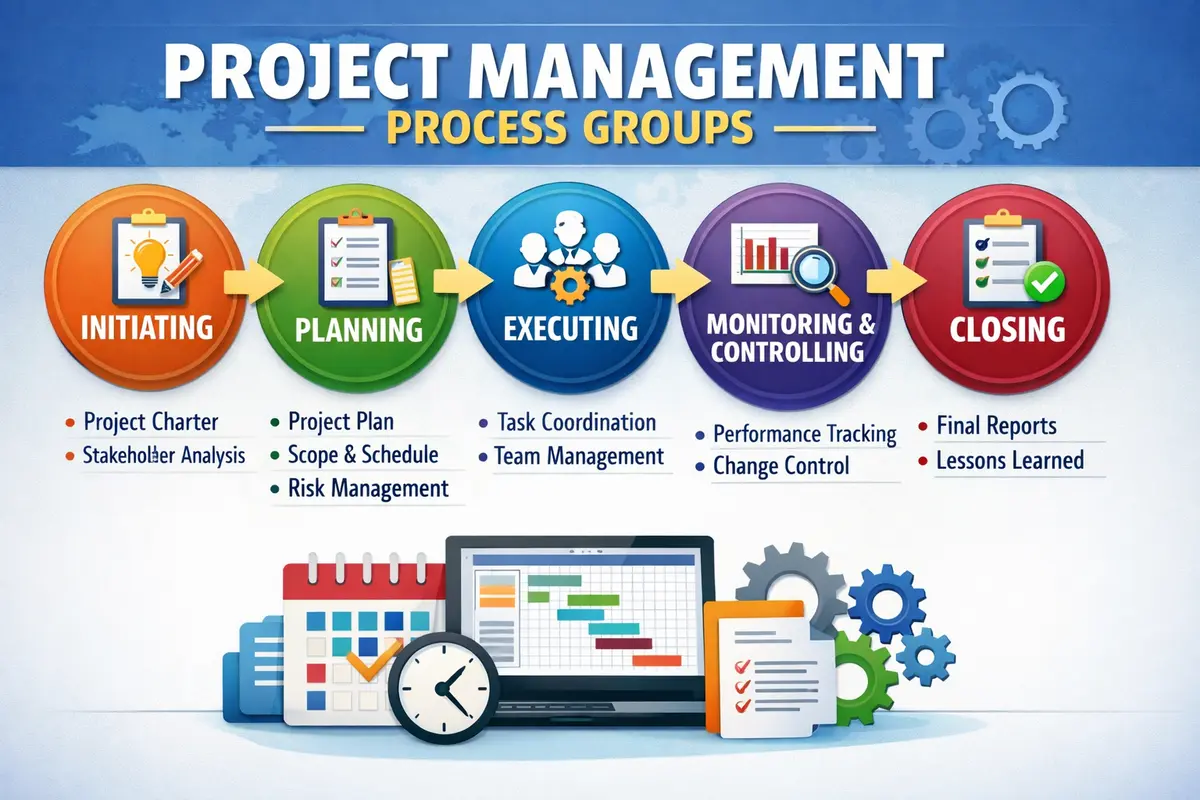
The five process groups collectively form a comprehensive system that governs all aspects of project management. Each group has distinct objectives, activities, and deliverables, yet they function as an integrated whole. Mastering their interactions enables project managers to maintain control, adapt to change, and deliver consistent results. These groups are not isolated stages but interconnected layers of management that operate simultaneously throughout the project lifecycle.
Initiating: defining the project foundation
The initiating process group establishes the foundation of the project by defining its purpose, scope, and stakeholders. It involves assessing feasibility, identifying risks, and formalizing the project through key documents such as the project charter. This document authorizes the project and defines the project manager’s authority. A well-executed initiation phase ensures clarity from the outset, reduces ambiguity, and aligns all stakeholders around shared objectives, significantly increasing the likelihood of success.
Planning: structuring execution and reducing uncertainty
The planning process group is the most comprehensive and critical stage, where all aspects of the project are structured in detail. It includes defining scope, scheduling, budgeting, resource allocation, communication strategies, and risk management. The primary deliverable is the project management plan, which serves as a central reference for all project activities. Effective planning minimizes uncertainty, enables proactive risk mitigation, and ensures optimal use of resources, ultimately improving project performance.
Executing: delivering project outcomes
The executing process group focuses on implementing the project plan and producing deliverables. It involves coordinating teams, managing resources, and maintaining communication with stakeholders. This group requires strong leadership and operational discipline to ensure that work is completed efficiently and meets quality standards. Execution is where strategy translates into action, making it a critical component of overall project success.
Monitoring and controlling: continuous performance management
The monitoring and controlling process group operates continuously throughout the project, ensuring alignment with objectives and identifying deviations. It involves tracking performance metrics, analyzing variances, and implementing corrective actions when necessary. Unlike a sequential phase, this group runs in parallel with execution, providing real-time insights that enable informed decision-making and proactive adjustments. This continuous oversight is essential for maintaining control and achieving desired outcomes.
Closing: finalizing and learning from the project
The closing process group marks the formal completion of the project, including final deliverable acceptance, documentation, and resource release. It also involves capturing lessons learned and evaluating overall performance. This phase is critical for organizational learning and continuous improvement, as it provides valuable insights that can be applied to future projects. A structured closing process ensures that all objectives are met and that knowledge is retained.
Key elements of each process group
A structured understanding of process groups requires clarity on their objectives, activities, and outputs. The following list summarizes the essential components of each group, providing a practical reference for implementation. This structured approach enhances usability and supports decision-making in real-world project environments.
- Initiating: define objectives, identify stakeholders, create project charter
- Planning: develop scope, schedule, budget, and risk plans
- Executing: coordinate resources, deliver outputs, manage teams
- Monitoring and Controlling: track performance, manage changes, ensure alignment
- Closing: finalize deliverables, document outcomes, capture lessons learned
Why process groups are critical in 2026
In 2026, project environments are more complex than ever, driven by digital transformation, cross-functional teams, and global collaboration. Project management process groups provide a structured framework that enables organizations to manage this complexity effectively. They enhance visibility, improve coordination, and reduce operational risks. Organizations that adopt these frameworks consistently outperform those that rely on ad hoc approaches, demonstrating the strategic value of structured project management.
Impact on project performance
The adoption of process groups has a measurable impact on project outcomes, including improved delivery timelines, cost control, and quality assurance. By standardizing processes and enabling better decision-making, these groups contribute to higher efficiency and reduced failure rates. They also support scalability, allowing organizations to manage multiple projects simultaneously without compromising performance.
Adapting process groups to Agile and hybrid environments
Contrary to common misconceptions, process groups are not limited to traditional waterfall methodologies. They can be adapted to Agile and hybrid frameworks, providing structure without sacrificing flexibility. For example, planning activities can be distributed across sprints, while monitoring and controlling integrate naturally into Agile ceremonies. This adaptability makes process groups highly relevant in modern project environments.
Practical example in Agile
In an Agile project, initiation may involve defining a product vision and initial backlog, while planning occurs incrementally during sprint planning sessions. Execution corresponds to iterative development cycles, and monitoring is embedded in daily stand-ups and retrospectives. Closing may occur at the end of a release, focusing on evaluation and knowledge capture. This demonstrates how process groups can coexist with Agile practices effectively.
Common mistakes to avoid
Despite their importance, process groups are often misunderstood or misapplied, leading to inefficiencies and project failures. Common mistakes include treating them as linear phases, neglecting planning, or overlooking the importance of continuous monitoring. Avoiding these pitfalls requires a clear understanding of their purpose and proper implementation within the project context.
Critical errors list
- Confusing process groups with project phases
- Ignoring continuous monitoring and control
- Underestimating planning complexity
- Skipping formal project closure
- Failing to adapt processes to context
FAQ about project management process groups
What is the difference between process groups and phases?
Process groups define how project management activities are organized, while phases represent the chronological progression of the project lifecycle. Understanding this difference ensures proper framework application.
Are process groups mandatory?
They are not mandatory but highly recommended, as they provide a structured approach that improves efficiency and reduces risks.
Can process groups be used in Agile?
Yes, they can be adapted to Agile methodologies, providing structure while maintaining flexibility and iterative workflows.