Scaled Agile Framework (SAFe): Understanding and Implementing Agile at Scale in 2026
Large organizations constantly face the challenge of coordinating multiple teams while maintaining speed, innovation, and product quality. As companies scale digital products, traditional agile frameworks designed for single teams often struggle to handle dependencies, strategic alignment, and long-term planning. The Scaled Agile Framework (SAFe) addresses this challenge by providing a structured approach to agile at scale, allowing dozens or even hundreds of professionals to collaborate toward shared product outcomes. In 2026, industry analyses estimate that nearly 37% of large enterprises implementing agile transformation rely on SAFe, making it one of the most widely adopted scaling frameworks worldwide. Its growing popularity stems from its ability to bridge the gap between business strategy, product management, and engineering execution. Organizations adopting SAFe aim to improve coordination, reduce delivery bottlenecks, and accelerate time-to-market while maintaining alignment across teams and departments.
What Is the Scaled Agile Framework (SAFe)?
The Scaled Agile Framework is a structured methodology designed to extend agile principles beyond individual teams and into complex enterprise environments. While frameworks like Scrum or Kanban help small teams organize their work efficiently, SAFe introduces mechanisms that enable multiple teams to collaborate on shared products and platforms. The framework integrates principles from Lean management, Agile development, and DevOps to create a system that connects strategic planning with operational execution. This alignment allows organizations to deliver value continuously while maintaining visibility across projects, dependencies, and product roadmaps.
In large companies, product development rarely occurs in isolation. Multiple teams often contribute to a single system, creating dependencies that can slow down progress and complicate coordination. SAFe addresses this issue by establishing shared planning cycles, common objectives, and structured collaboration mechanisms. These practices help organizations maintain agility while introducing the governance required to manage large-scale development initiatives. By synchronizing teams around shared goals and timelines, SAFe reduces misalignment and increases the predictability of product delivery.
The Origins and Evolution of SAFe
The framework was created by Dean Leffingwell in response to the challenges organizations faced when attempting to scale agile practices beyond small teams. Early agile implementations revealed that duplicating Scrum teams without a broader coordination system often created new bottlenecks rather than solving existing ones. SAFe emerged as a response to this problem, combining agile development practices with Lean systems thinking to create a scalable operational model. Over time, the framework evolved to incorporate practices such as continuous delivery, product management alignment, and enterprise portfolio governance.
The evolution of SAFe reflects the broader transformation of modern organizations toward digital product development and platform-based ecosystems. Today, the framework extends beyond engineering teams and influences how businesses structure strategy, budgeting, and product investment decisions. This shift highlights the growing importance of aligning business outcomes with development capabilities. As organizations adopt SAFe, they often rethink how value flows through their systems, enabling more responsive and adaptive product strategies.
The Core Principles Behind SAFe
The Scaled Agile Framework is built on a set of Lean-Agile principles that guide decision-making and organizational behavior. These principles encourage teams to optimize the entire system rather than focusing solely on local efficiency. By emphasizing flow, transparency, and continuous learning, SAFe promotes a culture where teams can adapt quickly to changing market conditions. This systemic approach allows organizations to deliver value more predictably while maintaining the flexibility necessary for innovation.
Organizations typically adopt SAFe to address three key challenges: fragmented initiatives, cross-team dependencies, and misalignment between strategy and execution. The framework introduces synchronized planning cycles and shared objectives that help teams coordinate their work effectively. These mechanisms create visibility across the organization and ensure that product development efforts remain aligned with strategic priorities. As a result, SAFe enables organizations to transform traditional project-based structures into value-driven product delivery systems.
The Four Core Values of SAFe
SAFe relies on four core values that guide collaboration and decision-making across the organization. These values provide a cultural foundation that supports the successful implementation of the framework. Without these principles, SAFe can become overly procedural and lose its agile spirit. When embraced fully, however, they foster a collaborative environment focused on continuous improvement and value delivery.
- Alignment: ensuring teams and stakeholders work toward shared strategic objectives.
- Transparency: making progress, risks, and dependencies visible across the organization.
- Built-in quality: embedding quality practices throughout the development process.
- Program execution: focusing on delivering real value to customers on a regular cadence.
These values shape how teams prioritize work, manage dependencies, and evaluate their progress. Organizations that implement SAFe successfully often emphasize cultural transformation alongside process changes. By fostering transparency and shared responsibility, these values help teams build trust and collaborate more effectively across organizational boundaries.
The SAFe Structure: Levels and Organizational Layers
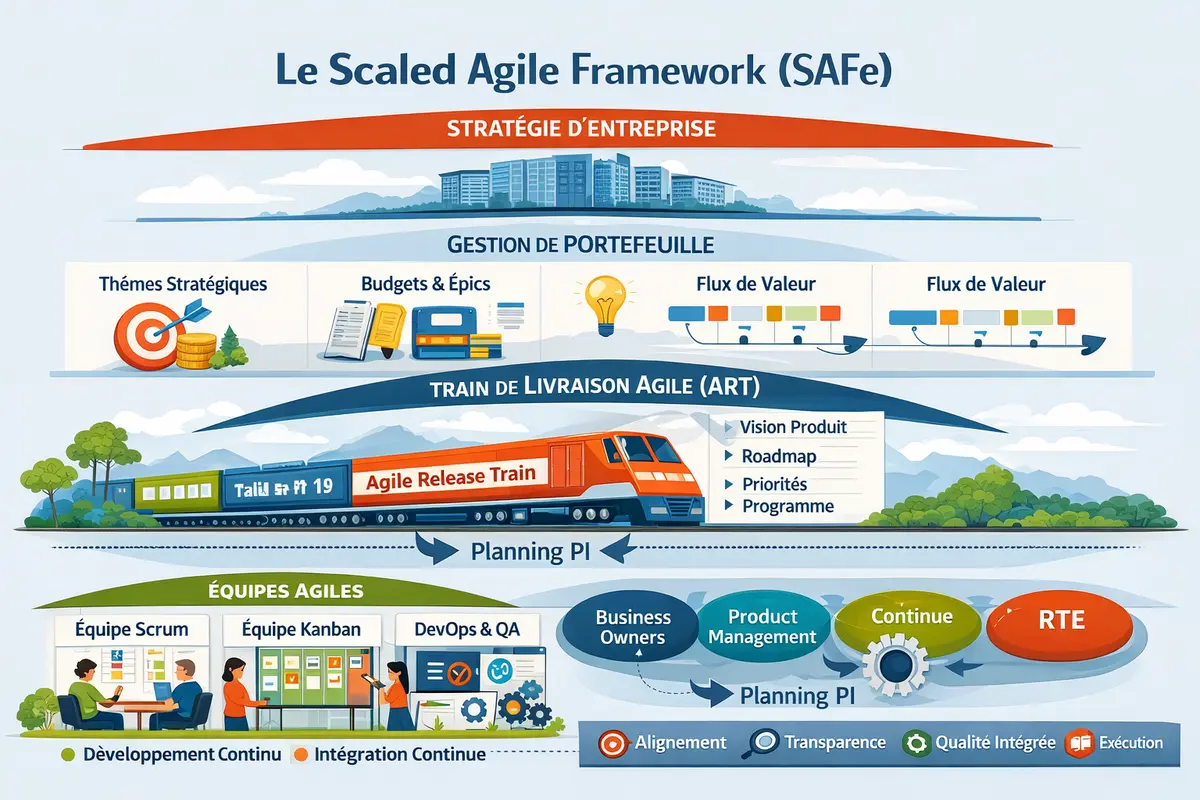
The architecture of the Scaled Agile Framework organizes work into several layers that connect strategic planning with team execution. Each level has a specific purpose and ensures that information flows efficiently between leadership and development teams. This layered structure helps organizations manage complexity while maintaining alignment across multiple initiatives. By defining clear responsibilities at each level, SAFe supports better decision-making and coordination.
The most commonly implemented configuration is known as Essential SAFe, which provides the minimal structure needed to coordinate multiple agile teams. Organizations can expand this configuration to include additional layers such as large solution coordination or portfolio management. This modular design allows companies to tailor the framework to their specific needs and organizational maturity.
The Team Level
The team level represents the operational foundation of SAFe and relies heavily on familiar agile practices such as Scrum and Kanban. Teams work in short iterations and deliver incremental improvements to the product. Regular ceremonies such as sprint reviews and retrospectives ensure continuous feedback and improvement. This structure maintains the agility and autonomy of individual teams while integrating them into a larger system.
Technical excellence plays a critical role at this level, as teams adopt practices like continuous integration, automated testing, and collaborative development workflows. These practices reduce technical debt and support frequent product releases. By focusing on quality and collaboration, teams contribute to the overall reliability and scalability of the product ecosystem.
The Program Level and the Agile Release Train
The program level introduces the concept of the Agile Release Train (ART), which is the primary coordination mechanism within SAFe. An ART brings together multiple teams that collaborate on a shared product or system. It functions as a long-lived organization composed of developers, product managers, architects, and other stakeholders working toward common objectives. This structure ensures that teams remain aligned while delivering features incrementally.
An Agile Release Train typically includes between 50 and 125 people, which allows effective collaboration without excessive organizational overhead. Teams within the train follow a shared cadence and synchronize their work through regular planning events. This coordination enables them to manage dependencies, share knowledge, and deliver cohesive product increments.
The Portfolio Level
The portfolio level connects organizational strategy with product execution. At this level, leaders define strategic themes and allocate funding to initiatives that support long-term business goals. These strategic decisions are translated into value streams that guide the work of Agile Release Trains. By aligning investments with product outcomes, organizations ensure that their development efforts contribute directly to measurable business impact.
This level also introduces governance mechanisms that help prioritize initiatives and track their performance. Portfolio management ensures that resources are allocated effectively and that teams focus on initiatives delivering the highest value. As a result, organizations gain greater visibility into how their investments translate into product outcomes.
PI Planning: The Operational Heart of SAFe
Program Increment Planning, commonly known as PI Planning, is the central event within the SAFe framework. During this planning session, all teams within an Agile Release Train come together to define their objectives for the upcoming development cycle. The event typically occurs every eight to twelve weeks and lasts approximately two days. It provides a structured environment where teams align their priorities, identify dependencies, and commit to shared goals.
The collaborative nature of PI Planning allows organizations to address coordination challenges before development begins. Teams discuss technical dependencies, clarify product priorities, and adjust their plans to accommodate constraints. By the end of the session, participants have a clear understanding of how their work contributes to the overall product vision.
Objectives of PI Planning
The primary goal of PI Planning is to establish alignment between teams and stakeholders. By gathering all participants in a shared planning session, organizations encourage open communication and collaborative problem-solving. Teams can raise questions, identify risks, and refine their plans based on feedback from other participants. This transparency improves decision-making and strengthens coordination across the program.
Another key objective is to build commitment around shared outcomes. Each team defines a set of PI Objectives that describe the value they aim to deliver during the program increment. These objectives provide a measurable framework for evaluating progress and ensure that teams remain focused on delivering meaningful results.
Typical Structure of a PI Planning Event
A PI Planning event follows a structured agenda designed to maximize collaboration and alignment. Leaders present the product vision and strategic priorities at the beginning of the session. Teams then work in breakout groups to plan their iterations and identify dependencies with other teams. These discussions enable teams to coordinate their plans and address potential conflicts early in the process.
At the end of the event, teams present their plans and commit to achievable objectives. Risks are identified and discussed collectively to ensure that potential challenges are addressed proactively. This process fosters transparency and accountability, helping teams move forward with a shared understanding of their goals.
Implementing SAFe in an Organization
Implementing the Scaled Agile Framework requires a comprehensive transformation that extends beyond adopting new ceremonies or tools. Organizations must align leadership, governance, and team practices around Lean-Agile principles. This often involves training executives, restructuring teams, and redefining decision-making processes. Without strong leadership commitment, the implementation of SAFe may remain superficial and fail to deliver its intended benefits.
Successful transformations usually begin with a pilot initiative that allows organizations to experiment with SAFe practices in a controlled environment. This approach enables teams to learn from experience and refine their processes before expanding the framework across the organization. Pilot implementations also help build internal expertise and demonstrate the value of agile transformation.
Key Steps in a SAFe Implementation
The adoption of SAFe typically follows a structured roadmap designed to guide organizations through the transformation process. While each organization adapts the roadmap to its own context, several common steps appear in most implementations. These steps focus on building alignment between leadership and teams while establishing the infrastructure needed to support agile at scale.
- Train executives and managers in Lean-Agile leadership.
- Identify the organization’s main value streams.
- Establish a transformation team responsible for guiding the change.
- Launch the first Agile Release Train.
- Continuously improve practices based on feedback and performance metrics.
This structured approach helps organizations reduce the risks associated with large-scale transformation initiatives. By focusing on learning and iteration, companies can gradually refine their processes and build a sustainable agile culture.
Benefits of the Scaled Agile Framework
The adoption of SAFe offers several advantages for organizations operating in complex product environments. By synchronizing teams around shared planning cycles and objectives, the framework improves collaboration and visibility across projects. Teams gain a clearer understanding of priorities and dependencies, which reduces delays caused by miscommunication. This improved coordination enables organizations to deliver features faster while maintaining alignment with business strategy.
Another significant benefit is the increased predictability of product delivery. Regular planning cycles and shared objectives provide a structured environment for tracking progress and managing risks. Organizations can adjust priorities based on feedback and market conditions while maintaining a stable development cadence. This balance between structure and flexibility makes SAFe particularly attractive for large enterprises seeking to scale agile practices.
Challenges and Criticism of SAFe
Despite its popularity, SAFe has also faced criticism from parts of the agile community. Some practitioners argue that the framework introduces too many roles and processes, which can create additional bureaucracy. When applied rigidly, SAFe may shift the focus from experimentation and learning toward excessive planning and control. These concerns highlight the importance of adapting the framework to each organization’s context rather than implementing it mechanically.
Organizations adopting SAFe must therefore maintain a strong commitment to agile principles such as transparency, collaboration, and continuous improvement. Leaders should view the framework as a flexible guideline rather than a fixed set of rules. By preserving team autonomy and encouraging experimentation, companies can ensure that SAFe remains a tool for enabling agility rather than restricting it.
Frequently Asked Questions About SAFe
How does SAFe differ from Scrum?
Scrum focuses on a single team working within short iterations to deliver incremental product improvements. The Scaled Agile Framework expands these principles to coordinate multiple teams working on the same product or platform. SAFe introduces additional planning events, roles, and governance structures that help manage dependencies and align teams with strategic objectives. This expanded structure allows organizations to maintain agility while operating at enterprise scale.
When should a company adopt SAFe?
SAFe becomes particularly relevant when organizations need to coordinate several teams working on complex products with shared dependencies. Companies experiencing difficulties with alignment, visibility, or cross-team collaboration often benefit from the framework’s structured approach. However, smaller organizations or independent teams may achieve their goals with lighter frameworks such as Scrum or Kanban. The decision to adopt SAFe should therefore depend on the complexity and scale of the organization.
How many people typically participate in an Agile Release Train?
An Agile Release Train usually consists of between 50 and 125 participants, including developers, product managers, architects, and other stakeholders. This size provides a balance between collaboration and manageability, allowing teams to coordinate effectively without creating excessive organizational overhead. Maintaining this balance is essential for preserving communication and alignment within the train.