FMEA: Complete Guide to Risk Analysis, Failure Prioritization and Process Reliability in 2026
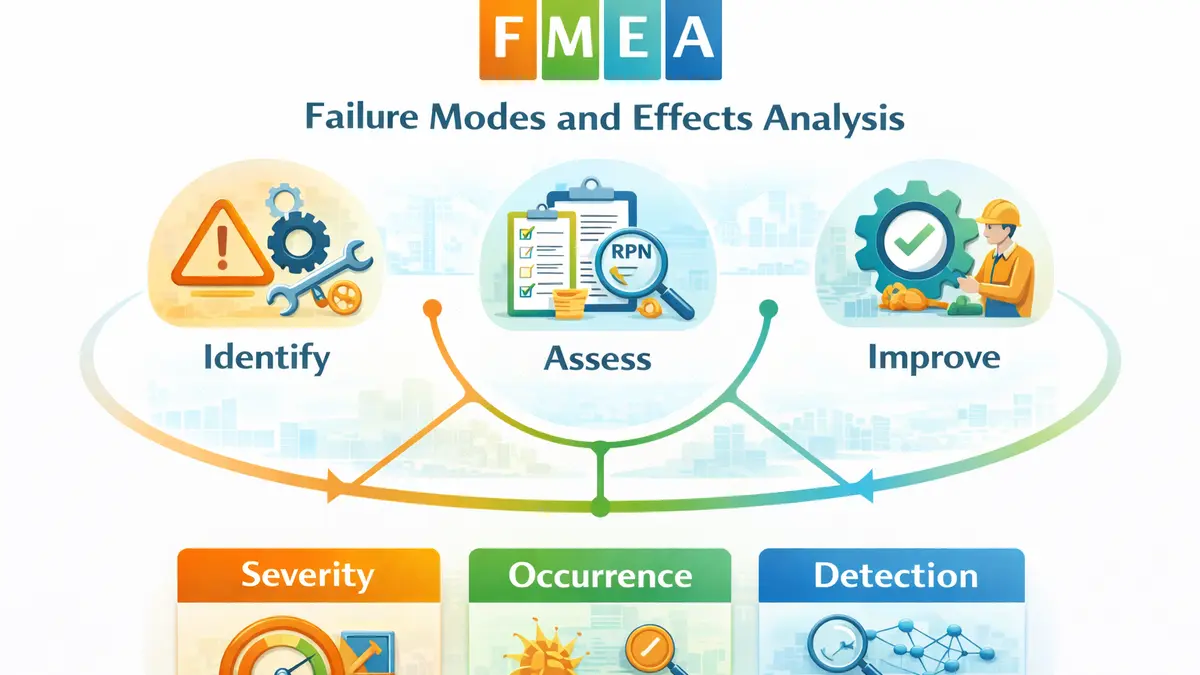
Failure Mode and Effects Analysis (FMEA) has become a cornerstone of modern risk management and operational excellence in 2026. Organizations across manufacturing, engineering, healthcare, energy and service industries rely on FMEA to anticipate failures before they occur, reduce non-quality costs and protect customer satisfaction. Rather than reacting to defects after they reach the market, FMEA structures a proactive, cross-functional analysis of potential failure modes, their causes and their consequences. This preventive mindset strengthens reliability, improves decision-making and aligns engineering, production and quality teams around measurable risk reduction. In a competitive environment defined by regulatory pressure, digital transformation and tighter margins, FMEA operates as both a technical tool and a strategic performance lever.
What Is FMEA? Clear Definition and Strategic Positioning
FMEA (Failure Mode and Effects Analysis) is a structured, systematic method used to identify potential failure modes within a product, system or process, evaluate their effects and prioritize them based on risk. The methodology focuses on prevention by assessing what could go wrong, why it might happen and how severe the consequences would be. Teams assign numerical ratings to quantify risk and determine which issues require immediate corrective action. Unlike reactive problem-solving approaches, FMEA is implemented early in the lifecycle, typically during design or process planning. This forward-looking perspective significantly reduces costly redesigns, recalls and production disruptions.
Difference Between FMEA and FMECA
While FMEA evaluates failure modes and their effects, FMECA (Failure Mode, Effects and Criticality Analysis) explicitly incorporates criticality assessment through quantitative risk scoring. In practice, many industries use the terms interchangeably because most modern FMEA implementations include a risk priority calculation. However, the distinction matters in regulated sectors such as aerospace and defense, where formal criticality ranking is mandatory. Both approaches aim to prioritize risks objectively and allocate resources efficiently. Understanding this distinction helps organizations choose the appropriate framework for compliance and operational control.
Why FMEA Is Essential in 2026
Risk anticipation has shifted from optional best practice to fundamental governance requirement. According to a 2026 European industrial performance survey, companies implementing structured FMEA programs reported an average 29% reduction in internal defect-related costs within two years of deployment. This measurable financial impact demonstrates that preventive analysis directly supports profitability and competitiveness. Additionally, supply chain complexity and increased customization amplify the probability of system interactions generating unexpected failures. FMEA provides the analytical discipline required to manage this complexity effectively.
Financial and Operational Impact
Unplanned production downtime can cost between $6,000 and $40,000 per hour depending on industry and scale, making preventive risk analysis economically critical. By identifying high-risk failure modes before launch or production ramp-up, FMEA minimizes disruptions and protects revenue streams. It also reduces warranty claims, product recalls and contractual penalties. Executives increasingly view FMEA not merely as a quality tool but as a strategic safeguard for operational resilience. This expanded role explains its growing integration into enterprise risk management frameworks.
Main Types of FMEA
FMEA adapts to different organizational needs and stages of the lifecycle. Each type addresses a specific scope of analysis and requires tailored expertise. Mature organizations frequently combine multiple FMEA types to ensure end-to-end risk coverage. This systemic approach strengthens reliability across design, production and service delivery.
Design FMEA (DFMEA)
Design FMEA focuses on product functions and components during the development phase. Engineering teams analyze how each function might fail, assess the potential impact on the end user and explore root causes tied to materials, geometry or tolerances. Implementing DFMEA early allows corrective design changes before tooling and mass production begin, dramatically lowering modification costs. It strengthens product robustness and long-term reliability. In highly regulated industries, DFMEA also supports compliance documentation and traceability requirements.
Process FMEA (PFMEA)
Process FMEA evaluates manufacturing or service processes to identify risks that could generate defects or inefficiencies. Each operational step is examined for potential failure modes, such as incorrect assembly, parameter drift or inadequate inspection. Teams assess the effectiveness of existing controls and propose improvements where necessary. PFMEA contributes directly to yield improvement, scrap reduction and process capability enhancement. It plays a central role in continuous improvement strategies and lean manufacturing initiatives.
System FMEA
System FMEA addresses interactions between subsystems within complex architectures. It identifies cascading effects where a local malfunction could trigger broader system disruption. This approach is particularly relevant for integrated technologies such as electric vehicles, medical devices or automated production lines. System-level analysis strengthens understanding of dependencies and mitigates systemic risk exposure. Organizations managing complex technical ecosystems benefit significantly from this holistic perspective.
Step-by-Step Methodology for an Effective FMEA
An effective FMEA requires structured facilitation and disciplined documentation. Superficial workshops or inconsistent scoring undermine the credibility of the analysis. A rigorous process transforms qualitative brainstorming into quantifiable decision support. The methodology follows sequential steps that build progressively toward prioritized action plans.
1. Define Scope and Build a Cross-Functional Team
The process begins by clearly defining the boundaries of the analysis, including product version, process segment or system configuration. A multidisciplinary team must be assembled, typically including engineering, production, quality, maintenance and supply chain representatives. Diverse expertise reduces blind spots and improves identification of realistic failure scenarios. An experienced facilitator ensures methodological consistency and prevents dominant voices from biasing the discussion. Strong governance at this stage determines overall effectiveness.
2. Break Down the Product or Process
Teams decompose the system into functions, components or operational steps. This structured breakdown ensures that each element is analyzed individually and systematically. Understanding normal operating conditions provides the baseline against which deviations are identified. Granularity increases analytical precision and avoids oversimplified assumptions. A clear functional description strengthens traceability within documentation.
3. Identify Failure Modes, Effects and Causes
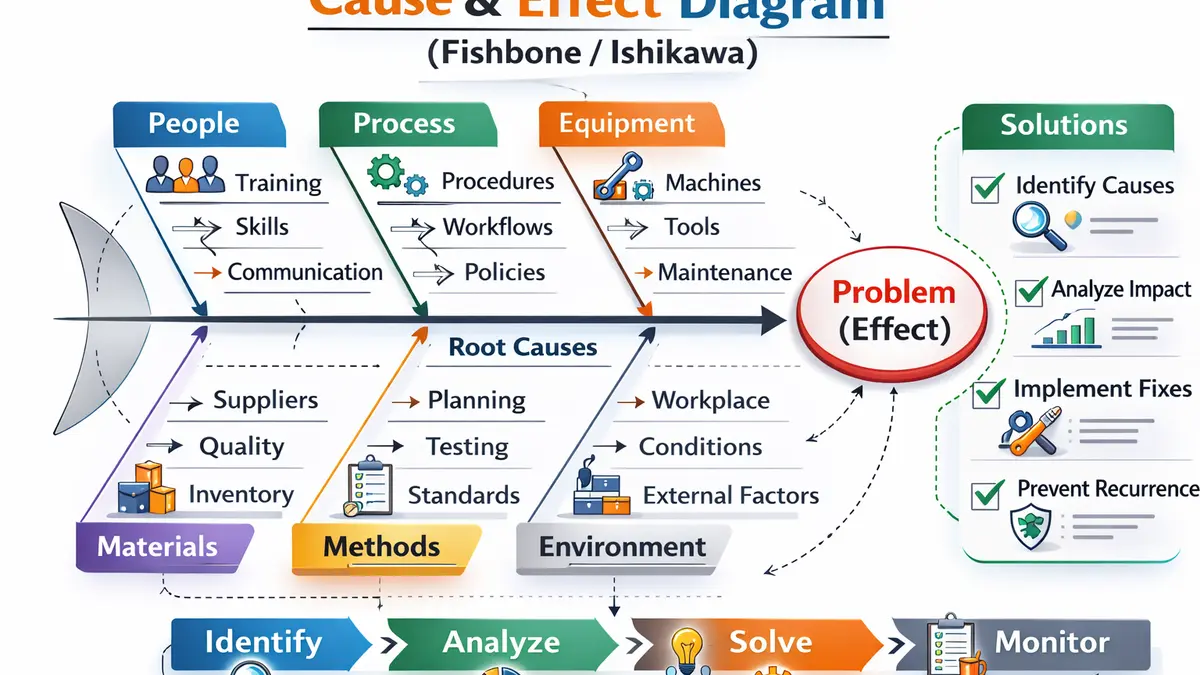
For each element, participants list potential failure modes, describe their effects on customers or downstream processes and identify likely causes. Root cause exploration may leverage tools such as cause-and-effect diagrams or historical defect data. Comprehensive identification prevents overlooking critical vulnerabilities. The quality of this step directly influences risk prioritization accuracy. Thorough documentation also supports future audits and updates.
4. Assess Risk: Severity, Occurrence and Detection
Risk evaluation relies on three core criteria rated typically on a 1–10 scale: Severity (S), Occurrence (O) and Detection (D). Severity measures impact magnitude, occurrence estimates probability and detection reflects the likelihood that controls will identify the issue before it reaches the customer. Multiplying S × O × D produces the Risk Priority Number (RPN). This numerical indicator ranks failure modes and guides prioritization. Consistent scoring criteria are essential to avoid subjective distortions.
5. Define and Implement Corrective Actions
High-priority risks require clearly defined corrective or preventive measures. Each action must include a responsible owner, a deadline and measurable effectiveness criteria. After implementation, teams reassess scores to confirm risk reduction. This feedback loop ensures that FMEA remains dynamic rather than static documentation. Continuous monitoring reinforces long-term process stability.
Structured Example of a Simplified FMEA
Consider a manufacturing process involving automated torque tightening on a safety-critical component. The identified failure mode is insufficient torque leading to component loosening during operation. Severity is rated 9 due to potential safety implications, occurrence 4 based on historical data and detection 6 because manual verification is inconsistent. The resulting RPN equals 216, exceeding the internal action threshold of 180. The corrective action introduces an automated torque tool with digital traceability, reducing occurrence to 2 and detection to 3 after reassessment.
Building a Robust Scoring System
An effective scoring matrix must rely on clearly defined criteria and empirical data rather than arbitrary judgment. Organizations should calibrate severity levels using documented customer impact scenarios and safety classifications. Occurrence ratings should reflect statistical defect frequency derived from historical performance indicators. Detection scoring must evaluate real control capability rather than perceived inspection rigor. Standardized internal guidelines enhance consistency across departments and sites.
- Define quantitative thresholds for each severity level
- Base occurrence ratings on statistical process data
- Assess actual detection effectiveness objectively
- Conduct periodic cross-team calibration workshops
Modern Evolution: Action Priority Approach
Recent industry standards increasingly replace sole reliance on RPN with an Action Priority (AP) model. Instead of multiplying three variables, AP categorizes risks as high, medium or low based on severity-weighted logic tables. This approach corrects mathematical limitations where different score combinations yield identical RPN values. In 2026, many automotive and advanced manufacturing organizations adopt this framework to strengthen risk prioritization consistency. The transition reflects a broader evolution toward more robust decision-support tools.
Keeping FMEA Alive and Relevant
An FMEA document loses value if it remains static after initial completion. Any design modification, supplier change, process deviation or major nonconformity should trigger a review. Some companies conduct field validation audits to compare documented controls with actual shop-floor practices. This verification process ensures alignment between theoretical risk assessment and operational reality. Continuous updates maintain reliability and regulatory compliance.
FMEA and Sustainable Performance
Preventing defects contributes directly to economic and environmental sustainability. Reduced scrap and rework lower material consumption and energy usage, supporting corporate sustainability goals. By improving reliability, FMEA enhances brand reputation and customer trust. The methodology therefore extends beyond technical risk management into broader corporate responsibility strategy. In 2026, sustainability metrics increasingly intersect with operational risk frameworks.
FAQ – Frequently Asked Questions About FMEA
What is the difference between DFMEA and PFMEA?
DFMEA focuses on product design and engineering functions before production begins, while PFMEA analyzes manufacturing or service processes. DFMEA aims to eliminate design weaknesses, whereas PFMEA stabilizes operational performance and defect prevention. Both approaches complement each other within a comprehensive risk strategy. High-performing organizations typically implement both methods systematically.
What RPN value requires action?
There is no universal RPN threshold applicable to all industries, but many companies define internal action limits between 150 and 200 depending on risk tolerance and regulatory exposure. The acceptable threshold depends on customer requirements, safety implications and contractual obligations. Organizations should formally document their decision criteria within quality management systems. Clear thresholds improve decision transparency and audit readiness.
How long does a full FMEA take?
Duration depends on system complexity and organizational maturity, but a comprehensive Process FMEA may require between three and eight weeks of structured collaborative work. Large-scale projects or multi-site analyses can extend over several months. Although resource-intensive, the investment yields substantial long-term cost savings and operational stability. Strategic planning ensures adequate time allocation without disrupting ongoing operations.
Related Articles
- Cause and Effect Diagram: Ishikawa Method
- PDCA Cycle: Plan-Do-Check-Act Complete Guide
- Pareto Principle: 80/20 Rule for Quality Management
- Six Sigma: Complete Methodology and Implementation Guide
Read also: Risk Matrix.