
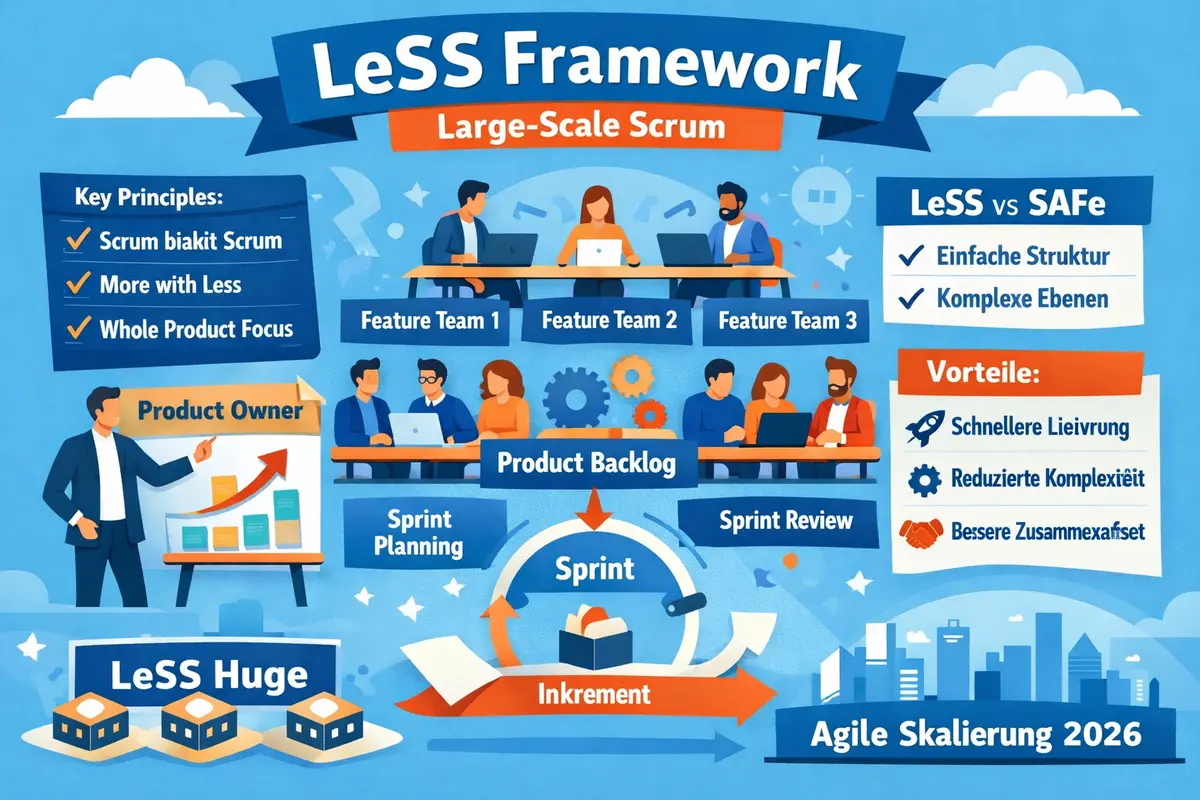
LeSS Framework: Complete Guide to Large-Scale Scrum for Agile Organizations in 2026
The LeSS framework (Large-Scale Scrum) has become one of the most influential approaches for scaling agile product development across multiple teams while preserving the simplicity of Scrum. Instead of introducing heavy governance layers, additional hierarchies, or complex coordination structures, Large-Scale Scrum focuses on extending the core principles of the Scrum framework to multiple teams working on the same product. This means a single product backlog, one clear product vision, and coordinated delivery across teams through synchronized sprints. In 2026, as organizations increasingly shift toward product-centric operating models, the need for efficient agile scaling frameworks has intensified. Companies that manage complex digital products often coordinate between 5, 20, or even more than 100 Scrum teams simultaneously. The LeSS framework addresses this complexity by emphasizing organizational simplicity, strong product ownership, and cross-functional collaboration. Its philosophy promotes reducing structural complexity so teams can focus on delivering valuable product increments quickly and continuously.
What is the LeSS Framework (Large-Scale Scrum)
The LeSS framework is an agile scaling approach designed to apply the principles of Scrum at scale while maintaining the simplicity and transparency of the original methodology. Unlike other agile scaling frameworks that add multiple management layers, LeSS extends the Scrum model by coordinating multiple teams working toward the same product goal. Each team operates as a standard Scrum team, following the same sprint cycles, planning sessions, and review practices. The key difference lies in the organizational structure: all teams share a single product backlog, work toward a unified product increment, and align around one product strategy. This unified structure eliminates the fragmentation that often occurs when multiple teams work independently on interconnected components. By maintaining a clear product focus and synchronized development cadence, the LeSS framework enables organizations to scale Scrum without losing agility.
Origins and evolution of Large-Scale Scrum
The concept of Large-Scale Scrum was introduced by Craig Larman and Bas Vodde, who observed the growing difficulty organizations faced when coordinating multiple Scrum teams on large software products. During the early 2000s, many global technology companies struggled with dependency management, conflicting priorities, and fragmented product ownership. Larman and Vodde designed LeSS to solve these challenges by extending Scrum principles to multi-team environments without adding unnecessary complexity. Over time, the framework evolved into two primary configurations: LeSS for organizations with two to eight teams, and LeSS Huge for environments involving dozens of teams working on a single product ecosystem. This evolution reflects the increasing scale of modern digital products and the need for agile frameworks that remain efficient even in large enterprise contexts.
Why companies adopt LeSS in 2026
By 2026, digital transformation initiatives and platform-based business models have forced organizations to rethink how they manage product development at scale. Research published in 2026 indicates that more than 70% of technology-driven organizations now rely on some form of agile scaling framework to coordinate multiple product teams. Many enterprises adopt the LeSS framework because it offers a lightweight alternative to more complex scaling models. Instead of introducing new layers of bureaucracy, LeSS simplifies the organization around a product-centric structure. Teams remain close to the customer, communication becomes more direct, and decision-making processes accelerate. This simplicity often leads to improved productivity, faster release cycles, and better alignment between engineering teams and product strategy.
Core principles of the LeSS Framework
The Large-Scale Scrum framework is guided by a set of fundamental principles derived from Scrum, Lean thinking, and systems thinking. These principles act as strategic guidelines that shape how organizations design their product development structures. Rather than relying solely on prescriptive rules, LeSS encourages teams and leaders to apply these principles when making organizational decisions. This emphasis on principles ensures that the framework remains adaptable across different industries, team sizes, and technological environments. By aligning the entire organization around shared agile values, companies can maintain consistency and focus while scaling product development operations.
The principle “Scrum is Scrum”
One of the most important ideas within the LeSS framework is the concept that Scrum remains Scrum, even when multiple teams collaborate on the same product. Scaling does not fundamentally change the core mechanics of Scrum; instead, it extends them to accommodate collaboration between teams. Each team still works within a sprint, participates in planning sessions, conducts reviews, and engages in retrospectives. Maintaining these core practices ensures that transparency, inspection, and adaptation remain central to the development process. By preserving the simplicity of Scrum, the LeSS framework prevents organizations from drifting toward overly complex management structures.
The principle “More with Less”
The More with Less principle reflects the Lean philosophy embedded within Large-Scale Scrum. Organizations often attempt to manage complexity by adding more roles, processes, and layers of coordination, which paradoxically creates even greater inefficiencies. LeSS challenges this tendency by encouraging companies to simplify their organizational structures and eliminate unnecessary overhead. Fewer roles, clearer responsibilities, and stronger collaboration between teams allow the organization to deliver more value with fewer resources. This principle promotes efficiency, reduces management bottlenecks, and empowers teams to focus on solving customer problems rather than navigating administrative processes.
The principle of Whole Product Focus
The Whole Product Focus principle encourages teams to think beyond individual components or technical subsystems. In traditional development organizations, teams are often structured around technical layers such as databases, APIs, or front-end interfaces. While this approach can improve specialization, it frequently creates dependencies that slow down development. The LeSS framework encourages organizations to build feature teams capable of delivering complete product features from concept to production. These teams include members with diverse technical skills, allowing them to build and release customer-visible functionality independently. This product-centric structure improves collaboration, reduces handoffs, and accelerates delivery cycles.
Organizational structure in Large-Scale Scrum
The organizational structure of the LeSS framework is intentionally minimalistic compared to many enterprise agile frameworks. Instead of introducing multiple layers of product management or complex coordination bodies, LeSS relies on a small set of roles aligned around the product itself. All teams collaborate on the same product and share responsibility for delivering integrated increments. This shared responsibility promotes accountability across the organization and eliminates silos that typically emerge when teams work on isolated components. By aligning all teams around a single product vision, organizations can maintain coherence even as they scale to dozens of teams.
The role of the Product Owner
Within the Large-Scale Scrum framework, the Product Owner plays a central role in ensuring strategic alignment across teams. Unlike some scaling frameworks that distribute product management responsibilities across multiple roles, LeSS maintains a single Product Owner responsible for the overall product backlog. This role ensures that product priorities remain consistent across teams and that development efforts align with business objectives. The Product Owner collaborates closely with teams to clarify requirements, refine backlog items, and evaluate delivered increments. In large environments using LeSS Huge, the Product Owner may delegate certain responsibilities to Area Product Owners, while still maintaining overall product ownership.
Scrum teams in a LeSS environment
Teams operating within the LeSS framework are typically organized as cross-functional feature teams capable of delivering end-to-end functionality. Each team usually consists of five to nine members who collectively possess the skills required to design, develop, test, and deploy product features. By structuring teams around features rather than technical components, organizations reduce dependencies between teams and increase delivery speed. All teams share a common Definition of Done, ensuring that each increment meets the same quality standards before integration. This shared definition promotes consistency and supports continuous integration practices across the entire product ecosystem.
The role of the Scrum Master at scale
The Scrum Master within a Large-Scale Scrum environment plays an expanded role compared to traditional Scrum teams. Beyond facilitating team ceremonies, the Scrum Master acts as a catalyst for organizational improvement. They identify systemic obstacles that affect multiple teams, promote agile principles across the organization, and help leaders remove structural impediments. In many organizations, one Scrum Master may support several teams simultaneously while working closely with other Scrum Masters to maintain alignment. This collaborative approach ensures that agile practices remain consistent across the organization and that teams continuously improve their processes.
Key events in the LeSS framework
The events in Large-Scale Scrum are derived directly from the Scrum framework but adapted to enable coordination among multiple teams. Synchronization plays a crucial role because all teams work within the same sprint cycle and deliver a combined product increment. This synchronization ensures transparency across the organization and allows stakeholders to evaluate progress at the end of each sprint. The events also create opportunities for teams to share knowledge, coordinate work, and resolve dependencies early in the development cycle.
Multi-team Sprint Planning
In a LeSS framework environment, Sprint Planning often takes place in two stages to facilitate coordination across teams. During the first stage, representatives from all teams meet with the Product Owner to review priorities from the product backlog and define the sprint goal. In the second stage, individual teams plan their work independently while remaining aware of dependencies with other teams. This two-part structure enables collaboration without sacrificing team autonomy. It also ensures that each team understands how its work contributes to the broader product objectives.
Shared Product Backlog Refinement
Product Backlog Refinement in the Large-Scale Scrum framework typically involves multiple teams working together to clarify upcoming backlog items. Collaborative refinement sessions allow teams to discuss technical approaches, estimate complexity, and identify potential dependencies early. These discussions improve collective understanding of the product and reduce misunderstandings that might otherwise slow down development. A well-refined backlog significantly improves sprint planning efficiency and helps teams deliver consistent increments during each sprint cycle.
Sprint Review and overall retrospective
The Sprint Review in a LeSS environment brings together all teams to demonstrate the integrated product increment delivered during the sprint. Stakeholders, product managers, and business representatives participate in the session to evaluate progress and provide feedback. This collaborative review ensures that the product evolves according to real user needs rather than assumptions. Following the review, teams conduct retrospectives to analyze their processes and identify improvement opportunities. In many organizations, a broader retrospective involving representatives from multiple teams helps address systemic challenges affecting the entire product organization.
LeSS vs SAFe: understanding the differences
The comparison between LeSS vs SAFe frequently arises when organizations evaluate options for agile scaling. Both frameworks aim to coordinate multiple teams working on complex products, but they approach the challenge from different perspectives. The LeSS framework emphasizes simplicity and minimal structure, whereas SAFe introduces several layers of governance designed for large enterprise environments. Understanding these differences helps organizations choose the framework that best aligns with their culture, size, and strategic objectives.
Organizational philosophy
The LeSS framework promotes a minimalist philosophy centered on reducing complexity and empowering teams. Instead of creating additional management roles, LeSS relies on strong collaboration between teams and clear product ownership. SAFe, by contrast, introduces multiple roles such as Release Train Engineers and portfolio managers to coordinate work across large organizations. While this structure can provide greater control, it may also increase administrative overhead. Organizations with a strong agile culture often prefer LeSS because it preserves the simplicity and flexibility of Scrum.
Governance and complexity
Governance represents one of the main differences between Large-Scale Scrum and other agile scaling frameworks. LeSS emphasizes transparency, shared responsibility, and decentralized decision-making. Teams collaborate directly and adapt quickly to changes in product strategy. In contrast, frameworks like SAFe implement structured governance models designed for large corporate environments. These governance structures can help manage risk and compliance requirements but may slow down decision-making processes. Organizations must evaluate their regulatory constraints, organizational culture, and agility goals before selecting the most appropriate scaling approach.
LeSS Huge: scaling Scrum beyond eight teams
When a product requires more than eight Scrum teams, organizations often adopt the LeSS Huge configuration to manage complexity effectively. This variant of the Large-Scale Scrum framework introduces additional coordination mechanisms without abandoning the simplicity of LeSS principles. The central concept within LeSS Huge is the creation of Requirement Areas, which group teams around specific customer-focused domains of the product. Each area is managed by an Area Product Owner responsible for refining and prioritizing backlog items relevant to that domain. This structure enables organizations to coordinate dozens of teams while maintaining a unified product vision.
Requirement Areas explained
Requirement Areas provide a scalable structure that helps organizations manage large product ecosystems. Each area typically includes four to eight teams working on related features within the broader product. Although teams focus on specific areas, they continue to share a common product backlog and a unified Definition of Done. This arrangement balances specialization with alignment across the entire organization. By structuring teams around customer-focused domains rather than technical components, organizations maintain a strong product perspective while scaling development capacity.
Benefits of the LeSS framework for organizations
The LeSS framework offers several strategic advantages for organizations seeking to scale agile product development without introducing excessive complexity. One of the most significant benefits is improved alignment between teams, which reduces duplication of work and accelerates delivery cycles. Because all teams operate from the same product backlog, priorities remain consistent across the organization. The framework also promotes stronger collaboration and knowledge sharing among teams. Over time, these benefits translate into faster product innovation and higher customer satisfaction.
Main benefits of Large-Scale Scrum
- Reduced organizational complexity by minimizing additional roles and processes.
- Stronger product alignment through a single product backlog and unified strategy.
- Improved collaboration thanks to cross-functional feature teams.
- Faster delivery cycles enabled by synchronized sprints and integrated increments.
- Greater transparency across product development activities.
SEO-optimized FAQ about the LeSS framework
What is the LeSS framework in agile?
The LeSS framework is an agile scaling methodology that extends the Scrum framework to multiple teams working on the same product. Instead of adding new layers of management, LeSS maintains the core Scrum structure while coordinating several teams through a shared product backlog and synchronized sprint cycles. This approach enables organizations to scale product development while preserving the transparency and adaptability of Scrum. As a result, companies can manage complex products without sacrificing agility.
When should companies use Large-Scale Scrum?
Organizations typically adopt Large-Scale Scrum when multiple Scrum teams collaborate on the same product and require better coordination mechanisms. The framework works best in product-centric environments where teams can operate as cross-functional feature teams. Companies with strong agile maturity often implement LeSS more successfully because the framework requires transparency, autonomy, and continuous improvement. When these conditions are present, LeSS can significantly improve product delivery speed and organizational alignment.
Is LeSS better than SAFe?
Whether LeSS is better than SAFe depends largely on the organization’s culture and operational requirements. LeSS prioritizes simplicity, minimal governance, and team autonomy, making it ideal for organizations that already embrace agile principles. SAFe provides more structured governance and may be better suited for enterprises with strict compliance or coordination requirements. Ultimately, the best framework depends on the organization’s scale, regulatory context, and agility objectives.