Needs Analysis in Project Management: Complete 2026 Methodology, Tools, Deliverables and Best Practices
Needs analysis in project management forms the strategic foundation of every successful initiative, whether digital, organizational, industrial, or transformational. It converts a vague business idea into structured, prioritized, measurable requirements that guide scope, budget, risk management, and delivery decisions. In 2026, projects operate in highly complex ecosystems shaped by artificial intelligence, regulatory pressure, cybersecurity requirements, sustainability objectives, and stakeholder diversity. According to a 2026 global performance report, 67% of project failures are directly linked to poor requirements definition, leading to an average 29% budget overrun. Mastering needs analysis is therefore not a documentation exercise but a value protection mechanism that directly influences return on investment, stakeholder satisfaction, and long-term organizational resilience.
Understanding Needs Analysis: Definition, Strategic Role and Scope
Needs analysis is the structured process of identifying, clarifying, documenting, validating, and prioritizing stakeholder expectations before moving into design and execution phases. It bridges the gap between strategic intent and operational implementation by translating high-level objectives into actionable and testable requirements. This discipline ensures alignment between business goals and project outputs while preventing premature solution design. When conducted rigorously, needs analysis reduces ambiguity, strengthens governance, and improves predictability across the entire project lifecycle.
Needs Analysis vs. Requirements Gathering vs. Statement of Work
Requirements gathering refers to the initial collection of stakeholder expectations, often expressed in informal or business-oriented language. Needs analysis goes further by refining, categorizing, validating, and transforming those expectations into structured requirements aligned with measurable outcomes. A Statement of Work (SOW) or formal specification document, in contrast, reflects the contractual or operational framework derived from this analysis and often introduces technical constraints or implementation details. The analytical phase therefore acts as an interpretative and strategic filter between raw input and formal commitment.
Why Needs Analysis Is Critical in 2026
Modern projects integrate digital systems, automation platforms, data analytics, compliance requirements, and user experience considerations within tight timeframes. Hybrid governance models combining agile delivery with structured oversight require clear baseline requirements to maintain coherence across iterations. Without rigorous needs analysis, organizations experience scope creep, uncontrolled change requests, stakeholder misalignment, and escalating operational risk. In contrast, a mature analytical approach enables value-driven decision-making and sustainable performance optimization.
The Core Phases of an Effective Needs Analysis Process
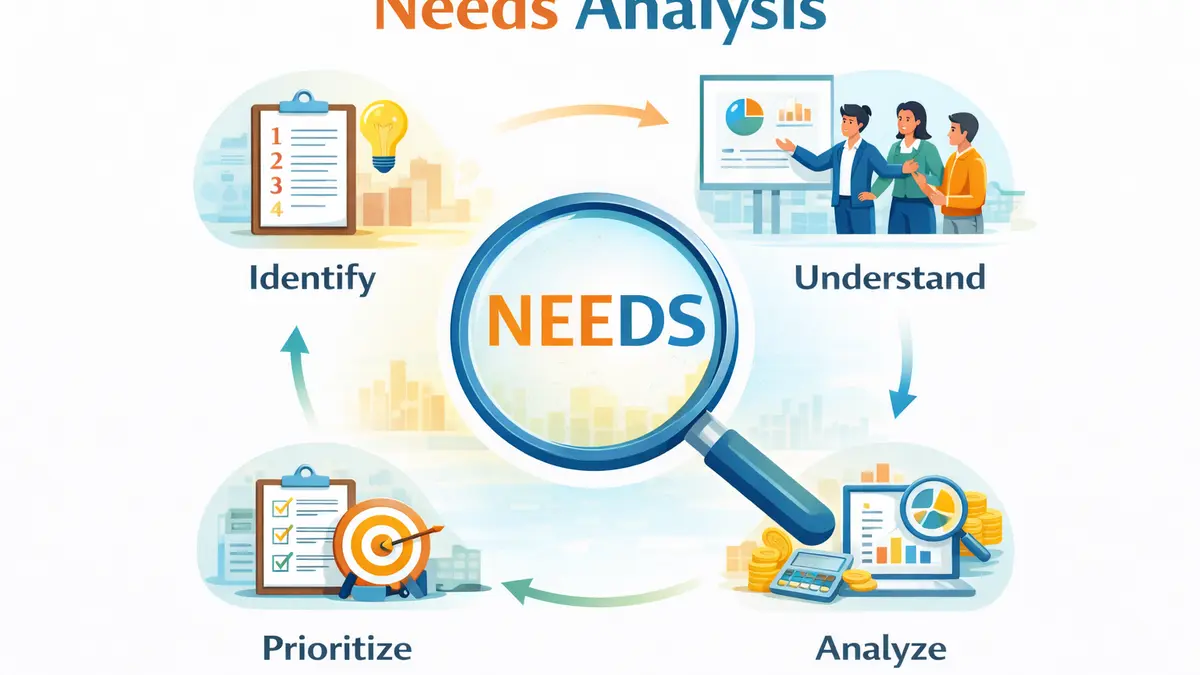
A high-performing needs analysis process follows a logical sequence of coordinated activities designed to progressively reduce uncertainty. Each phase must generate tangible outputs that clarify direction and minimize interpretation gaps. Methodological discipline ensures consistency between business vision and technical execution. Organizations that standardize this sequence significantly improve project predictability and cost control.
1. Stakeholder Identification and Mapping
The first step consists of identifying all relevant stakeholders, including sponsors, end users, operational managers, technical teams, compliance officers, and external partners. Stakeholder mapping clarifies influence levels, expectations, potential conflicts, and decision-making authority. A structured analysis such as a power-interest matrix enhances prioritization and communication planning. Early identification prevents late-stage resistance and misalignment that often generate delays and rework.
2. Structured Requirements Elicitation
Requirements elicitation relies on qualitative and quantitative techniques adapted to project context and stakeholder profiles. Individual interviews uncover implicit expectations, while collaborative workshops stimulate alignment and surface latent needs. Surveys and structured questionnaires provide measurable input, particularly in multi-location or enterprise-scale initiatives. Combining multiple elicitation techniques increases reliability and reduces cognitive bias in collected data.
3. Analysis, Categorization and Clarification
Once collected, requirements must be categorized into coherent groups such as functional requirements, non-functional requirements, regulatory constraints, performance criteria, and security expectations. This classification improves readability and facilitates technical translation. Each requirement should be reformulated in clear, measurable, and verifiable language to eliminate ambiguity. Linking every requirement to a strategic business objective preserves alignment and supports later evaluation.
4. Prioritization and Strategic Arbitration
Prioritization determines resource allocation, timeline feasibility, and scope realism. Frameworks such as MoSCoW, value-versus-effort matrices, or cost-benefit analysis enable structured decision-making. Transparent arbitration documentation reduces stakeholder conflict and enhances accountability. This disciplined approach prevents scope inflation while protecting strategic priorities.
5. Formal Documentation and Validation
The analysis must culminate in a structured reference document consolidating validated requirements. This deliverable includes project context, objectives, scope boundaries, detailed requirements, constraints, assumptions, and acceptance criteria. Formal validation ensures executive commitment and shared accountability. Clear documentation establishes the baseline against which progress, performance, and change impact will be assessed.
Key Deliverables of Needs Analysis
A comprehensive needs analysis produces multiple complementary deliverables that strengthen governance and cross-functional communication. These artifacts structure strategic thinking and facilitate operational execution. They also enhance regulatory compliance and internal audit capability. High-quality deliverables reduce uncertainty and improve stakeholder trust.
- Project Charter or Business Context Document
- Requirements Specification Document
- Requirements Traceability Matrix
- Stakeholder Register
- Change Management Plan
The Requirements Traceability Matrix
The requirements traceability matrix links each identified need to a formal requirement, corresponding deliverables, validation tests, and associated business objectives. This mechanism ensures that every implemented feature directly supports measurable value. It also facilitates impact analysis when change requests arise. In regulated industries, traceability serves as a critical compliance safeguard and audit reference.
Advanced Tools and Techniques for Needs Analysis
High-maturity organizations leverage structured methodologies and collaborative technologies to strengthen analytical rigor. Process modeling tools, user journey mapping, and workflow diagrams enhance shared understanding. Digital collaboration platforms centralize documentation, maintain version control, and preserve decision history. Data-driven insights increasingly complement qualitative input, enabling evidence-based prioritization.
Collaborative Workshops and Co-Creation
Well-structured workshops foster alignment between business and technical stakeholders while accelerating requirement clarification. Professional facilitation ensures productive dialogue and actionable outputs rather than unstructured brainstorming. Techniques such as empathy mapping and scenario analysis uncover underlying motivations and user pain points. This participative approach strengthens buy-in and reduces resistance during implementation.
Change Control and Continuous Governance
Needs analysis extends beyond initial validation because projects evolve in response to technological, economic, and regulatory changes. A formal change control process evaluates the impact of every modification on scope, budget, schedule, and risk exposure. Each change request must follow documented review and approval pathways to preserve coherence. Governance discipline prevents uncontrolled scope expansion and protects strategic alignment.
Common Pitfalls in Needs Analysis and How to Avoid Them
Recurring failures often stem from insufficient stakeholder involvement, vague requirement wording, or premature technical assumptions. Ambiguity leads to divergent interpretations and costly corrections during development. Lack of prioritization generates unrealistic scope and resource overload. Structured validation checkpoints and documented arbitration decisions mitigate these risks significantly.
Confusing Needs with Solutions
A need describes an expected outcome or business problem, whereas a solution defines a specific technical response. Conflating the two restricts innovation and narrows strategic options prematurely. This confusion frequently leads to suboptimal investments and rigid implementation paths. Maintaining conceptual separation preserves flexibility and supports better long-term decision-making.
Strategic Impact of Needs Analysis on Project Performance
Effective needs analysis strengthens strategic alignment, improves forecasting accuracy, and enhances cross-functional collaboration. It enables measurable value tracking from concept to delivery and supports executive governance through traceable documentation. Organizations that institutionalize structured requirements management report significantly higher delivery reliability and stakeholder satisfaction. In competitive markets, analytical rigor becomes a differentiator rather than an administrative burden.
Mini FAQ – Needs Analysis in Project Management
How long should a needs analysis phase last?
The duration depends on project complexity, stakeholder diversity, regulatory context, and organizational maturity. For a mid-scale digital transformation initiative, needs analysis may represent 10% to 20% of the overall project timeline. Investing time upfront reduces downstream rework and change-related delays. Balanced planning ensures depth without unnecessary administrative overhead.
What is the difference between functional and non-functional requirements?
Functional requirements describe what a system or process must accomplish, including specific services or actions. Non-functional requirements define performance standards such as reliability, scalability, security, availability, or compliance. Both categories require equal precision and measurable criteria. Neglecting non-functional requirements often undermines user experience and operational sustainability.
Why is requirements traceability essential in 2026?
The growing complexity of digital ecosystems and regulatory frameworks demands demonstrable accountability and audit readiness. Traceability ensures that every deliverable aligns with validated needs and strategic objectives. It also simplifies impact assessment when business conditions evolve. In 2026, mature traceability practices represent a benchmark of project governance excellence.