Feasibility Study: Complete Framework, Step-by-Step Method and Operational Template to Secure Your Project in 2026
A feasibility study is a structured, data-driven evaluation designed to determine whether a project is viable before significant time, capital, and organizational resources are committed. In 2026, with heightened market volatility, rapid technological shifts, regulatory pressure, and increased investor scrutiny, decision-makers can no longer rely on intuition or optimistic projections alone. A rigorous feasibility study assesses market demand, technical capability, financial sustainability, operational readiness, and legal compliance to transform uncertainty into measurable risk. By validating assumptions, modeling multiple scenarios, and identifying constraints early, organizations strengthen capital allocation discipline and improve strategic alignment. Executed properly, a feasibility study does not merely validate an idea; it clarifies whether to proceed, pivot, scale gradually, or abandon the initiative before irreversible costs accumulate.
What Is a Feasibility Study? Definition and Strategic Scope
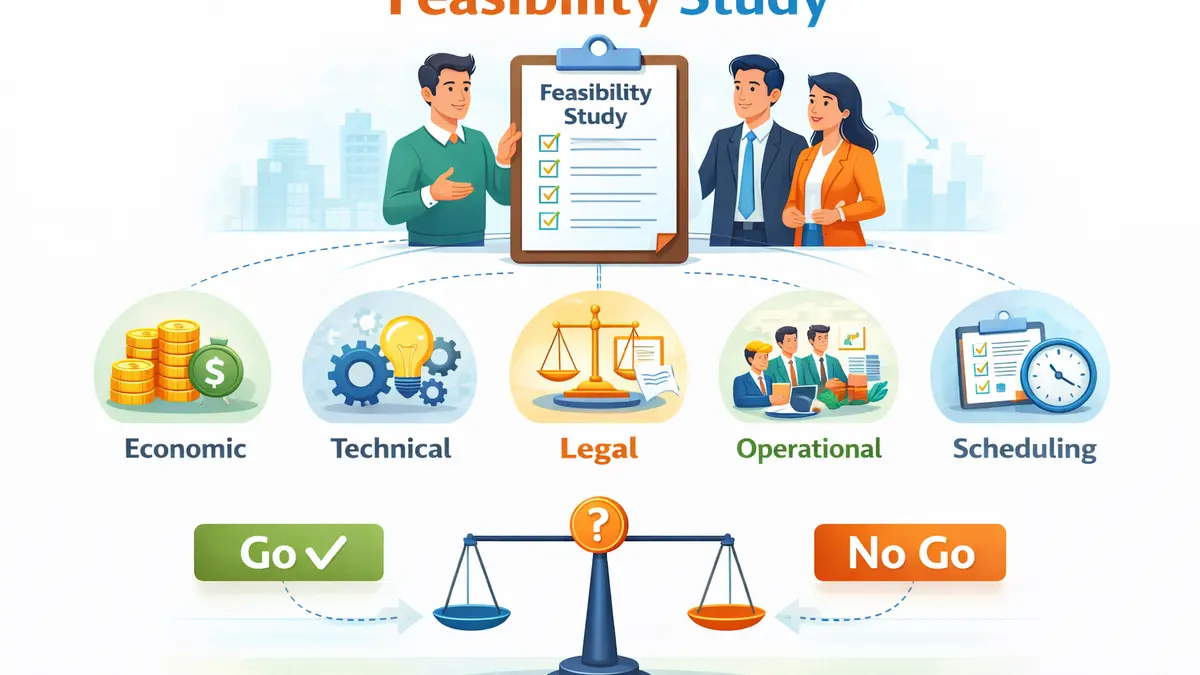
A feasibility study is a systematic analysis conducted to evaluate whether a proposed initiative can be successfully implemented and sustained under realistic conditions. It examines several interconnected dimensions, including commercial viability, technical feasibility, financial performance, legal compliance, and organizational capacity. Unlike a conceptual proposal or pitch deck, it relies on verifiable data, quantified assumptions, structured modeling, and documented risk assessments. Its primary objective is to support a rational go / no-go decision based on evidence rather than optimism. In mature organizations, feasibility studies function as strategic filters that protect capital, safeguard reputation, and ensure alignment with long-term objectives.
Difference Between a Feasibility Study and a Business Plan
A feasibility study precedes the business plan and serves a validation purpose, whereas a business plan is primarily a communication and funding document. The feasibility study challenges the core assumptions of the project and may conclude that the initiative should be redesigned or discontinued altogether. In contrast, a business plan assumes that the project will move forward and focuses on structuring growth projections, financial forecasts, and operational planning. A well-executed feasibility study strengthens the credibility of a subsequent business plan by grounding it in tested data and realistic projections. In 2026, investors increasingly expect documented feasibility validation before reviewing detailed funding proposals.
Why a Feasibility Study Is Critical in 2026
In 2026, competitive pressure and rapid digital transformation have increased project failure rates across multiple sectors, particularly in technology and innovation-driven industries. Recent industry analyses indicate that more than 40% of new ventures fail due to inadequate market validation, highlighting the cost of insufficient feasibility assessment. Organizations that conduct structured feasibility studies reduce exposure to capital misallocation, operational disruption, and reputational damage. Economic uncertainty, shifting consumer expectations, and evolving compliance standards require deeper analytical rigor than ever before. A feasibility study enables leaders to test resilience under multiple economic scenarios before committing strategic resources.
Risk Mitigation and Financial Protection
The primary advantage of a feasibility study lies in its ability to reduce financial and operational risk before full project deployment. By quantifying capital expenditures, operational costs, projected revenues, and cash flow timing, organizations gain clarity on the true investment profile. For example, a project requiring an initial investment of $300,000 may reveal through detailed modeling that an additional $90,000 in working capital is necessary to sustain operations during the first twelve months. Early identification of such financial gaps prevents liquidity crises and improves financing strategies. This proactive analysis ensures that strategic decisions are driven by measurable data rather than assumptions.
Core Components of a Comprehensive Feasibility Study
A robust feasibility study integrates multiple analytical perspectives to provide a holistic assessment of viability. Each dimension must be examined independently and then synthesized to ensure coherence across the entire project structure. Isolated evaluation of financial metrics without technical validation, for instance, can create misleading confidence. In 2026, advanced analytics tools and predictive modeling enhance the precision of feasibility assessments, but disciplined methodology remains the foundation. The most effective studies balance quantitative modeling with qualitative insight.
Commercial Feasibility and Market Analysis
Commercial feasibility evaluates whether a sustainable and profitable demand exists for the proposed product or service. This analysis includes market size estimation, target segmentation, competitive landscape evaluation, customer willingness to pay, and positioning strategy. Quantitative surveys, industry reports, trend analysis, and competitive benchmarking support objective assessment. Without validated market demand, even technically innovative solutions fail to generate sustainable revenue. Commercial feasibility ensures that the value proposition aligns with measurable customer needs and purchasing behavior.
Technical Feasibility
Technical feasibility determines whether the organization possesses or can acquire the technological and operational capabilities required for implementation. This includes infrastructure readiness, software architecture compatibility, production capacity, supply chain reliability, and availability of specialized expertise. Projects that appear financially attractive may prove impractical if technical constraints delay delivery or inflate costs. A structured technical evaluation reduces the risk of implementation bottlenecks and integration failures. It also clarifies whether outsourcing or strategic partnerships are required.
Financial Feasibility and Profitability Modeling
Financial feasibility centers on detailed financial modeling, including capital investment requirements, operating expenses, revenue projections, and cash flow forecasts. Analysts calculate indicators such as break-even point, internal rate of return, net present value, and payback period to assess long-term sustainability. Sensitivity analysis evaluates how fluctuations in demand, pricing, or cost structures affect profitability. In 2026, sophisticated financial modeling tools enable scenario simulations with greater accuracy and transparency. Decision-makers rely on these models to assess resilience under optimistic, realistic, and conservative projections.
Legal and Regulatory Feasibility
Legal feasibility ensures that the proposed project complies with all relevant laws, industry standards, and regulatory requirements. This includes licensing obligations, data protection regulations, environmental standards, labor laws, and contractual liabilities. Regulatory oversight has intensified across sectors in 2026, making compliance validation a strategic priority rather than a secondary concern. Failure to assess legal constraints early can result in penalties, delays, or forced project termination. Integrating compliance analysis into feasibility assessment strengthens governance and protects corporate reputation.
Step-by-Step Method: 6-Phase Framework for Conducting a Feasibility Study
A structured methodology enhances clarity, accountability, and analytical rigor throughout the feasibility process. While variations exist, a six-phase framework provides a comprehensive and practical structure adaptable to most industries. Each phase builds logically upon the previous one, ensuring progressive validation of assumptions. This approach improves communication among stakeholders and strengthens executive decision-making. In 2026, organizations increasingly standardize this methodology within their project governance models.
- Define objectives and scope
- Analyze the external environment and market
- Assess internal capabilities and constraints
- Develop financial projections and scenarios
- Identify and prioritize risks
- Formulate strategic recommendation
Phase 1: Strategic Definition and SMART Objectives
The first phase establishes clear, measurable, and time-bound objectives aligned with organizational strategy. Applying SMART criteria ensures precision and accountability in performance evaluation. Clear scope definition prevents resource dilution and uncontrolled expansion of project boundaries. This stage also identifies key stakeholders and decision criteria for final approval. Strong strategic alignment at this phase increases the overall reliability of the feasibility assessment.
Phase 2: External and Competitive Analysis
This phase examines macroeconomic, technological, regulatory, and social influences using structured frameworks such as PESTEL analysis. It also evaluates competitor positioning, market saturation, barriers to entry, and potential substitutes. Comprehensive environmental scanning reduces blind spots that could compromise long-term success. Accurate market intelligence strengthens the credibility of subsequent financial modeling. This stage ensures that the project responds to real and sustainable market dynamics.
Phase 3: Internal Resource Evaluation
Internal assessment focuses on organizational capacity, including human capital, operational systems, technological infrastructure, and financial resilience. Gap analysis identifies discrepancies between required capabilities and current resources. This evaluation may reveal the need for recruitment, partnerships, outsourcing, or additional capital. Recognizing internal constraints early improves planning accuracy and execution feasibility. Sustainable growth depends on realistic capability assessment.
Phase 4: Financial Modeling and Scenario Analysis
This stage converts strategic assumptions into quantitative projections, including income statements, cash flow forecasts, and investment schedules. Scenario modeling compares conservative, baseline, and aggressive projections to evaluate financial resilience. Analysts calculate break-even thresholds and stress-test variables such as pricing volatility or demand fluctuation. Quantitative modeling transforms abstract concepts into measurable decision metrics. Clear financial visibility strengthens executive confidence in the final recommendation.
Phase 5: Risk Identification and Prioritization
Risk analysis identifies potential threats and evaluates their probability and impact using structured matrices. This includes operational risks, financial volatility, technological uncertainty, regulatory changes, and reputational exposure. Prioritizing risks enables targeted mitigation strategies and contingency planning. Transparent risk documentation enhances governance and accountability. A realistic risk profile distinguishes robust feasibility studies from superficial assessments.
Phase 6: Final Recommendation and Go / No-Go Decision
The final phase synthesizes analytical findings into a clear strategic recommendation supported by quantitative evidence. Decision-makers review validated assumptions, financial resilience, market readiness, and operational preparedness before committing resources. The recommendation may propose immediate launch, phased implementation, strategic pivot, or cancellation. Evidence-based conclusions reduce cognitive bias and emotional decision-making. This disciplined approach strengthens long-term strategic performance.
Structure of a Professional Feasibility Study Report
A professional feasibility report must present findings in a structured, transparent, and logically sequenced format to support executive review. It typically includes an executive summary, project description, market analysis, technical evaluation, financial projections, risk assessment, and final recommendation. Each section must reference data sources, methodologies, and underlying assumptions to ensure traceability. Clear visual presentation of financial tables and risk matrices enhances readability. In 2026, digital dashboards increasingly complement written reports to facilitate stakeholder engagement.
Key Metrics and Quantitative Benchmarks
Quantitative precision strengthens the credibility of any feasibility study and provides objective thresholds for decision-making. Core metrics include break-even point, net present value, internal rate of return, payback period, and contribution margin. For instance, a project reaching break-even within 24 months may be considered financially sustainable depending on industry benchmarks and capital cost. Establishing predefined financial criteria prevents subjective interpretation of results. Data-driven thresholds ensure disciplined investment governance.
Common Mistakes to Avoid
Many feasibility studies fail due to overreliance on optimistic revenue projections, insufficient market validation, or underestimation of operational complexity. Ignoring regulatory constraints or failing to conduct sensitivity analysis can distort risk perception. Another frequent mistake involves separating financial modeling from strategic context, resulting in technically accurate but strategically irrelevant conclusions. In 2026, high-performing organizations integrate cross-functional expertise to avoid analytical blind spots. Comprehensive validation ensures that feasibility assessments remain realistic and actionable.
SEO-Optimized FAQ: Feasibility Study
How long does a feasibility study take?
The duration typically ranges from two weeks to three months, depending on project complexity and data availability. Technology-intensive or regulated industries may require extended technical and compliance evaluations. Adequate time allocation improves data accuracy and reliability. Rushed assessments increase the risk of flawed conclusions.
Who should conduct a feasibility study?
A feasibility study can be conducted internally by experienced project teams or externally by specialized consulting firms. Many organizations adopt a hybrid approach combining internal knowledge with external expertise. Objectivity and methodological rigor remain essential regardless of execution model. Independent validation strengthens stakeholder confidence.
Is a feasibility study mandatory?
Although not legally required in most cases, a feasibility study is considered best practice for significant investments or strategic initiatives. Financial institutions and investors increasingly expect documented feasibility validation before funding approval. In 2026, structured feasibility analysis represents a standard governance requirement for responsible project management. Proactive validation protects organizations from avoidable financial and operational setbacks.