Project Assumptions in 2026: how to identify, document, validate, and govern assumptions that shape project scope, schedule, cost, and risk
Project work never starts from perfect information, so teams rely on project assumptions to convert uncertainty into an executable plan. An assumption is a condition you accept as true so you can estimate effort, sequence work, allocate budget, and align stakeholders, even though you have not fully verified the condition. When you leave assumptions implicit, you create blind spots that distort scope, inflate optimism in the schedule, and weaken accountability for outcomes. In 2026, higher delivery volatility and faster change cycles make assumption discipline a competitive advantage: the teams that capture and validate assumptions early reduce late-stage rework and accelerate decisions. A well-run project treats assumptions as living items that you review, test, and, when necessary, convert into risks or issues with owners and dates.
What a project assumption is and what it is not
A project assumption is a statement you treat as true to proceed with planning and execution, such as “the product owner will be available twice a week” or “the vendor will deliver the API documentation by March.” You can use assumptions to define feasibility, estimate cost, and select an approach, but you must recognize that every assumption carries uncertainty and can fail. Assumptions differ from facts because you have not proven them, and they differ from guesses because you explicitly document and manage them. Treat an assumption like a temporary bridge between unknowns and decisions, not a permanent foundation. When you keep assumptions visible, you improve stakeholder alignment because everyone can see the conditions that must hold for the plan to work.
Explicit vs implicit assumptions: where projects quietly fail
Teams document explicit assumptions in charters, scope baselines, plans, and statements of work, but implicit assumptions usually cause more damage because nobody challenges them. Implicit assumptions hide in phrases like “it should be quick,” “legal will approve,” or “users will adapt,” and they often surface only when reality contradicts the plan. You reduce this risk by forcing assumptions into clear, testable statements with an owner and a validation method. The most effective teams treat every “of course” statement as a prompt to write an assumption, because certainty language often masks missing evidence. When you institutionalize this habit, you convert opinion into managed uncertainty and prevent late discovery from becoming a crisis.
Assumptions vs risks vs constraints vs dependencies
Projects run smoother when people use a shared vocabulary that separates assumptions from related planning objects. An assumption is a condition you accept as true, while a risk is an uncertain event or condition that can affect objectives if it occurs, and a constraint is a limitation you must obey, such as a fixed budget cap or a mandated deadline. A dependency is a relationship where one activity relies on another deliverable, team, or external party, and it often interacts with assumptions because you may assume the dependency will resolve on time. Confusing these categories leads to weak governance because you track the wrong thing in the wrong log and assign the wrong accountability. A practical rule is simple: if the statement starts as “we believe X is true,” it is an assumption; if it becomes “X might not be true and that would hurt,” it is a risk; if it is “we cannot change X,” it is a constraint.
How an assumption becomes a risk, then an issue
An assumption becomes a risk when you acknowledge uncertainty and describe the impact if the assumption fails, then you analyze probability and consequences. Once the risky condition happens or you observe evidence that it is happening, the risk can become an issue, which demands immediate action rather than contingency planning. This flow matters because it protects schedule and cost by forcing early mitigation, such as alternative sourcing, phased delivery, or scope adjustment. You should not wait for failure to formalize the risk because late documentation does not improve control, it merely records the reason you slipped. When you manage this progression intentionally, you stop treating project surprises as unavoidable and start treating them as predictable outcomes of unmanaged assumptions.
Why assumption management matters more in 2026
Delivery environments in 2026 punish slow decisions and reward early validation, especially in hybrid portfolios where teams mix product discovery with execution. Industry reporting on project outcomes continues to show material failure rates, and one 2026 industry snapshot reports project failure increasing from 12% in 2025 to 13% in 2026, highlighting persistent delivery instability and visibility gaps. That single point does not explain every failure, but it supports a practical reality: teams must tighten governance on inputs that shape estimates, and assumptions are among the most influential inputs. When you treat assumptions as first-class artifacts, you shorten feedback loops because you validate the plan’s weakest links before they become expensive. Assumption discipline also strengthens stakeholder trust because you communicate what must be true for the timeline to hold, instead of presenting forecasts as certainty.
Assumptions drive conversion outcomes, not just project mechanics
Assumptions influence business outcomes because they decide what you build, how fast you build it, and what trade-offs you accept, which directly affects revenue timelines and customer satisfaction. If you assume adoption will be easy, you may underinvest in enablement, training, and change management, and the solution can miss benefits even if the technical delivery succeeds. If you assume compliance approval is routine, you may plan a launch window that becomes impossible once review cycles expand. Strong teams convert assumptions into decision-ready checkpoints that leadership can approve or replan against, which reduces last-minute executive escalations. In conversion-oriented delivery, the goal is not to eliminate assumptions but to make them visible, measurable, and actionable so the business can commit with eyes open.
Common categories of project assumptions
Most projects reuse the same assumption families, so categorizing assumptions helps you scan for gaps and standardize review. Resource assumptions cover availability, skills, productivity, and vendor capacity, while schedule assumptions include lead times, approval cycles, and release windows. Cost assumptions include unit pricing, procurement timing, inflation impacts, and contingency levels, while scope assumptions include what is in and out, what “done” means, and what acceptance requires. Technology assumptions cover platform readiness, integration complexity, and non-functional performance, while stakeholder assumptions cover decision rights, engagement frequency, and sponsorship stability. When you consistently label assumptions by category, you can prioritize cross-cutting risks that threaten multiple workstreams and you can assign owners to the organizations that actually control the assumptions.
What “critical assumptions” look like in real projects
Critical assumptions are those that support the plan’s load-bearing elements, such as the chosen architecture, a contractual dependency, or a compliance timeline that gates launch. A typical program may record dozens of assumptions, but only a subset determines whether the plan can physically execute within constraints. A practical quantitative approach is to identify the top 10 assumptions that, if false, would create the largest replan, then validate those first with evidence, prototypes, or stakeholder commitments. This method avoids drowning the team in low-impact assumptions while still building resilience where it matters. When you make critical assumptions visible to leadership, you also improve governance because sponsors can invest in validation work instead of discovering reality through missed milestones.
How to identify assumptions systematically
You identify assumptions by interrogating every planning choice that lacks confirmed evidence, then writing the underlying condition as a clear statement. Start with artifact review because charters, business cases, scope documents, and contracts encode many assumptions that teams stop noticing once they become “the plan.” Next, run stakeholder interviews to surface implicit beliefs, especially where different functions interpret objectives differently, such as sales, operations, security, and finance. Then facilitate a structured workshop where you challenge statements like “we will,” “we must,” and “it will be,” because certainty language often hides unverified dependencies. A strong identification session ends with a prioritized list of assumptions written in plain language, each tied to a validation method and owner.
Assumption discovery prompts that reveal hidden uncertainty
Specific prompts help teams expose assumptions without blaming individuals, which improves psychological safety and data quality. Ask “what must be true for this estimate to be correct,” “what could invalidate this timeline,” and “what external decision do we rely on that we do not control.” Ask “what do we believe about user behavior,” “what do we believe about data quality,” and “what do we believe about regulatory interpretation,” because these areas often create late surprises. Ask “what are we treating as fixed but might be negotiable,” because constraints sometimes rest on assumptions rather than hard limits. When you capture answers as assumptions, you move the conversation from opinion to managed conditions, and you build an agenda for targeted validation work rather than endless debate.
How to write high-quality assumptions that are testable
A useful assumption is specific, testable, and linked to a decision, so you can validate it with evidence and adjust the plan when needed. Write assumptions in one sentence that names the condition, the context, and the timeframe, such as “The identity provider team will deliver production SSO configuration by May 15.” Avoid vague language like “soon,” “enough,” or “stable,” because vagueness prevents accountability and blocks effective risk analysis. Add acceptance criteria for the assumption when possible, such as “configuration includes MFA policy, documented failover, and test accounts,” because completeness matters as much as timing. When you write assumptions this way, you also set up clean conversion into risks, since the failure condition becomes immediately clear and measurable.
Convert assumptions into IF–THEN risk statements without friction
The IF–THEN pattern converts an assumption into a risk by stating what happens if the assumption is false, which makes probability and impact analysis straightforward. For example, if the assumption is “Legal will approve the privacy notice by April 1,” the risk becomes “IF legal approval slips beyond April 1, THEN launch moves at least one sprint and marketing spend shifts.” This framing forces clarity on business impact, not just task inconvenience, which improves prioritization. It also helps you define mitigation actions, such as pre-reviewing content, scheduling approval checkpoints, or preparing alternate copy. When you make IF–THEN a standard, you reduce time spent arguing about whether something is a risk because the risk becomes a logical transformation of an explicit assumption.
The assumption log: your operational backbone
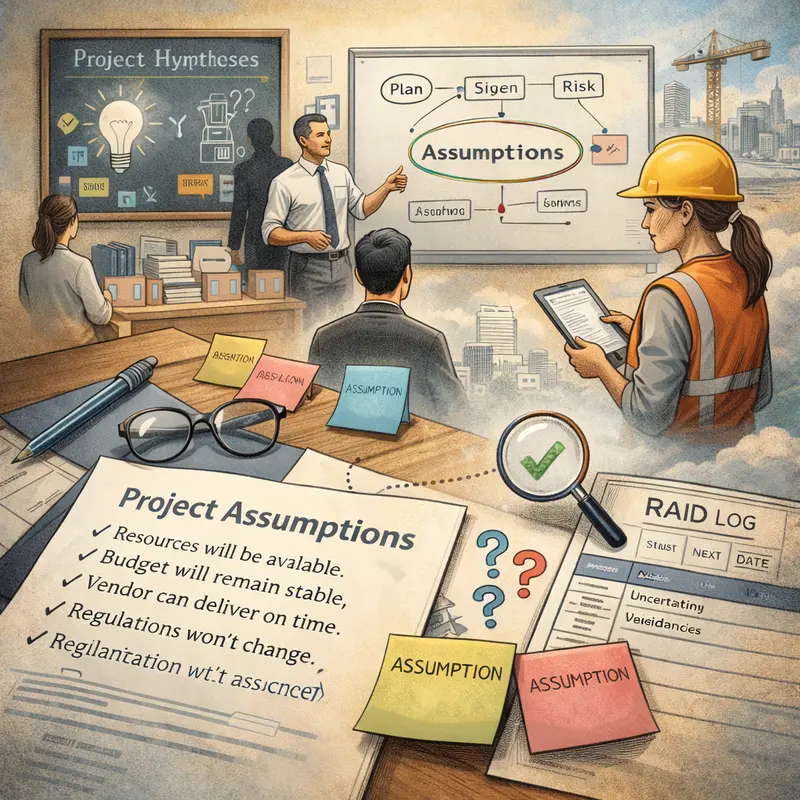
An assumption log is a structured register that captures assumptions, assigns ownership, schedules validation, and records outcomes so the team can manage assumptions like any other control item. Teams often merge assumptions into a RAID log so they can track assumptions alongside risks, actions, issues, and dependencies, which improves visibility and reduces duplicate meetings. A good log prevents “tribal knowledge” from becoming the plan because it centralizes what must be true for delivery success. It also supports governance because leadership can review assumption health at the same time they review schedule and budget, rather than learning about broken assumptions through slipped milestones. When the log is up to date, it becomes a decision tool rather than a compliance artifact.
Minimum fields that make an assumption log usable at scale
The log must balance completeness with usability, so you should define a minimum set of fields that teams can maintain without heavy overhead. Include an assumption ID, category, description, rationale, owner, impacted deliverables, and a confidence level that reflects evidence quality rather than optimism. Add a validation method, a due date for validation, and a next review date so assumptions do not stagnate in the log. Capture status as “unvalidated,” “validated,” “invalidated,” or “superseded,” and add a notes field for evidence links or meeting references. When you standardize these fields, you enable consistent reporting across teams and you make it easier to integrate assumption tracking into tooling and portfolio dashboards.
How often to review assumptions and who owns them
Assumptions degrade over time because reality changes, so review cadence is a control mechanism, not an administrative ritual. A practical governance model is to review detailed assumptions weekly within the project team, then escalate only critical assumption changes in monthly management reporting, because leadership needs signal rather than noise. Ownership should follow control: the owner is the person or role that can validate the assumption or drive mitigation, not necessarily the project manager. The project manager owns the process and ensures review happens, but domain owners must own domain assumptions, such as security, procurement, data, or operations. When ownership aligns to control, validation speeds up and accountability becomes fair and effective.
Assumptions in Agile, hybrid, and waterfall delivery models
Agile teams often manage assumptions through discovery, spikes, and backlog refinement, but they still benefit from an explicit assumption log because cross-team dependencies and organizational constraints do not disappear. In hybrid delivery, assumptions help synchronize predictive planning with iterative discovery, especially when fixed dates like regulatory deadlines coexist with evolving product scope. In waterfall models, assumptions appear in early baselines, and teams must revisit them during stage gates because late changes are expensive and can destabilize the critical path. The best practice across models is consistent: keep assumptions visible, revisit them on a defined cadence, and link them to decisions, risks, and mitigation actions. When you do this, the methodology becomes less important than the discipline of validation and governance.
Prioritizing assumptions: focus on what can break the plan
Not every assumption deserves equal attention, so you need a prioritization method that balances uncertainty and impact. Start by scoring assumptions on two dimensions: likelihood of being wrong and magnitude of impact on scope, schedule, cost, quality, or benefits. Place high-impact, high-uncertainty assumptions at the top of the validation queue because they represent the largest potential replan cost. Then consider time sensitivity because some assumptions are “early-break” items, where failure reveals itself quickly, while others fail late and create bigger damage if you discover them too late. Prioritization is a capacity decision: it tells you where to invest validation effort to protect the plan’s most valuable commitments.
A practical scoring model teams can run in under 20 minutes
Use a simple 1–5 scoring scale so teams can apply the method consistently without analysis paralysis, then compute a total score that drives action. Score uncertainty based on evidence quality, score impact based on the cost of rework and timeline shift if the assumption fails, and score controllability based on whether the team can influence the condition. Multiply or sum the scores, then define thresholds that trigger actions such as “validate this sprint,” “monitor weekly,” or “accept and document.” This approach produces a prioritized list that leadership can understand quickly, which supports fast decisions and reduces debate. When you implement scoring, you also generate quantitative trend data over time, such as “critical assumptions remaining unvalidated,” which becomes a strong governance KPI.
Validation strategies: how to test assumptions fast and cheaply
Validation reduces uncertainty, but it must be cost-effective, so you should choose the lightest method that provides sufficient confidence for the decision. For technical assumptions, use prototypes, spikes, proof-of-concepts, and performance tests that target the assumption directly rather than building broad solutions. For stakeholder assumptions, validate through signed decisions, RACI confirmation, scheduled review cycles, and documented acceptance criteria that reduce ambiguity. For vendor assumptions, validate through written commitments, capacity confirmations, and milestone-based contract terms that create enforceable expectations. The goal is not to prove everything upfront, but to validate the assumptions that most strongly shape your plan before you commit significant budget and schedule to downstream execution.
Evidence levels: from “belief” to “validated” without pretending certainty
Teams often overstate confidence, so defining evidence levels helps you manage truthfulness and avoid false certainty. Level one is belief or expert judgment, which you should document but treat as weak evidence, while level two is historical data from similar projects, which improves confidence but still carries context risk. Level three is direct confirmation, such as stakeholder sign-off, vendor documentation, or measured test results, which provides the strongest planning basis. Capture the evidence level in the assumption log and tie it to confidence scoring so you do not confuse optimistic language with validated facts. When you make evidence explicit, stakeholders can decide whether they accept the remaining uncertainty, fund additional validation, or adjust commitments to match reality.
Assumptions and scope: preventing silent scope creep
Scope creep often starts as an assumption that “someone else will handle it” or “it’s included,” so assumption management protects scope boundaries and acceptance clarity. When you assume a feature is “standard,” you risk missing non-functional requirements, compliance needs, or operational readiness work that must be scoped explicitly. You reduce this risk by linking assumptions to the scope baseline, requirements, and acceptance criteria, so changes in assumption status trigger scope review. When an assumption is invalidated, you should initiate change control quickly, because waiting only increases rework and stakeholder frustration. Clear assumption governance transforms scope management from reactive negotiation into proactive control of the conditions that define what “done” really means.
Assumptions that distort requirements and user value
Requirements failures often trace back to assumptions about user behavior, data quality, and operational reality rather than technical capability. If you assume users will change workflows without resistance, you may under-scope training and adoption supports, and benefits will lag even if delivery meets specifications. If you assume data is clean enough, you may discover late that data remediation dominates the timeline, forcing scope cuts or delaying go-live. You protect value by documenting these assumptions explicitly and validating them through user interviews, analytics reviews, and operational walk-throughs that test the assumption before full build. When you do this, you raise delivery quality because requirements become anchored to evidence, not wishful thinking.
Assumptions and schedule: managing lead times and approvals
Schedule risk often lives inside assumptions about approvals, lead times, and dependency delivery dates, so assumption management improves timeline realism. Teams routinely assume that reviews will take “a few days,” but legal, security, procurement, and architecture boards often operate on fixed meeting cadences that add weeks. You improve schedule accuracy by converting these timeline beliefs into explicit assumptions with validation dates, then confirming calendars and service-level expectations early. If validation shows longer lead times, you can shift sequencing, parallelize work, or adjust scope to protect the critical path. When schedule assumptions remain implicit, teams compensate by compressing execution time, which increases burnout, defects, and downstream operational issues.
Dependency assumptions: how to stop being surprised by other teams
Cross-team delivery depends on assumptions about priorities, capacity, and sequencing in other groups, and these assumptions fail frequently when portfolios shift. Document dependency assumptions explicitly and validate them through shared planning artifacts, committed milestones, and explicit escalation paths when conflicts appear. You can also use “commitment checkpoints” where the dependent team confirms that a deliverable remains on track at defined intervals, which reduces last-minute surprises. Strong dependency governance turns assumptions into shared commitments with evidence, not informal promises. When you treat dependency assumptions this way, you reduce schedule volatility and improve stakeholder confidence because the plan reflects real inter-team agreements rather than optimistic assumptions about alignment.
Assumptions and cost: protecting budgets from hidden work
Cost overruns frequently come from assumptions that hide effort, such as “integration is straightforward,” “support will absorb the work,” or “licensing is already covered.” You improve cost control by documenting cost-related assumptions and attaching them to estimates, procurement plans, and contract terms, so you can validate them early and update forecasts quickly. Include unit cost assumptions, rate assumptions, volume assumptions, and contingency assumptions, because budget accuracy depends on each of these components. When an assumption changes, update the estimate immediately and communicate trade-offs, because delayed budget updates damage credibility and reduce options. Assumption governance makes cost management more honest and gives leadership time to respond before cost pressure becomes irreversible.
Procurement and vendor assumptions: turn expectations into enforceable signals
Vendor assumptions carry high risk because they rely on external control, so you should validate them through contract structure and measurable milestones. Document assumptions about delivery dates, quality criteria, documentation completeness, and support responsiveness, then define how you will verify each assumption. Use milestone-based payments, acceptance gates, and clear escalation clauses to reduce ambiguity and create incentives aligned with delivery outcomes. Validate vendor assumptions early by requesting samples, running integration checks, and confirming named resources, because “we can staff it later” often becomes the reason delivery slips. When you govern vendor assumptions rigorously, you reduce both cost surprises and schedule churn, and you improve your negotiating position through evidence rather than emotion.
Assumptions in capital projects and regulated environments
Capital projects and regulated deliveries amplify the impact of assumption failure because physical constraints, procurement cycles, and compliance gates limit rework options. In these contexts, teams often manage assumptions through formal processes and integrated systems that link assumptions to risks, issues, and documentation evidence.A common failure pattern is assuming approvals will be routine, then discovering that documentation quality or interpretation differences create extended review cycles. You reduce this exposure by creating assumption validation plans tied to stage gates, ensuring each critical assumption has evidence before major capital commitments. When you treat assumptions as stage-gate inputs, you improve governance outcomes because leadership can make investment decisions based on validated conditions rather than optimistic projections.
Assumptions as part of integrated reporting and real-time visibility
In 2026, stakeholders increasingly demand real-time visibility, and assumption management supports that expectation by turning uncertainty into trackable signals rather than hidden fragility.When you integrate the assumption log with project dashboards, you can show the health of critical assumptions alongside schedule and cost indicators, which improves decision quality. For example, you can report how many critical assumptions remain unvalidated and how many were invalidated in the last reporting cycle, then explain the impact on milestones. This approach reduces the tendency to treat status reports as narrative persuasion because the data highlights the plan’s conditions clearly. Visibility does not eliminate uncertainty, but it ensures uncertainty is managed rather than ignored.
Assumption management best practices that consistently outperform
High-performing teams execute a repeatable assumption lifecycle: capture, clarify, score, validate, monitor, and convert to risk or issue as evidence changes. They also communicate assumptions widely so stakeholders share a single view of what must be true for the plan to succeed, which reduces misalignment and rework. They use lightweight templates, but they enforce disciplined ownership and review cadence so the process stays alive, not archived. They also focus on actionability by tying assumptions to decisions and by defining what will change if the assumption fails, such as scope cuts, sequencing shifts, or budget adjustments. When these practices become standard, teams spend less time defending forecasts and more time validating the conditions that make forecasts reliable.
- Make assumptions explicit in plain language and avoid vague qualifiers.
- Assign an owner who can validate or drive mitigation, not just observe.
- Define evidence and confidence levels so “belief” does not masquerade as fact.
- Review weekly at team level and escalate only critical changes to leadership reporting.
- Convert to risks using IF–THEN so mitigation becomes measurable and timely.
- Link to decisions so invalidation triggers change control, not surprise.
What to avoid: mistakes that make assumptions useless
Assumption management fails when teams treat the log as paperwork rather than as a decision instrument that protects delivery outcomes. The first mistake is writing assumptions too broadly, such as “resources will be available,” because you cannot validate or act on a vague statement. The second mistake is failing to assign ownership, which turns assumptions into passive observations without accountability or follow-through. The third mistake is skipping scheduled reviews, because assumptions change as the environment changes, and stale assumptions mislead planning. The final mistake is refusing to update scope, schedule, or cost when assumptions are invalidated, because governance exists to support adaptation, not to preserve a narrative of control.
Operational checklist: implement assumption governance in one sprint
You can implement effective assumption governance quickly if you focus on minimum viable discipline rather than complex tooling. Start by creating an assumption log with standard fields, then run a two-hour workshop to capture assumptions and score them for uncertainty and impact. Assign owners and validation methods for the top critical assumptions, then schedule validation tasks in the backlog or project plan with clear due dates. Set a weekly assumption review in the team cadence and define a short monthly leadership summary that highlights changes in critical assumptions and resulting plan adjustments. This approach builds habit and transparency, which matters more than perfection, and it creates a measurable governance loop that improves forecast reliability and stakeholder trust.
Mini FAQ about project assumptions
What is a project assumption in project management? A project assumption is a condition you accept as true so you can plan and execute work despite uncertainty, and it often covers resources, timelines, technology, stakeholders, or external approvals. You must document the assumption, assign an owner, and define how you will validate it, because assumptions can fail and destabilize objectives. A well-written assumption is specific, testable, and time-bound, which makes it easy to track and convert into a risk if evidence weakens. When you treat assumptions this way, you reduce hidden fragility and improve the quality of project decisions.
Why use an assumption log instead of keeping assumptions in meeting notes? Meeting notes scatter information and hide accountability, while an assumption log centralizes assumptions, owners, validation dates, evidence, and status in one operational register. The log improves transparency because every stakeholder can see what must be true for the plan to hold and what will change if the condition fails. It also supports governance because you can review assumptions on a cadence, track validation progress, and report critical changes without rewriting narratives each week. When assumptions live in a log, they become managed control items instead of forgotten beliefs.
When does an assumption become a risk, and what should you do next? An assumption becomes a risk when you acknowledge that the assumption might be false and that failure would affect scope, schedule, cost, quality, or benefits, which makes probability and impact analysis necessary. Use the IF–THEN format to describe the failure scenario, then define mitigation actions, triggers, and contingency plans that reduce damage if the risk materializes. If evidence shows the failure is happening, convert the risk into an issue and execute the response plan immediately, because monitoring no longer protects outcomes. This disciplined progression keeps uncertainty visible and actionable throughout delivery.