Project Forecast Scheduling: How to Build a Reliable Project Plan, Baseline, and Delivery System in 2026
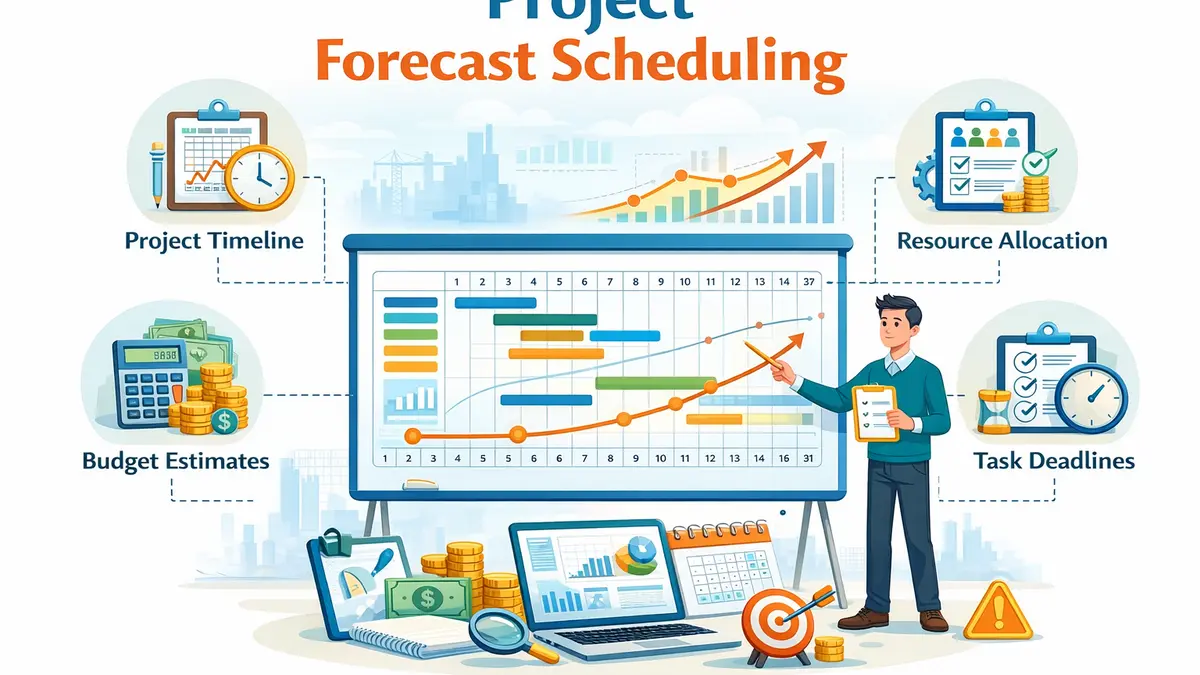
A project forecast schedule is more than a timeline with dates; it is a decision framework that translates scope into an executable sequence, exposes constraints, and makes delivery trade-offs visible before they become expensive. In 2026, delivery environments combine hybrid teams, tighter compliance, and faster iteration cycles, which raises the cost of vague planning and late risk discovery. One 2026 industry snapshot reports that project failure increased from 12% in 2025 to 13% in 2026, a signal that governance and planning discipline still lag behind complexity. A forecast schedule helps you align stakeholders on what “done” means, what must happen first, and which dependencies truly control the finish date. When you build it correctly, it becomes the backbone for status reporting, resource coordination, change control, and credible promises to customers and executives.
Search intent and what “forecast scheduling” must answer
The primary intent behind “planning prévisionnel” searches is informational, but strong pages also satisfy “light transaction” intent by providing practical templates, checklists, and tool guidance that readers can apply immediately. People want to know what a forecast schedule is, how it differs from a baseline, and how to create one that survives real-world disruption. They also want clarity on the classic planning building blocks: deliverables, work packages, milestones, dependencies, duration estimates, and resource capacity. A competitive article must therefore provide a step-by-step method, explain the logic behind sequencing, and show how to keep the schedule current without turning it into administrative noise. It should also answer common follow-up questions like retro-planning versus forward planning, critical path basics, and how to handle uncertainty.
What a project forecast schedule is, and what it is not
A forecast schedule is a time-phased model of project execution that expresses how work will flow from start to finish under explicit assumptions. It is not a wish list, and it is not a “pretty Gantt” built after decisions are already made; it should influence decisions while there is still flexibility. A credible forecast schedule includes a structured breakdown of work, logic links between tasks, milestone gates, and an explanation of constraints such as vendor lead times or regulatory approvals. It also includes explicit ownership, so every scheduled item has an accountable role rather than “the team” as a vague placeholder. When teams treat the schedule as a living model, it becomes an early-warning system that reveals risk before deadlines collapse.
Forecast schedule vs baseline vs rolling re-forecast
Teams often mix three different objects: the initial forecast schedule, the baseline, and the rolling re-forecast used for daily steering. The baseline is the approved reference plan used for performance measurement, contractual commitments, or portfolio reporting, while the forecast is the best current prediction of what will happen given today’s reality. A re-forecast updates durations, dates, and logic based on progress and new information, while preserving traceability so you can explain why a finish date moved. Mature delivery organizations treat re-forecasting as a routine management practice rather than an admission of failure, because uncertainty is normal and learning changes the plan. When you separate these concepts cleanly, you prevent political debates over “changing the plan” and focus on controlling outcomes.
The outcomes a strong forecast schedule must deliver
A schedule earns its place when it improves decisions, not when it looks complete in a planning tool. A good forecast schedule clarifies scope by forcing teams to specify deliverables and acceptance criteria, and it clarifies feasibility by exposing dependencies and capacity constraints. It supports resource decisions by highlighting overload periods and by showing where parallelization is possible without creating hidden rework. It also supports stakeholder management because it creates a shared map of upcoming commitments and decision points, which reduces last-minute surprises and escalations. Finally, it supports change control because it allows you to quantify the schedule impact of a scope change in days or weeks, rather than debating feelings and assumptions.
Featured-snippet definition you can reuse in documentation
A project forecast schedule is a structured timeline that lists project tasks and milestones, links them with dependencies, estimates durations and resource needs, and predicts start and finish dates based on explicit assumptions. It becomes actionable when it includes owners, constraints, and a cadence for updates that turns it into a living forecast rather than a static document. The schedule is validated when the logic is consistent, the critical path is understood, and the plan aligns with real capacity, vendor lead times, and decision gates. It remains credible only if the team updates progress consistently and re-forecasts when new risks or changes occur. This definition fits both governance language and operational planning language without oversimplifying.
Method: build a reliable forecast schedule in eight disciplined steps
A practical method beats abstract theory when teams need to deliver under pressure, so the most competitive approach is a structured, repeatable sequence. The eight-step method below combines scope definition, work decomposition, dependency logic, estimation, capacity validation, and governance, which reflects how high-performing project offices operate. Each step reduces a specific class of failure, such as missing work, unrealistic sequencing, optimistic durations, or unplanned overload. When you follow the steps in order, you produce a schedule that can be baselined and re-forecasted without collapsing into constant churn. The goal is to build a plan that is both communicable to stakeholders and computable for critical path, margins, and what-if analysis.
Step 1: lock the scope boundaries and success criteria
Start by clarifying what the project must deliver and what it will not deliver, because scope ambiguity is the most common upstream driver of downstream delay. Define the business outcome, the primary deliverables, acceptance criteria, and any non-negotiable constraints such as compliance deadlines or external release windows. Capture assumptions explicitly, including what you assume about stakeholder availability, vendor lead times, and data access, because assumptions are hidden risks unless you write them down. Confirm the decision owners for scope changes, since schedule credibility depends on stable governance as much as on planning technique. This step turns vague ambition into a bounded delivery contract that scheduling can actually support.
Step 2: decompose deliverables into a WBS that can be estimated
Build a Work Breakdown Structure that breaks deliverables into work packages and tasks that are small enough to estimate, assign, and track without ambiguity. Use deliverable-oriented language first, then translate deliverables into tasks, because a task list without deliverables often becomes an activity trap that produces motion without completion. Keep work packages consistent in granularity so the schedule remains readable and so progress reporting stays comparable across areas. A practical rule for many teams is to size tasks so they typically fall between one and ten working days, while allowing exceptions for long vendor lead times that cannot be decomposed further. The WBS becomes the backbone of the schedule, the cost model, and the ownership model at the same time.
Step 3: define milestones and decision gates before you sequence tasks
Milestones make a schedule useful to leadership because they convert detailed work into a small number of meaningful commitments. Define milestones for approvals, environment readiness, prototype sign-off, compliance checks, and release readiness, and treat them as governance points rather than cosmetic markers. A milestone should have clear entry criteria, a responsible owner, and a decision outcome such as “approved,” “rework required,” or “deferred,” because ambiguous milestones create false confidence. Place the milestone where it controls downstream work, so it prevents premature execution that later must be undone. This step creates a management rhythm and ensures the schedule reflects real decision-making, not just task execution.
Step 4: map dependencies with logic types and real constraints
Dependencies are where many schedules fail, because teams either omit them and create fantasy parallelism, or they add too many and create unnecessary rigidity. Map true logic links such as finish-to-start for sequential work, and use parallel links such as start-to-start only when work can genuinely proceed without hidden rework. Document external constraints like procurement lead times, legal review windows, and data migration cutovers, because these constraints often define the real critical path. Add lead and lag only when you can justify them, since arbitrary lags often hide missing tasks such as “training” or “stakeholder review.” A dependency map turns the schedule into a network model that you can analyze instead of a list of dates you can only hope for.
Step 5: estimate durations with evidence, not optimism
Duration estimation should reflect how work is actually performed, including review cycles, feedback loops, and the fact that people split time across multiple responsibilities. Combine historical data, expert judgment, and reference class forecasting, and challenge estimates that assume perfect conditions or uninterrupted focus. When uncertainty is high, use three-point estimates and convert them into a committed working duration with explicit contingency rather than burying uncertainty inside every task. Anchor estimates to acceptance criteria, because “done” without criteria becomes a moving target that expands the schedule silently. This step prevents the most common planning failure: a schedule that looks efficient on paper but cannot survive real execution.
Step 6: validate resource capacity and resolve overload before baselining
A schedule is not feasible if it requires the same person to deliver 160% capacity for three months, even if the dates appear mathematically consistent. Validate capacity by mapping roles to tasks and comparing planned effort to available hours, taking holidays, planned absences, and concurrent initiatives into account. Use workload smoothing and sequence adjustments to remove overload, and escalate resource trade-offs early when the plan requires additional staffing or reduced scope. Include the reality of part-time allocation, because “one day of work” often becomes “one day spread across five days” when a specialist supports multiple streams. Capacity validation turns the schedule from theoretical to operational, which is a key differentiator in 2026 planning maturity.
Step 7: build the Gantt view for communication, but keep the network logic for control
A Gantt chart is an excellent communication layer because it makes duration and overlap visible to non-specialists, but the control power comes from the underlying dependency network. Build a clean view that emphasizes milestones, major work packages, and the critical path, and avoid overwhelming stakeholders with low-level tasks that matter only to delivery teams. Use consistent naming conventions and include owners or responsible teams so the chart communicates accountability as well as time. Show “today” and progress indicators, because a Gantt without progress quickly becomes a static artifact that stakeholders ignore. Treat the Gantt as a window into the model, not the model itself, so you preserve analytical power while improving clarity.
Step 8: baseline, define update cadence, and run re-forecasting as a management routine
Once the plan passes logic and capacity validation, baseline the schedule for governance and performance measurement, then define how the schedule will be updated and by whom. A practical cadence for many delivery contexts is a weekly progress update and a biweekly re-forecast review, while longer programs may use monthly baseline reviews with weekly operational updates. Establish rules for change control so scope or dependency changes are reflected transparently, and ensure stakeholders understand the difference between “variance from baseline” and “latest forecast.” Define how progress is measured, ideally using objective completion criteria rather than subjective percentages, because “90% done” is often where projects hide risk. This final step turns planning into scheduling discipline, which is what creates on-time delivery behavior in practice.
Critical path, float, and schedule risk: the control layer
Once your schedule has dependency logic, you can compute the critical path, which is the sequence of tasks that determines the earliest possible finish date. Critical path awareness helps teams focus on the few tasks that cannot slip without moving the project end date, which improves prioritization and reduces unproductive multitasking. You also gain visibility into total float and free float, which show where you have flexibility and where you do not. This analytical layer is what separates professional forecasting from calendar management, because it allows you to run what-if scenarios, test recovery strategies, and quantify trade-offs. In 2026, leaders expect this level of schedule intelligence because modern tools compute it automatically when the underlying model is built correctly.
How to explain float without confusing stakeholders
Float is often misunderstood as “extra time you can waste,” so you must frame it as controlled flexibility that protects commitments. Total float is the time a task can slip without delaying the project finish date, while free float is the time a task can slip without delaying the start of its immediate successor. When stakeholders understand float, they can approve tactical trade-offs such as reallocating a specialist from a non-critical activity to a critical activity to protect a milestone. You should also highlight that float can disappear quickly when upstream tasks slip, which is why monitoring is essential even for non-critical tasks. Clear float communication reduces conflict because it replaces opinion-based debate with schedule mechanics that everyone can see.
Quantitative planning rule: a 10-business-day buffer policy for high-impact milestones
When uncertainty is material and the milestone has high business impact, you need a clear buffer policy rather than ad-hoc padding. A practical quantitative rule used in many organizations is to protect the final integration or readiness milestone with a 10-business-day buffer, while keeping intermediate tasks lean and explicit about assumptions. This approach keeps contingency visible and manageable, and it discourages hidden safety time scattered across every activity, which often gets consumed silently. The buffer should be governed, meaning only the project lead can spend it, and the team must record why buffer was used so learning improves future estimates. A visible buffer policy improves trust because stakeholders can see where uncertainty lives and how it is controlled.
Retro-planning vs forward planning: choose based on constraints, not preference
Retro-planning starts from a fixed end date and works backward to determine the latest allowable start dates for each task, which is ideal when the finish date is non-negotiable. Forward planning starts from available start conditions and predicts a finish date based on logic and capacity, which is ideal when feasibility is unclear and you need an honest forecast. Many 2026 delivery contexts require a hybrid approach: you retro-plan against a market window or regulatory deadline, then forward-plan to validate feasibility and identify the scope or resource trade-offs required to hit the date. The key is to avoid using retro-planning as a fantasy mechanism that forces impossible dates into the schedule, because that destroys credibility and leads to burnout. When used correctly, retro-planning is a constraint tool, not a pressure tool.
How to reconcile a fixed deadline with a realistic forecast
When a deadline is fixed, your schedule must reveal the gap between “required plan” and “feasible plan” rather than hiding it. Build the network logic and capacity-based forward forecast first, then compare it to the deadline and quantify the delta in time and resources. Use that delta to drive structured options such as scope reduction, phased delivery, parallelization with risk acceptance, or additional capacity through staffing or vendor support. Document the chosen option and baseline the result, so governance reflects the decision rather than a compromise no one owns. This approach preserves trust because it converts pressure into explicit trade-offs, which is what leadership ultimately needs to decide.
Tools in 2026: what to use for forecast scheduling and why
Tool choice affects planning speed and collaboration, but it does not replace the underlying scheduling discipline. Lightweight teams may use spreadsheets for quick schedules, while complex programs often require dedicated scheduling engines that handle resource leveling, multiple calendars, and advanced dependency logic. Modern platforms also add collaboration features, automated reporting, and integrations with ticketing systems, which reduces manual status churn. The right tool is the one that supports your governance: it must allow baselining, variance tracking, and controlled re-forecasting, while remaining usable for the people who update progress. If the tool is too heavy, teams stop updating; if it is too light, leaders cannot trust the forecast.
When a spreadsheet is enough, and when it becomes a trap
A spreadsheet works when the project is small, dependencies are simple, and updates are infrequent, because it gives speed and flexibility without a steep learning curve. It becomes a trap when you need reliable critical path analysis, multi-resource capacity validation, or consistent baselines, because manual formulas and copy-paste logic create hidden errors. Spreadsheets also struggle with concurrent editing and governance, which increases version confusion when stakeholders share files across emails and chat tools. If you use a spreadsheet, you should keep it deliverable-focused, use clear milestone rows, and lock a single source of truth with a clear update owner. When complexity grows, migrating early avoids the painful mid-project switch that often damages schedule credibility.
Scheduling software: baseline, variance, and portfolio-ready reporting
Dedicated scheduling tools earn their value when you need formal baselines, controlled change tracking, and robust dependency networks that remain consistent as scope evolves. They allow you to calculate critical path automatically, visualize float, and test scenario impacts without rebuilding the entire plan. They also support standard reporting patterns such as milestone slippage trends, critical-path task aging, and variance-by-workstream, which leaders use to steer investment and risk decisions. In enterprise contexts, scheduling data often feeds portfolio dashboards, so tool consistency matters for aggregation and governance. For complex work, the tool becomes the execution model, not just a visualization layer.
Collaborative platforms and work management systems
Collaborative work management platforms are useful when teams need real-time visibility, frequent reprioritization, and transparent ownership across distributed groups. They often connect schedule tasks to operational tickets, documents, and discussions, which reduces the gap between “the plan” and “the work.” The risk is that some platforms emphasize activity tracking over schedule logic, so you must ensure dependencies, milestones, and baseline concepts remain explicit rather than implied. In hybrid contexts, teams often maintain a high-level scheduling model for governance while managing execution details in the work system, then sync milestones and progress between the two layers. This two-layer approach preserves analytical scheduling while keeping daily work friction low.
Semantic building blocks: the vocabulary Google associates with forecast scheduling
To rank strongly in 2026, your content must cover the full semantic field around planning, scheduling, and control, because search engines evaluate topical depth and entity relevance. Core terms include scope, deliverables, work packages, tasks, milestones, dependencies, constraints, calendars, resource allocation, workload, critical path, float, baseline, variance, and change control. Co-occurrences that strengthen topical authority include estimation methods, risk registers, stakeholder management, governance rituals, and performance indicators such as schedule performance. You also need to integrate planning-related entities and frameworks to match how users learn the topic, while keeping the article tool-agnostic enough to be broadly useful. The strongest pages connect definitions to actionable workflows, because that creates both informational satisfaction and conversion readiness.
Entities and frameworks to reference for credibility
When readers search for planning discipline, they expect alignment with recognized frameworks even if you present a pragmatic method. Mentioning standards like and the helps anchor terminology such as WBS, baselines, and schedule control in an established body of knowledge. In enterprise settings, readers also associate forecasting with portfolio governance, reporting cycles, and stage-gate decision models, which you can incorporate without turning the article into a textbook. The point is not to quote standards, but to align language so readers and stakeholders share a common understanding of what a schedule represents. Credibility comes from precision and consistency, not from buzzwords.
How to keep the schedule alive: operating rhythm and governance
A forecast schedule only creates value if it stays current, because outdated dates train stakeholders to ignore the plan. The key is to define a light but disciplined operating rhythm that captures progress, updates forecasts, and triggers decisions when variance grows. Weekly updates work well for many projects, but the real success factor is the quality of progress measurement: “percent complete” without completion criteria creates false stability. Governance should define who can change logic links, who can approve scope changes, and when a re-baseline is allowed, because uncontrolled edits destroy traceability. When you treat scheduling as a management system rather than a document, teams stop debating opinions and start steering outcomes.
Progress measurement that avoids the “90% done” trap
To avoid misleading progress, define completion using observable evidence such as signed approvals, merged code, validated test results, delivered components, or accepted documents. Use discrete status states like “not started,” “in progress,” “in review,” and “done,” each with entry criteria, instead of arbitrary percentages that mean different things to different people. For long tasks, break them into measurable sub-deliverables so progress reflects completed outcomes rather than time spent. Connect milestone readiness to these evidence points so governance decisions are grounded in objective reality. This approach improves forecast accuracy because completion becomes measurable, which reduces last-minute “surprise” delays caused by unfinished quality work.
Variance management: when to re-forecast and when to re-baseline
Re-forecasting should happen whenever new information changes the likely finish date, but re-baselining should be rarer and governed, because the baseline is your performance reference. A good practice is to re-forecast continuously while requiring formal approval for re-baseline events such as major scope changes, regulatory shifts, or strategic replans. Maintain variance metrics at milestone level, because stakeholders care about outcomes more than about individual task slips, and milestone variance is easier to interpret. Record the cause of variance in categories such as estimation error, dependency delay, resource shortage, scope change, or external constraint, because this drives learning and prevents repeating the same failure patterns. Variance discipline turns scheduling into organizational improvement, not just project tracking.
Advanced schedule reliability: risk, uncertainty, and scenario planning
Forecast scheduling becomes resilient when it integrates uncertainty explicitly rather than hoping uncertainty disappears. High-impact risks should link to schedule elements, so mitigation work is planned and tracked instead of living as a separate risk register nobody executes. Scenario planning allows you to test decisions such as adding capacity, reducing scope, or splitting delivery into phases, and it allows you to quantify how many days a mitigation might save. In 2026, leadership teams increasingly expect data-driven scenario explanations because delivery failures have become more visible through dashboards and cross-functional governance. When you integrate risk into scheduling, you can justify buffers, protect critical milestones, and avoid reactive crisis management late in the timeline.
Rolling-wave planning for long or uncertain projects
For long projects or initiatives with evolving requirements, rolling-wave planning keeps the near term detailed while keeping the distant horizon at a higher level. This approach prevents the false precision of scheduling tasks six months out when information is not yet stable, while still providing a credible milestone roadmap for governance. Define detailed tasks for the next 4 to 8 weeks, define work packages for the next quarter, and define milestones for the remainder, then refine as you learn. Rolling-wave planning supports agility without losing forecasting discipline, because it preserves dependency logic and capacity checks in the period that matters most. It also improves stakeholder trust because you avoid constant micro-edits to distant tasks that never reflected reality anyway.
Industry examples: how forecast schedules differ by context
Different project types impose different constraints, so your schedule model must adapt while keeping the same underlying principles. Digital product delivery often needs short cycles and frequent release gates, while construction or infrastructure work often needs long lead times, regulatory steps, and multi-vendor sequencing. Marketing and events face fixed dates where retro-planning is essential, while research and innovation work faces uncertainty where rolling-wave planning is safer. In all cases, the same mechanics apply: define deliverables, model dependencies, estimate durations realistically, validate capacity, and govern changes. The difference is which constraints dominate and where the critical path tends to live.
IT and digital delivery schedules
In IT delivery, forecast schedules must reflect testing, rework loops, environment readiness, security approvals, and deployment windows, which often create hidden dependencies if teams plan only “build” tasks. The critical path frequently runs through integration and validation, so you should model milestones like “integration complete,” “UAT sign-off,” and “release readiness” as true decision gates. Resource capacity matters because key specialists, such as platform engineers or security reviewers, often support multiple streams and create bottlenecks that generic scheduling misses. You also need explicit time for documentation, training, and operational handover, because skipping these tasks tends to push delays into go-live chaos rather than eliminating work. A high-quality IT forecast schedule makes these invisible tasks visible and controllable.
Event and campaign schedules
Event and campaign planning relies on fixed deadlines, vendor lead times, content approvals, and logistical dependencies, so retro-planning is a natural fit. The most important milestones usually include venue confirmation, vendor contracts, creative approval, production lock, and final rehearsal or readiness checks. Capacity validation matters because marketing and event teams often juggle multiple campaigns, so the schedule must reflect real availability and approval turnaround times. Risk planning must cover supplier delays, shipment risk, and last-minute changes, which can be mitigated by earlier decision gates and explicit buffers around high-impact milestones. A disciplined forecast schedule reduces stress because it transforms “everything is urgent” into sequenced commitments with owners.
Construction and industrial schedules
Construction and industrial projects often have external constraints such as permit approvals, inspection windows, material delivery lead times, and weather considerations, so your schedule must include these constraints as explicit activities or milestones. The critical path may run through procurement, site readiness, or inspection approvals as much as through physical work. Resource leveling matters because equipment and specialized crews are limited, and overbooking them creates cascading delays. A well-built schedule clarifies the interface between trades and vendors, reducing idle time and rework caused by missing prerequisites. The forecast schedule becomes a coordination contract, not merely a project management artifact.
Common mistakes that make forecast schedules unreliable
Most schedule failures are not caused by advanced math; they are caused by missing work, missing logic, and missing governance. Teams often skip WBS discipline, then discover late that crucial deliverables were never scheduled, which creates emergency work that pushes milestones. They also confuse effort with duration, assuming that “40 hours” equals “one week,” while the resource is allocated at 40% capacity and spread across multiple initiatives. Another frequent issue is dependency denial, where teams plan parallel execution without acknowledging review cycles, approvals, or shared environments. Finally, schedules become stale when updates are inconsistent, which trains stakeholders to ignore forecasts and removes the early-warning value the schedule should provide.
Schedule optimism and hidden rework loops
Optimism often hides inside assumptions like “no defects,” “instant approval,” or “no changes,” which rarely reflect reality in complex work. Rework loops such as design-review cycles, test-fix cycles, and stakeholder feedback cycles must be explicit, because they are often the real reason schedules slip. When you model these loops, you can shorten them through better preparation and clearer acceptance criteria, which improves both time and quality. If you ignore them, they still happen, but they happen off-schedule, which creates surprise variance and erodes trust. A schedule is credible when it models the work you actually do, not the work you wish you did.
Conversion-oriented assets: templates, checklists, and schedule validation
Even with informational intent, readers value assets they can use immediately, because applying a method is the fastest way to reduce uncertainty. Provide a checklist that validates schedule quality, and provide a simple template structure they can implement in a spreadsheet or a scheduling tool. These assets also support conversion because they position your approach as operational, not theoretical, and they reduce the effort required to take action. A good schedule template includes columns for task name, WBS code, owner, duration, predecessor, successor, milestone flag, and acceptance criteria. When you offer a validation checklist, you help readers catch mistakes before the schedule becomes a liability.
- Scope completeness: every deliverable has scheduled work and an acceptance checkpoint.
- Dependency realism: logic links reflect real prerequisites, approvals, and environments.
- Estimate evidence: durations are grounded in data, expertise, and explicit assumptions.
- Capacity feasibility: key roles are not overloaded and critical bottlenecks are addressed.
- Milestone governance: decision gates have owners and clear outcomes.
- Baseline and cadence: the baseline is set and the update rhythm is defined and respected.
Mini FAQ: project forecast scheduling in plain terms
What is the simplest way to define a forecast schedule?
A forecast schedule is a structured timeline that predicts how a project will unfold by listing tasks and milestones, linking them with dependencies, estimating durations, and assigning ownership so work becomes executable. It differs from a calendar because it models cause and effect, showing how delays propagate through dependencies and where the critical path constrains the finish date. A reliable schedule also documents assumptions and constraints, because those factors determine whether dates are feasible or merely hopeful. If the schedule can be updated consistently and still makes sense, you have a forecasting tool rather than a one-time planning artifact. The simplest definition is “a dependency-based plan you can re-forecast weekly without losing credibility.”
How many tasks should a forecast schedule contain?
The right number of tasks depends on complexity and governance needs, but the schedule should be detailed enough to be estimable and controllable without becoming unreadable. Many mid-sized projects land between 30 and 300 tasks when they structure work by deliverables and keep task sizes within a manageable range. Too few tasks hide risk and make progress reporting subjective, while too many tasks create administrative overhead and dilute attention from what matters. A practical approach is to keep detailed tasks for near-term execution and aggregate distant work into work packages, refining it through rolling-wave planning. Your schedule is at the right level when task owners can give confident status and when milestones reflect meaningful decision points.
What is the difference between a baseline and a re-forecast?
The baseline is the approved reference schedule used to measure performance, often tied to commitments such as contracts, portfolio reporting, or executive governance. A re-forecast is the updated prediction of likely dates based on actual progress, new information, and changes in constraints, and it should be updated regularly because reality changes. You keep both because stakeholders need to understand variance from the plan and also need the best current view for decision-making. If you overwrite the baseline every time something changes, you lose accountability and learning; if you refuse to re-forecast, you lose control and credibility. The discipline is to re-forecast often and re-baseline only under governed conditions.
How do you keep the schedule accurate without wasting time?
Accuracy comes from a lightweight rhythm: collect objective progress evidence weekly, update task status and remaining duration quickly, then review forecast impact and risks in a short re-forecast session with the right owners. Focus on milestone variance and critical path health rather than micro-updating every minor activity, because control comes from managing constraints and bottlenecks. Use clear completion criteria so updates are factual, not subjective, and limit who can change dependency logic to protect schedule integrity. Automate reporting where possible so the team spends time solving problems rather than formatting slides. A schedule stays accurate when it is treated as a steering tool, not as a compliance chore.