Risk Matrix: Complete Guide to Understanding, Building, and Using a Risk Assessment Matrix in 2026
The risk matrix, also known as a risk assessment matrix or probability impact matrix, is one of the most widely used tools in modern risk management and enterprise risk management (ERM). Organizations must continuously identify, evaluate, and prioritize potential threats that may impact operations, financial performance, regulatory compliance, or reputation. A risk matrix provides a structured framework that transforms complex risk analysis into a clear visual model, allowing decision-makers to assess and compare threats quickly. By mapping risks according to their likelihood and severity of impact, companies can focus resources on the most critical exposures and design mitigation strategies more effectively. In 2026, the growing complexity of digital transformation, cybersecurity threats, and regulatory environments makes structured risk prioritization essential for business resilience.
Across industries such as technology, finance, healthcare, and manufacturing, the risk management matrix has become a central component of governance and strategic planning. According to risk governance reports published in 2026, more than 78% of large organizations use a probability impact matrix as part of their risk management frameworks, demonstrating its importance as a decision-support tool. When designed correctly, a risk matrix allows teams to visualize critical exposures, align risk tolerance with organizational strategy, and communicate complex threats in a format that executives and stakeholders can easily understand. This combination of clarity and analytical structure explains why the risk matrix remains a foundational method in modern risk analysis.
What Is a Risk Matrix and Why It Matters in Risk Management
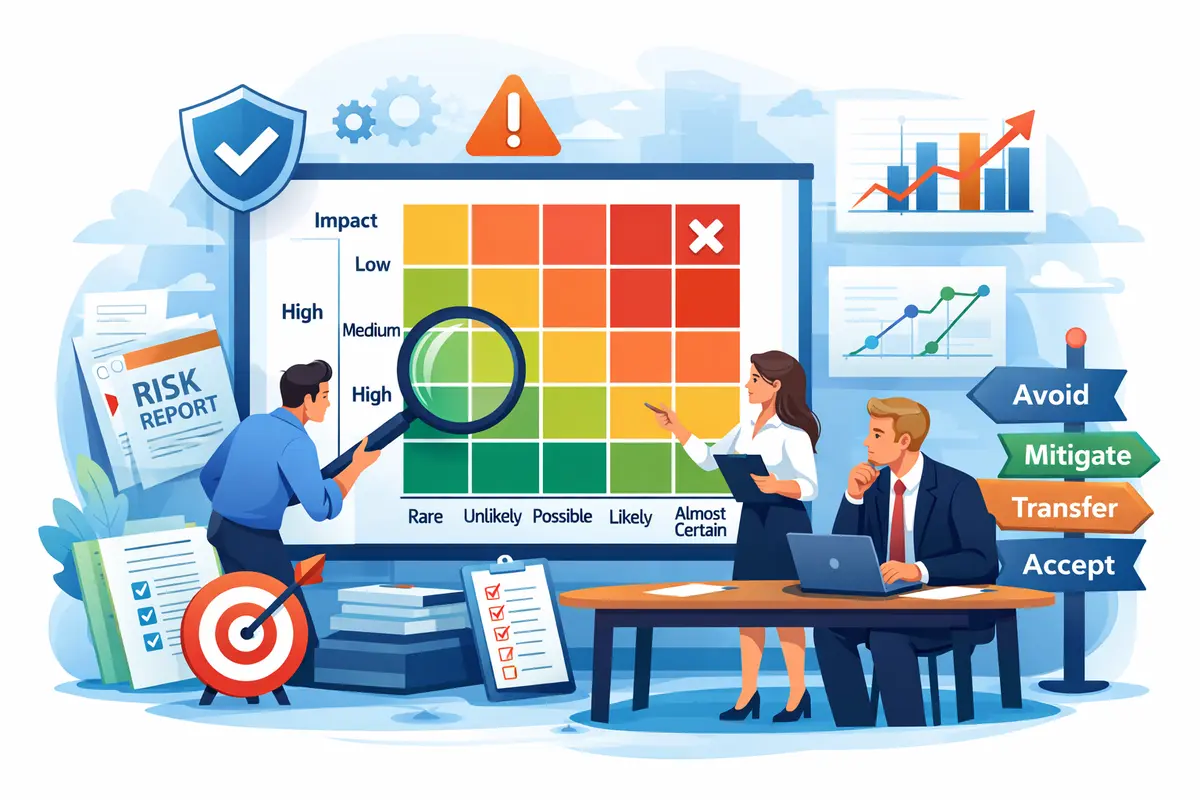
A risk matrix is a visual framework used to evaluate and categorize risks based on two primary variables: the probability of occurrence and the potential impact of an event. These variables are plotted along two axes, creating a grid that allows analysts to position risks according to their severity. The most critical risks appear in the high-impact, high-probability quadrant of the matrix, typically highlighted in red. Lower-priority risks appear in yellow or green areas, indicating reduced urgency. This structure helps organizations prioritize mitigation strategies and allocate resources effectively.
The popularity of the risk assessment matrix comes from its ability to simplify complex risk scenarios into a structured decision-making framework. Rather than analyzing each risk independently without context, teams can compare threats relative to one another. This comparative perspective allows organizations to understand which risks require immediate action and which can be monitored over time. As risk landscapes become increasingly complex, this prioritization capability becomes essential for maintaining operational stability and protecting long-term business performance.
Operational Definition of a Risk Assessment Matrix
The risk assessment matrix functions as a decision-support tool that assigns each identified risk a position within a grid based on its probability and impact scores. Organizations typically define standardized scales for both variables, such as “rare,” “unlikely,” “possible,” “likely,” and “almost certain” for probability. Impact levels might include categories such as “insignificant,” “minor,” “moderate,” “major,” and “severe.” The intersection of these two values determines the overall risk level and helps guide management decisions regarding risk mitigation, transfer, avoidance, or acceptance.
When integrated into broader risk management frameworks, the matrix often complements other tools such as the risk register, key risk indicators (KRIs), and governance dashboards. Together, these components provide a structured environment for monitoring emerging threats and ensuring that mitigation strategies remain aligned with organizational objectives. The visual nature of the probability impact matrix also facilitates communication across departments, ensuring that executives, project managers, and compliance teams share a consistent understanding of risk exposure.
Core Components of a Risk Management Matrix
An effective risk matrix template includes several key components that ensure consistency and reliability in the risk evaluation process. These components define how risks are measured, classified, and interpreted across the organization. Without clearly defined criteria for probability and impact, a risk matrix can become subjective and inconsistent, reducing its effectiveness as a decision-making tool. Organizations must therefore establish clear definitions, thresholds, and scoring methodologies before implementing a matrix within their risk management programs.
Likelihood or Probability of Risk Occurrence
The likelihood dimension measures how frequently a specific risk event is expected to occur within a given time frame. In a typical risk management matrix, this variable is divided into several levels that represent increasing probabilities of occurrence. Each level should be supported by measurable criteria, such as statistical frequency or historical incident data. This approach ensures that risk assessments are based on objective evidence rather than subjective perceptions, improving the reliability of the overall evaluation process.
Organizations with mature risk management practices often rely on historical data analysis, predictive modeling, and industry benchmarks to estimate probability levels. For example, cybersecurity teams may analyze past breach incidents or threat intelligence data to estimate the likelihood of ransomware attacks. By incorporating quantitative data into the risk assessment matrix, companies can create more accurate evaluations that support better strategic decision-making.
Impact or Consequence Severity
The impact dimension measures the severity of consequences that could result if a risk materializes. In most risk matrix examples, impact levels include financial losses, operational disruption, reputational damage, regulatory penalties, or safety incidents. Organizations often create structured criteria for each impact level, ensuring that risks are evaluated consistently across departments. This structured approach helps decision-makers understand the potential consequences of a risk event and prioritize mitigation strategies accordingly.
Many organizations use multi-dimensional impact assessments in their enterprise risk management frameworks. Instead of focusing solely on financial losses, they consider broader consequences such as customer trust, legal exposure, and long-term strategic implications. This broader perspective provides a more accurate representation of risk exposure and helps ensure that high-impact threats receive appropriate attention from leadership teams.
Common Types of Risk Matrix Formats
The structure of a risk matrix template can vary depending on the complexity of the risk environment and the level of detail required in the analysis. Some organizations prefer simpler matrices that prioritize usability and speed, while others use more detailed structures to capture nuanced differences between risk scenarios. The most commonly used formats include 3x3, 4x4, and 5x5 risk matrix models.
3x3 Risk Matrix
The 3x3 matrix represents one of the simplest forms of risk assessment matrix. It divides both probability and impact into three categories, resulting in nine possible risk positions. This format is particularly useful for small projects, startups, or organizations with relatively simple operational structures. Because of its simplicity, the 3x3 matrix allows teams to perform rapid risk assessments without extensive data collection or complex modeling.
However, the simplicity of the 3x3 matrix also introduces limitations in complex risk environments. With fewer categories available, it becomes difficult to distinguish between moderately high risks and truly critical threats. This lack of granularity may lead organizations to underestimate certain exposures or allocate resources inefficiently. For this reason, larger organizations often adopt more detailed matrix structures.
5x5 Risk Matrix
The 5x5 risk matrix is widely considered the industry standard for structured risk evaluation. By providing five levels for probability and five levels for impact, the matrix generates twenty-five possible risk combinations. This level of detail allows organizations to categorize risks more precisely and differentiate between moderate, high, and extreme threats. The additional granularity also supports more refined decision-making processes.
In large organizations implementing enterprise risk management, the 5x5 matrix often forms the backbone of risk dashboards and executive reporting tools. Risk managers can use the matrix to visualize overall exposure across departments and identify patterns in emerging threats. This strategic overview enables leadership teams to align mitigation strategies with broader business objectives and regulatory requirements.
How to Create an Effective Risk Matrix
Designing an effective risk matrix requires a structured methodology that combines qualitative analysis with quantitative data. A poorly designed matrix may lead to inaccurate risk prioritization and ineffective mitigation strategies. Organizations must therefore follow a systematic process that includes risk identification, scoring, prioritization, and monitoring. When executed correctly, this process transforms the matrix into a powerful decision-support tool.
Step-by-Step Process for Building a Risk Matrix
The development of a risk management matrix typically follows a series of structured steps that ensure consistency and reliability in the evaluation process. These steps help organizations move from a simple list of potential threats to a prioritized framework for risk mitigation and strategic decision-making.
- Identify potential risks by analyzing internal operations, market conditions, technological vulnerabilities, and regulatory requirements.
- Evaluate probability for each risk using historical data, expert analysis, or predictive models.
- Assess impact across financial, operational, reputational, and compliance dimensions.
- Map risks within the probability impact matrix to determine their overall severity.
- Define mitigation strategies such as avoidance, reduction, transfer, or acceptance.
This structured process ensures that the risk matrix becomes more than a static visualization tool. Instead, it functions as an integrated component of the organization’s broader risk governance framework. By linking risk levels to concrete mitigation actions, organizations can create a proactive approach to managing uncertainty and protecting long-term business value.
Limitations and Criticism of Risk Matrices
Despite their widespread use, risk matrices have several limitations that organizations must consider when relying on them for decision-making. One major criticism involves the potential subjectivity of probability and impact evaluations. Different stakeholders may interpret risk scenarios differently, leading to inconsistent assessments across teams. Without standardized evaluation criteria, these differences can undermine the reliability of the matrix.
Another limitation concerns the simplification inherent in two-dimensional risk models. Complex risks often involve multiple variables, including interdependencies between different events or uncertainties related to future conditions. A traditional probability impact matrix may not fully capture these complexities, which means organizations should complement the matrix with additional analytical tools such as scenario analysis, quantitative modeling, or simulation techniques.
Practical Examples of Risk Matrix Applications
Risk matrices are used across many industries to support strategic planning and operational resilience. In project management, for example, teams often rely on risk matrix examples to evaluate potential delays, cost overruns, or technical failures that could affect project timelines. By identifying these threats early, project managers can implement contingency plans that reduce the likelihood of disruptions.
Cybersecurity teams also rely heavily on risk assessment matrices to prioritize threats such as malware attacks, data breaches, or system vulnerabilities. In this context, the matrix helps security professionals determine which vulnerabilities require immediate remediation and which can be monitored over time. By aligning cybersecurity investments with risk severity, organizations can improve their resilience against evolving digital threats.
FAQ: Risk Matrix Questions and Answers
What is the difference between a risk matrix and a risk register
A risk register is a detailed document that records all identified risks within an organization, including descriptions, owners, mitigation plans, and monitoring indicators. A risk matrix, on the other hand, is a visual representation used to categorize these risks according to probability and impact. The register provides detailed information, while the matrix offers a simplified overview that supports prioritization and decision-making.
Which risk matrix size is best
The optimal matrix size depends on the complexity of the risk environment. Small organizations or short-term projects may benefit from a 3x3 matrix due to its simplicity. Larger organizations implementing enterprise risk management typically prefer a 5x5 risk matrix because it provides greater granularity and supports more accurate risk classification.
Are risk matrices reliable for decision-making
The reliability of a risk assessment matrix depends largely on the quality of the data used to evaluate probability and impact. When organizations base their assessments on reliable metrics and clearly defined criteria, the matrix can provide valuable insights into risk prioritization. However, if evaluations rely solely on subjective judgment, the resulting classifications may be misleading and should be supplemented with additional analytical methods.
```