V-Model in Project Management: Complete Definition, Phases, Advantages, Limitations and Strategic Implementation in 2026
The V-Model remains one of the most structured and governance-driven project management methodologies used in complex engineering and software environments. Built on a sequential logic derived from the waterfall model, it connects every design phase to a corresponding testing phase, forming a visual “V” that reflects the symmetry between specification and validation. This structure emphasizes traceability, verification and validation, and rigorous documentation, making it particularly relevant in regulated industries and safety-critical systems. In 2026, despite the widespread adoption of agile frameworks, the V-Model continues to dominate projects where requirement stability, compliance, and risk control outweigh the need for iterative flexibility. Organizations seeking predictable delivery, contractual clarity, and measurable quality standards still rely heavily on this approach. Understanding its mechanics, strategic advantages, and operational constraints is essential for making informed methodological decisions.
Precise Definition of the V-Model and Conceptual Foundations
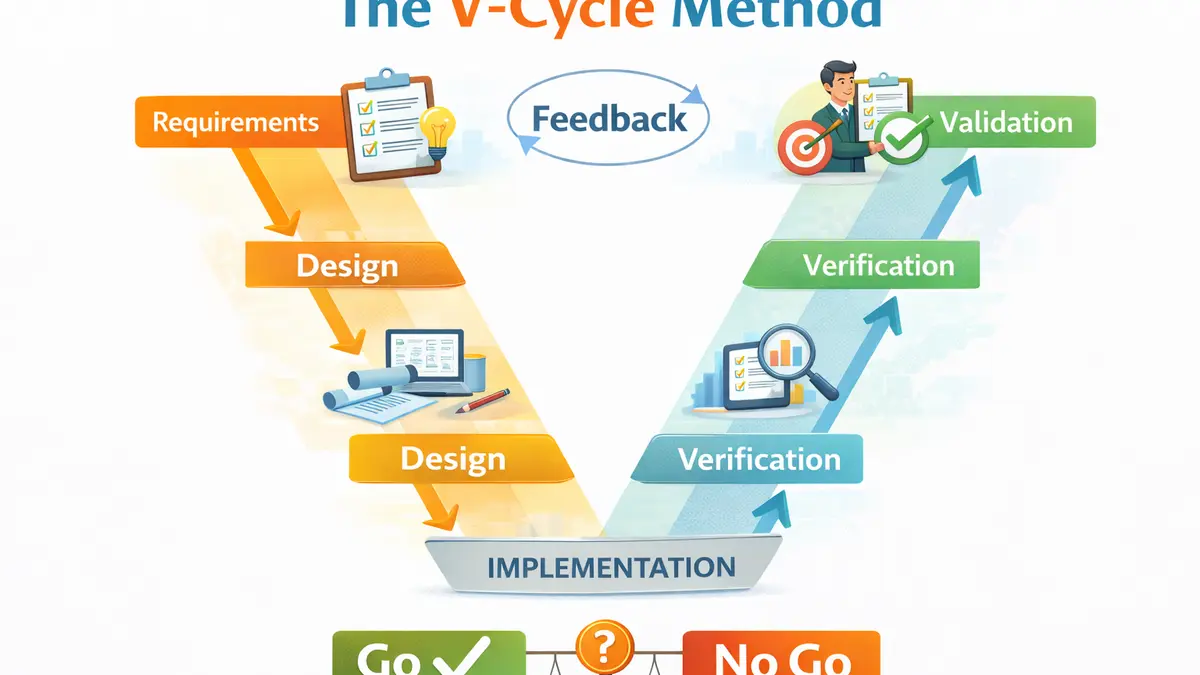
The V-Model is a sequential project management framework in which each development phase is directly linked to a corresponding validation phase, ensuring systematic alignment between requirements and delivered outcomes. The left side of the V represents requirements analysis and system design, while the right side represents testing and validation activities performed in reverse order. This structured symmetry reinforces early planning of verification activities and reduces ambiguity during implementation. Unlike iterative models, the V-Model progresses through predefined milestones with formal approval gates at each stage. Although controlled change is possible, modifications are governed by structured change management processes to maintain consistency and compliance.
Historical Origin and Evolution
The V-Model emerged in the 1980s as an enhancement of the traditional waterfall model, addressing the need for earlier integration of testing activities in system development. Engineers recognized that late-stage defect detection dramatically increased correction costs, sometimes multiplying remediation expenses by a factor of ten compared to early design adjustments. By mapping each requirement to a corresponding validation phase, the V-Model institutionalized proactive quality assurance. Over time, it became widely adopted in aerospace, automotive, medical device development, and defense industries, where certification and documentation standards are mandatory. In 2026, it remains a foundational reference in compliance-driven environments aligned with standards such as ISO frameworks and sector-specific regulatory protocols.
Detailed Structure of the V-Model
The structural strength of the V-Model lies in its explicit pairing of development and testing phases, creating a direct traceable path from initial requirements to final validation. Each stage produces documented deliverables that must be reviewed and approved before progression to the next milestone. This sequential clarity enhances governance transparency and reduces cross-functional misunderstandings. The model supports accurate cost estimation because each phase has clearly defined objectives and outputs. Organizations prioritizing accountability and structured oversight often select the V-Model for these governance benefits.
Left Side of the V: Requirements and Design Phases
The descending branch of the V begins with requirements definition, where functional and non-functional needs are documented in a formal specification. This stage is followed by system and architectural design, which translate business needs into technical blueprints. Detailed design then defines individual components, interfaces, and data flows to guide implementation. Each stage requires stakeholder validation to ensure alignment and prevent scope ambiguity. The overall quality of a V-Model project depends heavily on the depth and precision of this initial documentation.
Bottom of the V: Implementation Phase
At the lowest point of the V lies the implementation phase, where developers build the system according to validated specifications. Although often perceived as the central activity, implementation is structurally dependent on the thorough preparation conducted in earlier phases. Teams rely on approved documentation to avoid subjective interpretations and technical inconsistencies. Technical documentation is continuously updated to preserve end-to-end traceability. The discipline applied during implementation directly impacts the efficiency of subsequent validation stages.
Right Side of the V: Verification and Validation Phases
The ascending branch of the V organizes testing activities in direct correspondence with earlier design phases. Unit testing validates individual components against detailed design specifications, while integration testing ensures modules interact according to architectural plans. System testing verifies the complete solution against functional specifications, and acceptance testing confirms that the system satisfies initial business requirements. This hierarchical testing structure allows teams to trace defects back to their source documentation efficiently. Early planning of these validation activities distinguishes the V-Model from purely sequential development approaches.
Key Deliverables and Traceability Management
Successful implementation of the V-Model requires comprehensive documentation that ensures complete alignment between requirements and validation artifacts. A requirements traceability matrix plays a central role by linking each requirement to specific design elements and test cases. This documentation framework supports governance audits and contractual validation. In 2026, advanced Application Lifecycle Management platforms automate requirement-to-test mapping, significantly improving consistency and reporting accuracy. While documentation intensity can increase administrative overhead, it also provides measurable accountability and quality assurance. Organizations operating in regulated sectors consider this structured traceability indispensable.
- Business Requirements Specification
- Functional Specifications
- System Architecture Documentation
- Detailed Design Documents
- Test Plans and Test Cases
- Requirements Traceability Matrix
- Validation and Acceptance Reports
Strategic Advantages of the V-Model
The V-Model offers significant advantages in environments requiring predictable timelines, fixed budgets, and regulatory compliance. Its structured approach enhances project visibility and facilitates clear communication among stakeholders. The explicit linkage between requirements and validation activities strengthens overall product quality and reduces the likelihood of critical production defects. According to a 2026 industry governance report, 62% of certified safety-critical system projects in Europe continue to rely on V-Model or derivative frameworks, underscoring its sustained relevance. The model also supports contractual assurance, as every phase is documented and formally approved. These strengths make it particularly attractive for large-scale infrastructure and embedded systems projects.
Risk Management and Compliance Strength
The V-Model enhances risk mitigation by requiring early validation of requirements before development begins. Formal approval gates act as quality checkpoints, limiting the propagation of design errors into later stages. In highly regulated industries such as medical devices and aerospace engineering, this structured documentation ensures alignment with compliance standards. The methodology simplifies external audits because each deliverable is archived and validated within a defined process. This alignment between governance and execution significantly reduces regulatory exposure. Organizations prioritizing safety and reliability benefit greatly from this disciplined framework.
Limitations and Structural Constraints
Despite its strengths, the V-Model is often criticized for its rigidity and limited adaptability to evolving requirements. Changes introduced after formal validation can trigger costly revision cycles due to strict documentation dependencies. The sequential nature of the model may delay user feedback until later stages, reducing opportunities for iterative refinement. Administrative overhead associated with documentation can slow innovation in fast-paced digital markets. Therefore, the effectiveness of the V-Model strongly depends on initial requirement stability and organizational maturity. When applied in volatile contexts, its rigidity may become a competitive disadvantage.
V-Model vs Agile Methodologies
The comparison between the V-Model and Agile methodologies centers on predictability versus adaptability. Agile frameworks emphasize iterative development, continuous stakeholder collaboration, and rapid responsiveness to change. In contrast, the V-Model prioritizes structured planning, formal validation, and comprehensive documentation. In 2026, many organizations adopt hybrid models that combine V-Model governance with incremental development cycles to balance compliance and flexibility. This hybridization reflects a broader trend toward methodological pragmatism rather than strict adherence to a single framework. Both approaches serve distinct strategic objectives depending on project complexity and risk profile.
When to Use the V-Model
The V-Model is particularly suitable when project requirements are clearly defined and unlikely to evolve significantly during execution. It aligns well with safety-critical systems, regulated industries, and fixed-scope contractual agreements requiring extensive documentation. Organizations with mature quality assurance teams and structured governance processes benefit most from its systematic design. Infrastructure development, embedded software engineering, and hardware integration projects often rely on this methodology due to high modification costs in later stages. Selecting the V-Model should be based on risk assessment, regulatory exposure, and requirement stability. Strategic alignment between methodology and project context remains essential.
Operational Implementation in 2026
Implementing the V-Model effectively in 2026 requires integration with digital governance tools that streamline documentation, traceability, and automated testing. Modern ALM platforms connect requirements, development artifacts, and test cases in real time, improving reporting accuracy and audit readiness. Automation of unit and integration tests accelerates validation cycles while preserving methodological rigor. Structured change management boards oversee requirement modifications to minimize disruption. Data-driven performance indicators enhance transparency and continuous improvement. These technological enhancements modernize the V-Model without compromising its foundational structure.
Mini SEO FAQ About the V-Model
What is the V-Model in project management?
The V-Model is a sequential project management framework that pairs each development phase with a corresponding testing phase. It ensures traceability between initial requirements and final validation outcomes. The model emphasizes documentation, governance, and early planning of verification activities. It is commonly used in regulated and safety-critical industries. Its structured approach differentiates it from iterative methodologies.
What are the main advantages of the V-Model?
The primary advantages include strong predictability, comprehensive documentation, and improved quality assurance through early validation planning. It supports regulatory compliance and simplifies audits due to structured deliverables. The methodology enhances accountability by defining clear roles and milestones. Risk exposure is minimized through formal validation checkpoints. These strengths explain its continued relevance in 2026.
Is the V-Model still relevant in 2026?
Yes, the V-Model remains highly relevant in 2026, particularly in industries where compliance and reliability are critical. While agile approaches dominate digital product development, the V-Model continues to underpin safety-critical and regulated projects. Many organizations integrate hybrid strategies to combine structure with flexibility. Advances in automation and lifecycle management tools further strengthen its operational viability. Its relevance ultimately depends on project stability and regulatory context.
Read also: Waterfall vs Cycle V.