
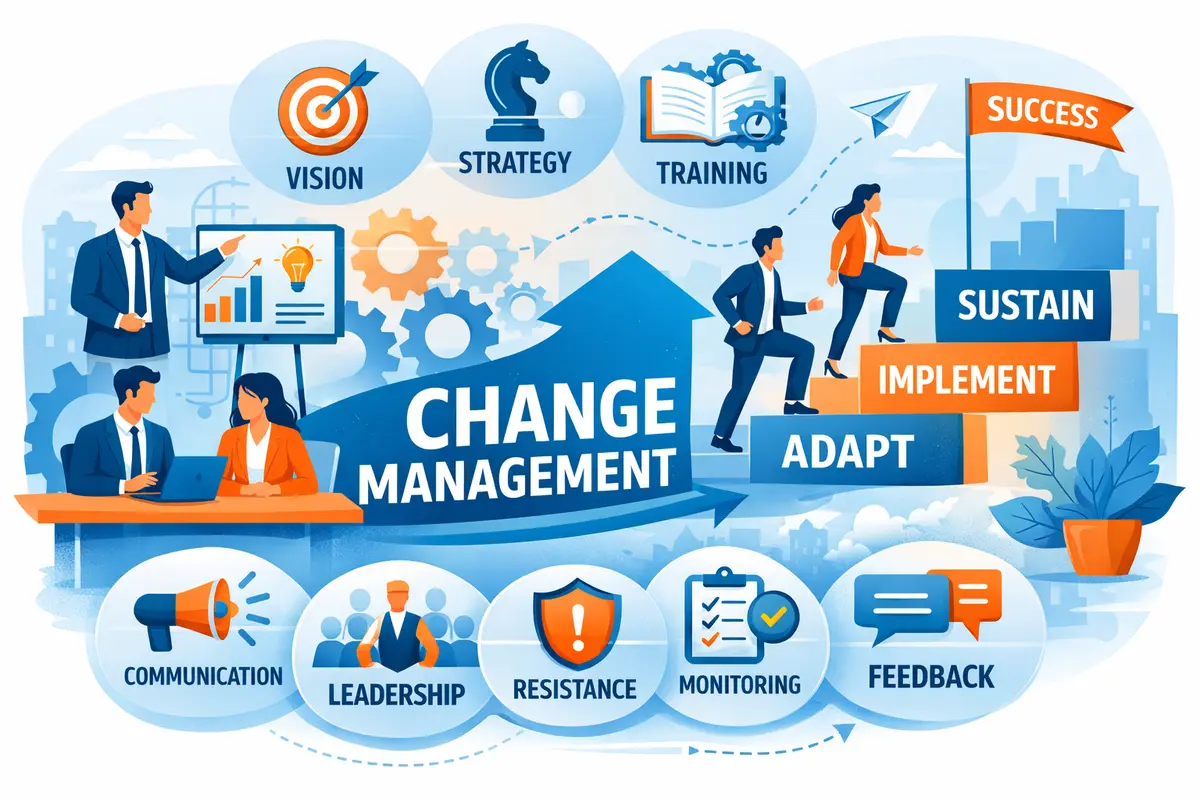
Change Management: Strategies, Models, and Best Practices to Successfully Lead Organizational Transformation in 2026
Change management has become a critical capability for organizations facing continuous technological, economic, and cultural transformations. Companies must integrate new digital tools, rethink operational models, adapt management practices, and guide employees through increasingly rapid cycles of transformation. According to multiple industry studies published in 2026, nearly 70% of transformation initiatives fail or fall short of their original objectives, largely due to poor adoption and insufficient attention to the human side of change. Successful transformation no longer depends solely on technology, strategy, or project execution; it depends on the ability to mobilize people, align teams, and structure a systematic approach to organizational change. Understanding the core principles, frameworks, and operational practices of change management enables organizations to significantly increase the likelihood of success, strengthen employee engagement, and ensure that transformation efforts generate measurable business impact.
Understanding Change Management and Its Strategic Importance
Change management refers to the structured set of methods, tools, and practices used to guide individuals, teams, and organizations through transformation. Its objective is to facilitate the adoption of new processes, technologies, or strategies while minimizing resistance and disruption. In modern organizations characterized by rapid digitalization, evolving markets, and continuous innovation, the ability to manage change effectively has become a decisive competitive advantage. Companies that master change management can accelerate transformation initiatives while maintaining employee alignment and operational stability.
The discipline of change management sits at the intersection of multiple fields including leadership, psychology, organizational behavior, and project management. It addresses not only operational implementation but also the emotional and behavioral reactions that people experience during transformation. A well-structured change management approach ensures that transformation projects do not remain theoretical initiatives defined by leadership but instead become real, operational changes embedded in daily workflows. Organizations that integrate change management early in strategic initiatives typically achieve higher adoption rates and stronger long-term performance outcomes.
Why Organizational Transformations Often Fail
Despite the widespread adoption of transformation frameworks and management methodologies, many organizational change initiatives still fail due to underestimated human and cultural factors. Lack of leadership commitment, unclear vision, inconsistent communication, and insufficient understanding of employee concerns frequently create resistance. Employees may perceive transformation initiatives as threats to their roles, professional identity, or job security, which leads to hesitation and slower adoption of new systems or processes.
Another frequent reason for failure is the overemphasis on technology or operational restructuring without addressing behavioral transformation. Organizations often assume that deploying a new platform or restructuring processes automatically leads to improved performance. In reality, employees frequently revert to familiar habits if the transformation is not supported by proper training, communication, and reinforcement. Change management provides a structured framework to anticipate these challenges and to ensure that transformation initiatives lead to genuine behavioral change across the organization.
Core Change Management Models Used by Organizations
Several theoretical frameworks shape the modern discipline of change management and provide structured guidance for organizations implementing transformation programs. These models help leaders understand the psychological, cultural, and operational mechanisms behind organizational change. While each framework approaches transformation differently, they all share a common principle: sustainable transformation occurs only when individuals adopt new behaviors and practices. Organizations frequently combine elements from multiple frameworks to create a customized approach tailored to their context and industry.
The ADKAR Model: Individual-Centered Change
The ADKAR model is one of the most widely used change management frameworks and focuses primarily on individual adoption of change. Developed to explain how people move through transformation, the model describes five sequential stages: Awareness, Desire, Knowledge, Ability, and Reinforcement. Each stage represents a critical condition that must be achieved for employees to successfully adopt new behaviors or systems.
The Awareness stage ensures employees understand why change is necessary and what risks exist if the organization remains unchanged. Desire focuses on motivating individuals to actively support the transformation. Knowledge provides the information and training necessary for employees to understand new processes or technologies. Ability represents the capability to implement new skills in practice, often supported by coaching or hands-on learning. Finally, Reinforcement ensures long-term adoption through recognition, performance metrics, and continuous support mechanisms that sustain behavioral change.
Kotter’s 8-Step Model for Leading Change
The Kotter 8-Step Change Model remains one of the most influential frameworks for large-scale organizational transformation. This model emphasizes leadership alignment, collective momentum, and organizational mobilization as the driving forces behind successful change initiatives. It begins with creating a sense of urgency and progresses through building a guiding coalition, defining a strategic vision, and empowering teams to execute transformation initiatives.
Kotter’s framework highlights the importance of short-term wins that demonstrate early progress and reinforce confidence in the transformation. These visible successes help maintain momentum and validate the effort invested by employees and leaders. The final stages focus on institutionalizing change within organizational culture so that new behaviors become the standard way of operating. By structuring transformation into sequential and visible phases, the model enables organizations to maintain engagement and alignment during long-term change initiatives.
Lewin’s Model: Understanding the Psychology of Change
The Kurt Lewin Change Model provides a foundational conceptual framework for understanding the psychological dynamics of transformation. It describes organizational change as a three-stage process consisting of Unfreeze, Change, and Refreeze. The Unfreeze stage prepares the organization to accept transformation by challenging existing assumptions and creating awareness of the need for change.
During the Change stage, new behaviors, processes, or technologies are introduced and gradually adopted across the organization. This stage often creates uncertainty among employees, making leadership support and effective communication essential. The Refreeze stage focuses on stabilizing new behaviors and embedding them within organizational culture and processes. By reinforcing new practices and aligning performance systems with the transformation, organizations ensure that change becomes permanent rather than temporary.
A Complete Change Management Methodology
Implementing an effective change management strategy requires a structured methodology capable of aligning leadership, operational execution, and employee engagement. Successful transformation initiatives follow a progressive approach that integrates strategic analysis, stakeholder alignment, communication planning, and continuous measurement of adoption. Organizations that approach change systematically can significantly reduce resistance and accelerate the adoption of new practices.
Impact Assessment and Organizational Diagnosis
The first step in any change management initiative involves conducting a detailed assessment of the current situation and identifying the organizational impacts of the transformation. This diagnostic phase examines affected processes, roles, and departments while identifying potential risks and resistance points. A thorough stakeholder analysis allows organizations to understand employee expectations, concerns, and motivations regarding the transformation.
Mapping stakeholders also enables organizations to identify internal influencers who can accelerate adoption or create resistance. Many organizations use influence matrices and engagement mapping tools to prioritize change initiatives and tailor communication strategies for different employee groups. This diagnostic stage forms the strategic foundation of the entire change management process and ensures that transformation plans align with organizational realities.
Defining the Change Strategy
Once the diagnostic phase is complete, organizations must define a clear and coherent change strategy. This strategy outlines transformation objectives, expected benefits, success metrics, and the roadmap for implementation. It also defines governance structures, including executive sponsors, project leaders, and change champions responsible for guiding the transformation.
Leadership plays a decisive role in the success of change initiatives because employees often interpret executive behavior as a signal of the organization’s priorities. Leaders must actively communicate the transformation vision, demonstrate commitment to the initiative, and provide ongoing support for teams navigating the transition. Visible leadership engagement significantly increases trust and strengthens employee alignment with the transformation goals.
Communication Strategy and Employee Engagement
Communication represents one of the most powerful tools within change management because it reduces uncertainty and builds clarity around transformation initiatives. Effective communication strategies explain not only what is changing but also why the change is necessary and how it will benefit the organization and its employees. Transparent communication helps prevent rumors and misinformation, which can otherwise undermine transformation efforts.
Organizations that successfully manage change often adopt multi-channel communication strategies that include town hall meetings, internal newsletters, collaboration platforms, and interactive workshops. These channels allow employees to ask questions, share concerns, and participate in the transformation process. When employees feel heard and informed, they are more likely to support and adopt new processes or technologies.
Essential Tools Used in Change Management
Modern change management professionals rely on a variety of structured tools to guide transformation initiatives and improve adoption outcomes. These tools support planning, communication, training, and monitoring of behavioral changes across the organization. Their systematic application helps organizations maintain clarity and alignment during complex transformation programs.
- Stakeholder mapping to identify key actors involved in transformation
- Impact analysis to understand how processes and roles will evolve
- Structured communication plans to inform and engage employees
- Training programs to develop the skills required for new systems
- Adoption metrics to track behavioral and operational changes
- Change ambassador networks to promote transformation internally
These tools enable organizations to structure change initiatives systematically and avoid reactive decision-making during transformation. Their effectiveness depends largely on adaptation to the organization’s culture and structure as well as strong managerial involvement. Managers play a critical role in translating strategic decisions into operational behavior, making them essential drivers of successful transformation.
Measuring Change Adoption and Transformation Success
One of the most challenging aspects of change management is measuring whether employees have truly adopted new practices or technologies. Organizations must define clear performance indicators that track both behavioral and operational outcomes. Quantitative metrics such as system usage rates, productivity indicators, and training participation can provide valuable insights into adoption progress.
Qualitative indicators also play a crucial role in evaluating the effectiveness of transformation initiatives. Employee surveys, feedback sessions, and leadership interviews help organizations understand how teams perceive the change and identify areas that require adjustment. Continuous monitoring and feedback loops allow organizations to refine their strategies and ensure long-term adoption of transformation initiatives.
Managing Change Fatigue in Modern Organizations
Modern organizations frequently face change fatigue, a phenomenon that occurs when employees experience continuous waves of transformation initiatives without sufficient recovery time. Digital transformation, process optimization, and organizational restructuring often occur simultaneously, creating pressure and uncertainty for employees. When change fatigue emerges, employee engagement decreases and resistance increases, which undermines transformation outcomes.
Effective organizations address change fatigue by prioritizing initiatives and managing the transformation portfolio strategically. Rather than launching multiple initiatives simultaneously, leaders identify the most critical transformations and temporarily postpone less urgent projects. This prioritization approach helps maintain employee focus and ensures that transformation initiatives receive the attention and resources required for successful implementation.
FAQ About Change Management
What is the difference between change management and project management?
Project management focuses on planning, coordinating, and delivering projects within defined timelines, budgets, and scopes. Change management focuses on the human dimension of transformation and aims to ensure that employees adopt new processes, systems, or behaviors. While project management ensures that a solution is delivered, change management ensures that the solution is effectively used and integrated into daily operations.
What role do managers play in change management?
Managers play a critical role in the success of transformation initiatives because they serve as the primary link between leadership and employees. They translate strategic objectives into operational actions, provide guidance during the transition, and address employee concerns. Managers also reinforce new behaviors by recognizing progress and supporting employees as they adapt to new systems or processes.
How long does a change management program typically last?
The duration of a change management program varies depending on the scale and complexity of the transformation initiative. Technological transformations may require several months of structured support, while cultural or organizational transformations may extend over several years. Many organizations structure change initiatives into progressive cycles of adoption and improvement to ensure that new practices become permanently embedded within daily operations.