Green Belt Lean Six Sigma: Complete 2026 Guide to Role, Skills, Certification and Career Impact
The Green Belt Lean Six Sigma certification represents a strategic milestone for professionals aiming to drive measurable performance improvement within modern organizations. Positioned at the intersection of statistical rigor and operational excellence, the Green Belt level equips practitioners to lead structured improvement projects using the DMAIC methodology. In 2026, companies face increasing pressure to optimize costs, reduce variability, improve customer experience, and leverage data-driven decision-making across all business functions. As a result, Lean Six Sigma capabilities remain among the most in-demand operational skills globally. A Green Belt professional does not simply understand improvement theory; they translate business challenges into measurable metrics, identify root causes using statistical tools, and implement sustainable solutions that generate tangible financial and operational results.
| Level (Belt) | Role | Training Duration | Typical Projects | Prerequisites |
|---|---|---|---|---|
| White Belt | Awareness of Lean Six Sigma basics | 1-2 days | Support and participation | None |
| Yellow Belt | Active contributor on projects | 3-5 days | Data collection, simple analysis | White Belt recommended |
| Green Belt ✓ | Leads improvement projects alongside regular role | 3-6 weeks | Departmental projects (savings 50-150k€) | Yellow Belt or field experience |
| Black Belt | Full-time Six Sigma project manager | 4-6 months | Complex cross-functional projects (>150k€) | Certified Green Belt + validated project |
| Master Black Belt | Expert and internal trainer | 6-12 additional months | Strategic deployment, coaching Black Belts | Certified Black Belt + multi-project experience |
The DMAIC cycle — core method of the Green Belt
Green Belts lead DMAIC projects autonomously while keeping their operational role
What Is a Green Belt Lean Six Sigma?
A Green Belt Lean Six Sigma is a certified professional trained to lead medium-scale process improvement initiatives using structured problem-solving and statistical analysis. This level sits between Yellow Belt, which provides foundational awareness, and Black Belt, which oversees complex cross-functional transformation programs. Green Belts typically manage improvement projects within a department, production line, service workflow, or business unit while collaborating with Black Belts on broader initiatives. Their primary objective is to reduce process variation, eliminate waste, improve quality performance, and ensure measurable gains aligned with strategic business goals.
Green Belt vs Yellow Belt vs Black Belt
Understanding the hierarchy of Lean Six Sigma belts clarifies responsibilities and expectations within an organization. A Yellow Belt supports improvement initiatives and understands core concepts but does not independently lead full DMAIC projects. A Green Belt leads projects of moderate complexity, applies statistical tools, manages stakeholders, and delivers quantifiable results within a defined scope. A Black Belt oversees enterprise-level programs, coaches Green Belts, handles advanced statistical modeling, and aligns continuous improvement strategy with executive leadership objectives. This structured progression ensures methodological consistency, accountability, and scalable deployment of Lean Six Sigma principles.
Why Green Belt Matters in 2026
In 2026, organizations operate in increasingly competitive and data-intensive environments where operational inefficiencies directly impact profitability. Businesses must optimize processes without proportionally increasing headcount or capital investment, making structured improvement capabilities essential. According to global workforce analytics published in early 2026, process optimization and operational excellence skills rank among the top 20 most requested competencies across manufacturing, logistics, healthcare, and financial services sectors. Green Belt certification provides practical expertise to address this demand by combining Lean waste reduction with Six Sigma statistical precision. This dual capability positions certified professionals as key contributors to cost control, quality improvement, and strategic performance management.
The DMAIC Methodology: Core Framework of Green Belt Certification
Working on a similar project?
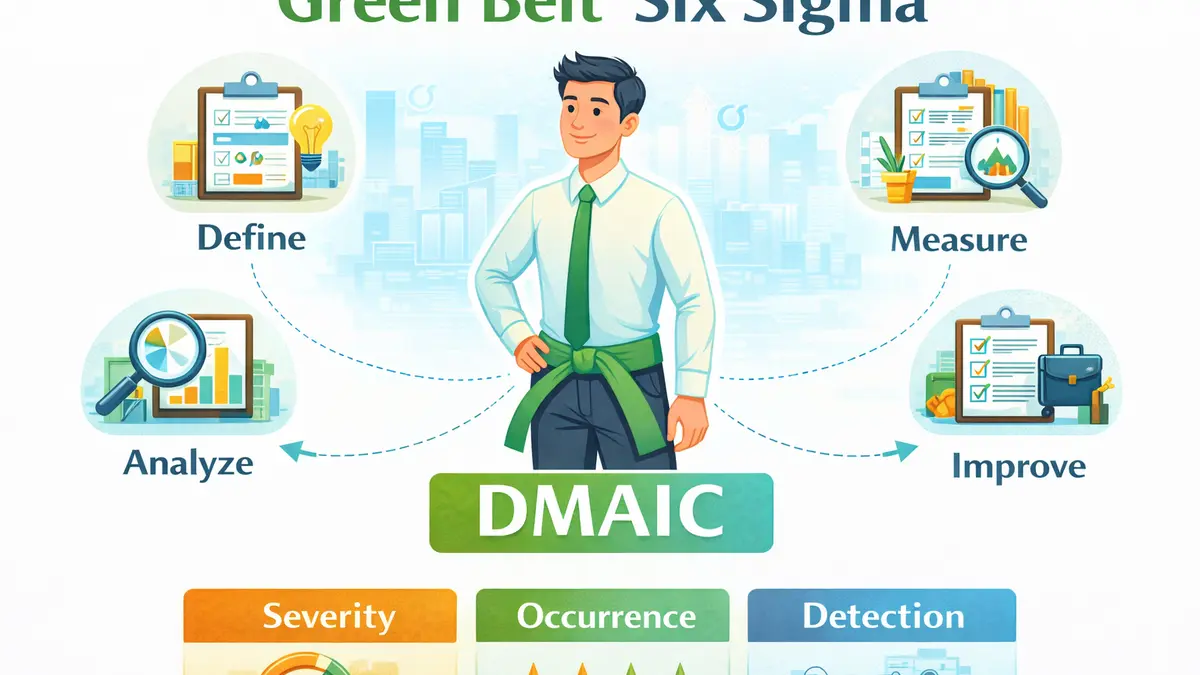
The DMAIC framework forms the backbone of Green Belt training and certification standards worldwide. DMAIC stands for Define, Measure, Analyze, Improve, and Control, and provides a disciplined roadmap for solving complex business problems. Rather than relying on intuition or quick fixes, DMAIC emphasizes data validation, root cause identification, solution testing, and sustainability planning. Each phase includes defined deliverables, quantitative metrics, and structured decision gates that ensure accountability and measurable outcomes. Mastery of DMAIC distinguishes Green Belt professionals as structured problem-solvers capable of delivering repeatable and scalable improvements.
Define Phase: Framing the Business Problem
The Define phase establishes project clarity and stakeholder alignment before any data collection begins. Green Belts develop a Project Charter outlining scope, financial impact, objectives, timeline, and risk considerations while ensuring alignment with business strategy. Tools such as the SIPOC diagram help map suppliers, inputs, processes, outputs, and customers at a high level to clarify system boundaries. This structured scoping prevents project drift and ensures resources focus on measurable value creation. Clear definition at the outset significantly increases project success rates and executive support.
Measure Phase: Establishing a Reliable Baseline
The Measure phase quantifies current process performance using validated data collection systems. Green Belts design measurement plans, verify data integrity, assess repeatability and reproducibility, and calculate key performance indicators such as defect rates, cycle time, yield, or cost per transaction. Establishing a baseline enables objective comparison after improvements are implemented. A precise quantitative example illustrates the importance of statistical rigor: a process operating at 3 sigma produces approximately 66,800 defects per million opportunities, highlighting substantial room for improvement. Reliable measurement prevents assumptions and ensures data-driven analysis.
Analyze Phase: Identifying Root Causes
During the Analyze phase, Green Belts apply statistical tools to determine the true drivers of process inefficiency or variation. Techniques may include Pareto analysis, hypothesis testing, regression analysis, correlation studies, or cause-and-effect diagrams. The objective is to isolate statistically significant variables rather than superficial symptoms. Rigorous root cause validation avoids costly implementation of ineffective solutions and strengthens project credibility. Analytical competence at this stage differentiates certified professionals from informal problem-solving approaches.
Improve Phase: Designing and Validating Solutions
The Improve phase focuses on generating, testing, and implementing corrective actions that eliminate validated root causes. Green Belts may conduct pilot programs, structured experiments, or design of experiments to confirm solution effectiveness before full-scale rollout. Proposed improvements must demonstrate measurable impact on defined KPIs and financial outcomes. Many Green Belt projects deliver cost reductions between 20% and 40% within targeted process areas, depending on baseline inefficiencies. Controlled implementation ensures practical feasibility and stakeholder buy-in.
Control Phase: Sustaining the Gains
The Control phase institutionalizes improvements and prevents regression to previous performance levels. Green Belts develop control plans, establish monitoring dashboards, and implement statistical process control charts with defined escalation thresholds. Ownership of ongoing performance monitoring transitions to operational teams to ensure sustainability. Failure to implement adequate control mechanisms represents one of the primary causes of long-term project underperformance. Sustained performance validation distinguishes Lean Six Sigma from short-term improvement initiatives.
Core Skills Developed Through Green Belt Certification
Green Belt certification builds a balanced combination of technical, analytical, and leadership capabilities that extend beyond basic process knowledge. Certified professionals gain confidence in statistical interpretation, structured project management, stakeholder communication, and change facilitation. They learn to translate executive objectives into measurable operational metrics and align cross-functional teams around improvement targets. This hybrid skillset explains why Green Belt certification often serves as a catalyst for career advancement in operations, supply chain, IT, finance, and healthcare sectors. In 2026, employers increasingly prioritize measurable performance improvement experience over purely theoretical qualifications.
- Statistical data analysis and hypothesis testing
- DMAIC project management expertise
- Process mapping and waste identification
- Root cause analysis and corrective action design
- Performance measurement and KPI monitoring
- Change management and stakeholder engagement
Green Belt Certification: Standards, Exams, and Requirements
Several internationally recognized organizations offer Green Belt Lean Six Sigma certification, each based on a defined Body of Knowledge. Certification exams typically consist of proctored multiple-choice assessments evaluating conceptual understanding and applied problem-solving capability. Candidates must achieve a minimum passing score defined by the certifying body, often within a timed testing environment. While some providers require documented project completion, others focus exclusively on examination performance. Choosing a reputable certification ensures global recognition and strengthens professional credibility.
Training Certificate vs Professional Certification
Distinguishing between a training certificate and a professional certification is essential when evaluating program options. A training certificate confirms course attendance or completion but does not necessarily validate standardized competence through independent assessment. A professional certification requires passing a structured examination aligned with a recognized Body of Knowledge and may include recertification requirements. Employers typically assign greater value to certifications backed by rigorous assessment standards. This distinction directly influences return on investment for candidates pursuing credential-based career advancement.
Selecting the Right Green Belt Project
The success of a Green Belt initiative depends heavily on selecting a project with meaningful business impact and accessible data. A suitable project addresses a measurable problem with defined scope, committed sponsorship, and realistic implementation timelines. Clear baseline metrics and improvement targets are critical to demonstrating value to leadership. In practice, Green Belt projects often target measurable improvements between 20% and 50% in cycle time, defect rates, or operational cost within a defined process segment. Strategic project selection enhances certification credibility and maximizes professional visibility within the organization.
Career Impact, Employability and Salary Outlook in 2026
Green Belt Lean Six Sigma certification strengthens professional positioning across diverse industries including manufacturing, logistics, healthcare, financial services, and digital operations. Employers value candidates capable of quantifying results and leading structured improvement initiatives that align with strategic objectives. In 2026, certified Green Belts frequently advance into roles such as Continuous Improvement Manager, Process Excellence Lead, Operations Project Manager, or Quality Analyst. Depending on region and experience, certification can contribute to salary increases ranging from 5% to 15% when combined with demonstrated project outcomes. Beyond compensation, the credential enhances professional credibility and long-term leadership potential.
Frequently Asked Questions About Green Belt Lean Six Sigma
How long does it take to earn a Green Belt certification?
Preparation timelines vary depending on training format, prior statistical knowledge, and project scope. Most structured programs span between 8 and 12 weeks, combining theoretical instruction with applied project execution. Intensive bootcamp models may shorten preparation time, but practical project validation remains critical for competence development. Thorough exam preparation and real-world application significantly increase certification success rates.
Is Green Belt certification internationally recognized?
Yes, provided the certification is issued by a reputable organization aligned with a standardized Body of Knowledge. Multinational companies recognize globally established credentials that emphasize methodological consistency and examination rigor. Demonstrating measurable project results further strengthens recognition beyond the certificate itself. Practical experience combined with formal certification maximizes global employability.
Can someone move directly from Yellow Belt to Black Belt?
Although technically possible, progressing directly from Yellow Belt to Black Belt is uncommon and challenging. The Green Belt level provides essential experience in managing structured DMAIC projects and applying statistical tools independently. Skipping this intermediate stage may limit practical exposure and confidence in complex transformation initiatives. Most professionals benefit from building foundational competence through Green Belt certification before advancing to Black Belt leadership roles.
Related Articles
- Six Sigma: Complete Methodology and Implementation Guide
- Lean Management in Services: Complete Guide
- PDCA Cycle: Plan-Do-Check-Act Complete Guide
Take the next step
Discover how LUCKiwi can transform your project management.