Project Constraints in 2026: Master Scope, Time, Cost, Quality, Resources, and Risk to Deliver Without Drift
Project constraints are the limits, requirements, and boundary conditions that shape what a project can realistically deliver and how it must be executed. In 2026, constraints matter more because organizations operate under tighter governance, faster market cycles, heavier compliance demands, and more complex delivery ecosystems that include vendors, cloud platforms, and cross-functional dependencies. Recent 2026 benchmark reporting indicates that only about 31% of IT projects achieve the classic “on time, on budget, on scope” outcome, while a large share remain “challenged,” which shows why constraint management cannot rely on optimism or informal alignment. A practical constraint strategy does not try to “defeat” limitations; it makes them explicit, ranks them by business impact, and turns trade-offs into decisions that stakeholders own. When teams treat constraints as first-class inputs, they reduce surprises, protect value, and increase delivery credibility without inflating process overhead.
What project constraints are and why they determine real project performance
A constraint is not just a problem to solve; it is a condition that limits the space of feasible options and forces prioritization. A contract cap, a regulatory deadline, a fixed budget, limited expert capacity, a mandatory technology choice, or a non-negotiable quality threshold all constrain design and execution. Constraints determine the “shape” of the project by influencing architecture decisions, staffing plans, sequencing, test strategies, and governance cadence. Many visible failures—late delivery, cost overruns, unstable releases—trace back to constraints that were assumed rather than clarified, or to constraints that were declared “flexible” but treated as “fixed” in day-to-day decisions. A mature approach makes constraints measurable and auditable, so the project can adapt intentionally instead of drifting reactively. That maturity usually separates projects that recover early from projects that collapse late.
Constraints also behave like a system because they are interdependent, and a change in one dimension often forces change elsewhere. When you compress the schedule without reducing scope or increasing capacity, you typically raise integration pressure, defect rates, rework volume, and ultimately total cost. When you cut costs without changing scope or time, you often reduce quality buffers, testing depth, or expert availability, which increases the probability of incidents and delays. On large initiatives, the consequences of implicit trade-offs can be extreme, and that is why governance frameworks emphasize explicit decision-making rather than silent compromises. A frequently cited quantitative signal from megaproject analysis is the magnitude of drift in complex delivery environments, with average cost overruns around 80% and schedule overruns around 50% in some portfolios, which illustrates how quickly unmanaged constraints escalate. A constraint-first operating rhythm reduces that escalation by forcing clarity early, when change is cheaper.
Constraints vs. risks vs. dependencies: the clarity that prevents governance mistakes
Many teams lose weeks because they confuse constraints, risks, and dependencies, then apply the wrong tool to the wrong issue. A constraint already exists and limits what you can do, such as a maximum budget, a mandated go-live date, a security standard, or a limited availability of a specific expert role. A risk is uncertain and may or may not occur, and it must be assessed via probability, impact, triggers, and response plans rather than negotiated as a fixed boundary. A dependency is a relationship to another delivery element, such as a vendor release, an API availability, a committee approval, or a shared environment window, and it must be managed with commitments, dates, and contingency paths. When you treat a constraint like a risk, you “hope it won’t happen” even though it already defines reality. When you treat a risk like a constraint, you freeze options prematurely and inflate cost without improving outcomes.
The classic model: the triple constraint and why it is still useful (and insufficient)
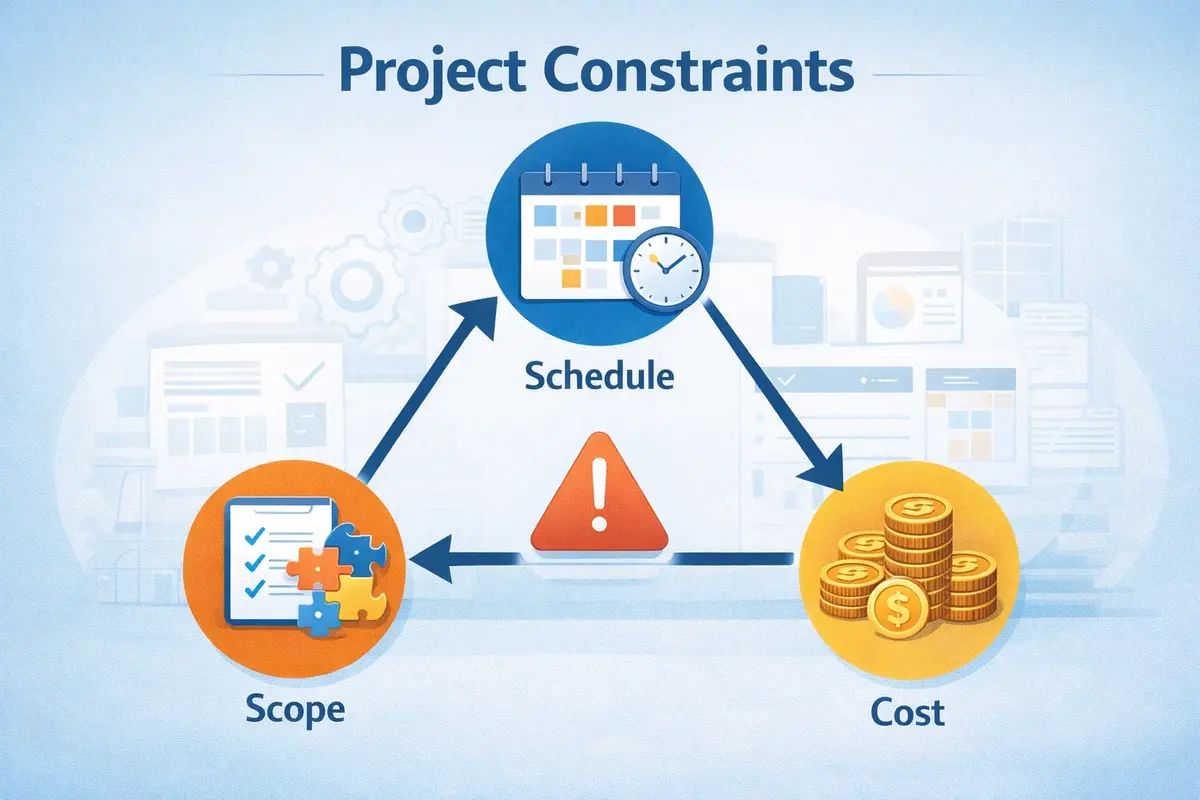
The most recognized framework for project constraints is the triple constraint, often visualized as the “iron triangle” of scope, time, and cost. It remains useful because it gives stakeholders a shared language for trade-offs, especially in steering committees where detailed technical debates stall decisions. The triangle helps teams surface a basic truth: if two corners are fixed, the third must move, or the project will absorb the conflict as quality erosion, burnout, and unplanned rework. The limitation appears when organizations use the triple constraint as the only definition of success, because “on time and on budget” can still mean “low adoption, high incidents, weak value realization.” In 2026, many competitive articles expand the model precisely because modern delivery environments require visibility into quality, capacity, risk tolerance, and benefits. The triangle is a good starting map, but it is not the whole territory.
Scope as a constraint: why scope clarity prevents the most common form of drift
Scope becomes a constraint when deliverables are contractually or strategically required, or when regulatory outcomes demand specific features and controls. In practice, scope causes drift through ambiguity and accumulation, because small “harmless” requests compound into complexity that breaks schedule and budget assumptions. Scope problems rarely look dramatic at first; they show up as repeated rework, unclear acceptance criteria, and endless alignment meetings that burn time without producing progress. Strong scope management makes scope observable by defining outputs, acceptance criteria, exclusions, and a change control rule that links every request to its cost, schedule, resource, quality, and risk impact. That discipline does not block innovation; it forces prioritization and protects the minimum viable value. When scope is explicit and measurable, stakeholder conversations become decisions rather than negotiations that repeat every week.
Time as a constraint: why deadlines are rarely solved by speed alone
Time turns into a hard constraint when a project faces legal compliance dates, market windows, seasonal campaigns, platform end-of-support events, or synchronized releases with external partners. Under pressure, teams often try to “buy time” by adding people or parallelizing tasks, but coordination overhead rises and the gain quickly saturates in complex systems. High-performing teams manage time by building proof-based milestones, protecting buffers, and reducing decision latency, not by pretending that the plan can be compressed indefinitely. The fastest projects are often the ones that decide early on irreversible choices, such as architectural boundaries, vendor commitments, and scope partitions, because late decisions create cascading rework. Effective time management also depends on dependency realism, because the critical path is often controlled by external approvals, environment readiness, and integration gates rather than internal effort. When time is the primary constraint, you typically must make scope flexible or invest more cost and capacity intentionally, not accidentally.
Cost as a constraint: why budgets reflect design choices, not just accounting limits
Cost is not only a spending cap; it is a reflection of solution complexity, delivery approach, testing depth, compliance posture, and long-term operations. When the budget is fixed, you cannot keep all other variables fixed without creating hidden trade-offs that will later appear as technical debt, production incidents, and reputation damage. Cost overruns often come from optimistic estimates, under-scoped integration work, underestimated change management, and late discovery of constraints that require expensive redesign. Strong cost control uses explicit assumptions, phased funding, contingency reserves, and a clear separation between “build cost” and “run cost.” In 2026, cloud and licensing models make recurring costs more visible, and projects that ignore total cost of ownership can meet the build budget but fail financially within twelve months. Cost discipline becomes stronger when it is paired with value-based prioritization, so spending aligns with outcomes rather than activity volume.
Beyond the triangle in 2026: why modern constraint models are multi-dimensional
Competitive content increasingly treats the triple constraint as necessary but not sufficient, because projects can satisfy scope, time, and cost while still failing on usability, security, adoption, or maintainability. In 2026, organizations face constraints linked to cybersecurity requirements, data governance, vendor lock-in risk, platform reliability, and talent scarcity, which makes a three-variable view too narrow for steering decisions. Expanded models commonly add quality, resources, and risk, and some add benefits or value as the ultimate constraint that redefines success. This evolution mirrors real executive concerns, because sponsors want to know not only whether the project will “ship,” but whether it will produce measurable outcomes without unacceptable exposure. The 2026 benchmark signal that only 31% of IT projects reach the classic triple-constraint success standard reinforces why governance must see the full constraint landscape rather than a simplified triangle. A multi-constraint framework makes trade-offs explicit earlier, when they can still be managed proactively.
Quality as a constraint: the difference between controlled outcomes and silent erosion
Quality becomes a constraint when failure is costly, such as in security, performance, reliability, safety, or compliance-heavy environments. Many projects treat quality as an adjustable variable that gets sacrificed when schedule pressure rises, but that approach rarely stays contained; it converts short-term speed into long-term slowdown through incidents and rework. A quality constraint becomes manageable when teams define “done” with enforceable criteria, including testing gates, performance thresholds, security checks, documentation essentials, and monitoring readiness. This does not require perfection; it requires a standard aligned to risk and user expectations, plus explicit decisions when exceptions are necessary. When quality is explicit, stakeholders can choose conscious compromises with time-bounded remediation plans, instead of accepting hidden debt that later explodes into outages. In practice, elevating quality to constraint status improves predictability because it prevents the project from “shipping unfinished work” that looks complete on paper but fails in reality.
Resources as a constraint: capacity, skills, and availability as the real bottleneck
Resources constrain projects through a combination of capacity, skill scarcity, and calendar availability, and these constraints often dominate modern delivery more than budget does. Even with funding, you cannot instantly acquire the right expertise in architecture, cybersecurity, data engineering, platform operations, or complex domain knowledge, especially when multiple initiatives compete for the same talent pool. Overloading key people creates hidden delays via context switching, coordination overhead, and reduced decision quality, and it increases turnover risk, which amplifies knowledge loss and rework. Mature organizations use capacity planning, explicit staffing commitments, and work-in-progress limits to prevent “everything is top priority” scenarios that stall delivery. When resource constraints are dominant, the correct response is usually to reduce scope, resequence deliverables, or simplify the solution, not to demand more output from the same constrained experts. Treating resource scarcity as a first-class constraint improves credibility because it aligns plans with human reality.
Risk as a constraint: tolerance levels that define what is acceptable to ship
Risk acts as a constraint when an organization’s tolerance is low or when compliance and safety requirements impose strict controls. In such contexts, not all options are permissible, and certain controls must exist before production release, which directly shapes scope, timeline, and cost. Risk-driven constraints commonly include security baselines, privacy requirements, audit readiness, continuity plans, vendor due diligence, and segregation of duties, and these are often non-negotiable once a project is in motion. The most practical way to manage risk constraints is to define thresholds and triggers that convert abstract concerns into operational decisions, such as “no production launch without penetration test sign-off” or “no customer data processing without encryption and retention controls.” In 2026, projects that incorporate AI components often add risk constraints around data provenance, bias management, model monitoring, and usage rights, which can block go-live even when prototypes appear successful. When risk constraints are explicit, sponsors can approve trade-offs knowingly rather than discovering late-stage blockers.
Benefits and value as constraints: redefining success beyond delivery mechanics
Some modern models add benefits or value as a constraint because delivery mechanics alone do not guarantee meaningful outcomes. A project that ships on time and on budget can still fail if adoption is low, if the solution does not solve the business problem, or if it creates operational burdens that erase its benefits. Value constraints force teams to define outcome metrics early, such as cycle time reduction, conversion uplift, compliance coverage, customer satisfaction, or measurable cost savings. This shifts decision-making from “did we build it?” to “did we change the business in the intended way?” and it often clarifies scope trade-offs by identifying features that add little value relative to cost and risk. Value constraints also support phased delivery, because incremental outcomes validate direction and reduce the chance of investing heavily in the wrong solution. In stakeholder communication, value framing increases buy-in because it speaks the language of impact rather than the language of tasks.
A practical constraint taxonomy: internal vs external, hard vs soft, fixed vs flexible
A clear taxonomy helps teams avoid treating every constraint as equally rigid, which is a common source of unrealistic planning. Internal constraints originate inside the organization, such as budget allocation rules, staffing policies, architecture standards, security baselines, tooling mandates, or governance calendars. External constraints come from the environment, including regulation, customer contracts, vendor dependencies, market deadlines, or partner release windows, and they typically require formal negotiation to change. This distinction matters because internal constraints can sometimes be adjusted by portfolio decisions, while external constraints demand contractual or regulatory pathways that take time. In 2026, multi-vendor ecosystems and platform dependencies increase the volume of external constraints, making early mapping essential. A constraint taxonomy also improves stakeholder alignment because it provides a shared language for “what we can change,” “what we can influence,” and “what we must accept.” When teams combine taxonomy with ownership and decision rights, constraint management becomes a repeatable capability rather than heroic improvisation.
Hard constraints vs soft constraints: the fast way to separate non-negotiables from preferences
Hard constraints cannot be violated without major consequences, such as legal exposure, safety failures, severe reputational damage, or contractual penalties. Soft constraints reflect preferences or stretch goals, like “ideally before quarter end,” “target budget,” or “preferred technology,” and they should be optimized without being treated as inviolable. Many projects fail because stakeholders implicitly treat soft constraints as hard ones, which forces impossible plans that collapse into late-stage compromises. A robust approach labels each constraint as hard, soft, or conditional, and documents the cost of violation in business terms, such as revenue loss, compliance exposure, or operational disruption. That documentation transforms debates into choices, because it shows the real price of “must-have” claims. When soft constraints are clearly labeled, teams gain room to design realistic delivery paths that still respect strategic intent without promising the impossible.
Fixed vs flexible constraints: the rule that prevents mathematically impossible plans
Every project benefits from naming what is fixed and what is flexible, because “everything is fixed” produces drift by definition. If the date is fixed, you must make scope, budget, or solution approach flexible, or quality will be sacrificed silently as the project tries to reconcile conflicting demands. If budget is fixed, you must prioritize value delivery, phase scope, and simplify design so you can deliver meaningful outcomes within the cap. If quality and compliance are fixed, you must allow time and cost flexibility to implement necessary controls and testing, or you will delay go-live anyway when audit gates block release. In many environments, the most realistic strategy is to fix one primary constraint and keep two secondary constraints within guarded ranges, using staged decision points to recalibrate. In 2026, this discipline becomes a governance advantage because it reduces late surprise and protects sponsor credibility. Clear fixed-flexible decisions also improve team morale because expectations align with reality.
How to identify constraints early: methods, artifacts, and questions that expose hidden limits
Constraint discovery should be a structured activity, not a casual brainstorming session, because the most damaging constraints often hide in contracts, policies, integration assumptions, and stakeholder decision processes. A strong approach combines stakeholder interviews, document review (contracts, regulations, architecture standards), dependency mapping, and validation of assumptions that usually remain implicit. The goal is not to create a long list; it is to identify constraints that can break the project if discovered late, such as mandatory security approvals, data residency requirements, licensing limits, or vendor lead times. Early discovery improves planning realism and reduces rework because teams can shape design and sequencing around constraints rather than colliding with them. In complex programs, discovery also includes organizational constraints like change windows, training capacity, and operational readiness requirements that influence go-live feasibility. When constraints are uncovered early, teams can negotiate, phase, or re-scope before sunk costs lock them in.
The Constraint Log: a lightweight artifact that prevents recurring misunderstandings
A constraint log is a concise, living register that documents each constraint with ownership, type, origin, rigidity level, impacted deliverables, and the point in time when it becomes binding. It works because it turns vague statements into auditable facts that can be referenced in every steering conversation, reducing repetitive debates and “surprise” escalation. Each entry should answer five practical questions: who imposes it, how negotiable it is, what the business cost of violation is, what work items it affects, and when it will constrain decisions or delivery steps. In governance, the constraint log complements RAID logs by focusing on boundaries rather than uncertainties, which helps teams choose the right response mechanism. When change requests appear, the constraint log becomes a decision accelerator because it shows instantly which constraints are impacted and what trade-off options exist. Keeping the log short and decision-focused is critical, because verbosity reduces usage and defeats the purpose.
Discovery questions that reliably expose constraint blind spots
Constraint discovery improves when you ask decision-oriented questions that force specificity instead of generalities. Ask which date has legal, contractual, or revenue consequences if missed, and which acceptance criteria must be satisfied for stakeholders to consider the project successful. Clarify what scope is mandatory for compliance and what scope is optional for convenience, because that separation defines where flexibility exists. Validate capacity with concrete commitments by role, including how many hours key experts can truly allocate and which periods are blocked by other initiatives. Map integration and release constraints by asking which external systems, vendors, or committees can block progress, and what their lead times and approval requirements are. Finally, ask about decision constraints: who must approve architecture, procurement, or production readiness, and what turnaround time is realistic, because slow decisions become a time constraint as powerful as any schedule. These questions convert uncertainty into actionable constraints, which prevents late-stage “we didn’t know” surprises.
Prioritization and trade-offs: turning constraints into fast, owned decisions
You do not manage constraints with control alone; you manage them with prioritization and explicit trade-off decisions. When stakeholders declare multiple constraints as simultaneously non-negotiable, they remove the degrees of freedom necessary for a project to succeed, and the conflict reappears later as silent quality degradation and team burnout. High-performing teams identify the dominant constraint by estimating the business cost of violating each constraint, then align scope sequencing, staffing, and governance around that choice. This is also where bottleneck thinking becomes practical: if a rare capability or a fixed deadline controls feasibility, you protect that bottleneck and optimize everything else around it. Decision-making becomes easier when teams present a small set of scenarios with clear impacts rather than a long list of options, because leaders can compare trade-offs quickly. In 2026, the strongest constraint management practices emphasize decision latency, because slow decisions are a hidden constraint that magnifies all others. Faster, documented trade-offs produce better outcomes than perfect plans that arrive too late.
The trade-off matrix: a steering tool that makes compromises visible and defensible
A trade-off matrix compares two or three feasible options across a fixed set of criteria: expected value, delivery time, delivery cost, risk exposure, technical debt, and operational impact. It removes emotional debate by converting preferences into explicit comparisons that stakeholders can understand and defend, even when the outcome requires concessions. Each option should include a defined scope set, a target date, a cost envelope, and an expected quality posture, along with the consequences of choosing that option. This format increases stakeholder alignment because it makes the costs of “more scope” or “faster delivery” concrete rather than abstract. The matrix only works if assumptions are visible and if the team updates it when constraints change, because stale comparisons become misleading quickly. When used consistently, the trade-off matrix becomes a conversion asset internally by building trust, reducing last-minute escalations, and showing that decisions are grounded in evidence rather than optimism.
The six operational constraints: a compact framework that matches 2026 delivery reality
A practical 2026-ready framework often uses six constraints: scope, time, cost, quality, resources, and risk. This model works because it prevents hidden compromises, particularly on quality and capacity, which are commonly sacrificed under schedule pressure yet later cause cost spikes and delays. It also fits executive conversations because it maps directly to what sponsors care about: what will we deliver, when, at what cost, with what assurance level, using what capacity, and with what exposure. The 2026 benchmark statistic of about 31% triple-constraint success in IT reinforces that leaders need a broader view to steer projects realistically. The goal is not to add bureaucracy; it is to ensure that every major decision considers the constraints that actually determine outcomes. When teams use this framework consistently, they improve predictability because they stop managing only what is easy to measure and start managing what is actually limiting delivery.
- Scope: deliverables, requirements, exclusions, and change rules tied to measurable acceptance criteria.
- Time: deadlines, proof-based milestones, dependencies, buffers, and release windows.
- Cost: total budget, contingency reserves, procurement constraints, and build vs run cost visibility.
- Quality: definition of done, test strategy, performance thresholds, and non-negotiable compliance controls.
- Resources: capacity, scarce skills, availability commitments, and coordination limits that shape feasible plans.
- Risk: tolerance thresholds, triggers, mitigation actions, vendor exposure, and governance gates for release readiness.
Managing each constraint with practical levers that hold up under pressure
Constraint management becomes real when each constraint has concrete levers, early-warning indicators, and clear decision rights. A useful approach is to treat constraints like a control system: you define a target range, measure drift with leading indicators, and apply corrective actions before failure becomes inevitable. This avoids heavy reporting by focusing on a small set of signals that predict trouble, such as rising change volume, missed integration milestones, growing defect density, or shrinking capacity in critical roles. In 2026, teams also benefit from making operational readiness part of constraint control, because the distance between “feature complete” and “safe to operate” can be large in modern platforms. Practical constraint management also depends on decision speed, since unresolved trade-offs accumulate and turn into schedule and cost drift that no amount of effort can later recover. When a constraint is threatened, the team should not simply report it; the team should propose options and request a decision with explicit consequences. This is what converts governance into delivery advantage rather than overhead.
Scope control: define outcomes, partition delivery, and enforce change discipline
To manage scope as a constraint, start by structuring deliverables into small, testable units with explicit acceptance criteria and clear exclusions. A well-formed backlog or work breakdown structure prevents hidden expansion because everyone can see what is included, what is optional, and what is out of scope. Scope change should not be blocked by default; it should trigger a trade-off discussion where stakeholders decide what to add, what to remove, and what to shift in time, cost, or quality posture. Prioritization methods like MoSCoW or value-based scoring help teams protect essential outcomes while deferring low-value items that create disproportionate complexity. A leading indicator for scope risk is the rate and size of change requests, especially when they appear late in the schedule or after architecture decisions harden. When time is fixed, scope must remain intentionally flexible, and the change process should make that logic explicit rather than leaving the team to absorb it as overtime and rework.
Time control: proof-based milestones, dependency realism, and protected buffers
To manage time constraints, replace activity-based milestones with proof-based milestones that demonstrate real progress, such as successful integration tests, validated performance, completed security checks, or user acceptance sign-off. This reduces the illusion of progress that occurs when teams report tasks completed but still cannot ship a working increment. Dependencies must be treated as schedule constraints with owners, commitments, and contingency paths, because external blockers often dominate critical paths in modern systems. Buffers should be explicit and protected by governance rather than hidden inside tasks, because hidden buffers are quickly consumed without anyone noticing. In complex programs, critical path or critical chain thinking helps teams focus on the true bottlenecks, especially when scarce resources or integration gates control throughput. Decision latency is also a time driver, so a weekly decision rhythm that resolves blockers quickly can protect the schedule more effectively than detailed replanning. When time is threatened, the best recovery options usually involve scope partitioning and sequencing rather than unrealistic acceleration promises.
Cost control: assumptions, phased funding, contingencies, and total cost of ownership
To manage cost constraints, make estimation assumptions explicit and tie spending to value checkpoints so the project can stop, pivot, or re-scope without catastrophic waste. Phased funding supports better decisions because it avoids committing full budget before validating the hardest unknowns, such as integration feasibility, security constraints, or data readiness. Contingency reserves should be visible, with clear rules for usage and replenishment, because hidden buffers destroy trust while absent buffers create brittle plans. Cost control also improves when you separate build cost from run cost, since operational expenses in cloud and licensing models can exceed development costs over time. In 2026, ignoring recurring costs such as infrastructure consumption, observability tooling, and inference or data pipeline expenses can create financial failure even when delivery meets its build budget. A useful early signal for cost drift is variance by work package combined with rising rework, because rework is a strong predictor of future spend. When the budget is fixed, prioritization must tighten, and the team should use value-based sequencing to ensure that what is funded delivers outcomes rather than partially completed work.
Quality control: definition of done, test strategy, and technical debt governance
To manage quality as a constraint, define “done” in a way that prevents the project from declaring victory before the product is safe, stable, and operable. That definition should include appropriate testing levels, security checks, documentation minimums, monitoring readiness, and performance thresholds aligned with user expectations and risk. Technical debt must be governed as a constraint because debt is not free speed; it is deferred work that slows future delivery, increases incident risk, and inflates total cost. Quality control benefits from simple leading indicators such as defect density in critical components, rework volume, incident counts in pre-production, and flakiness in automated tests. When schedule pressure rises, leaders should not demand quality cuts implicitly; they should decide explicitly whether to reduce scope, invest more time, or accept a bounded quality compromise with a remediation plan. A disciplined quality stance improves predictability because fewer late surprises occur during stabilization, compliance checks, and go-live. Quality becomes a delivery accelerator when it reduces rework and creates confidence in incremental release cycles.
Resource control: capacity planning, focus protection, and continuity of expertise
To manage resources effectively, treat capacity and skill availability as hard inputs to planning, not as variables you can adjust by willpower. Teams slow down when key roles are fragmented across initiatives because context switching increases coordination costs and reduces decision quality, even when total allocated hours look sufficient. Capacity planning should focus on critical roles, peak periods, and dependency-driven workloads such as integration, security reviews, and operational readiness activities. Work-in-progress limits protect throughput by preventing the organization from starting too many items at once, which is a common cause of “everything is delayed” outcomes. Continuity matters as much as headcount, so teams should include minimal knowledge transfer mechanisms, such as pairing, documented decisions, and backup ownership for critical components. When a scarce expert is the bottleneck, the correct optimization is often to simplify architecture or reduce scope rather than to overload that expert. Resource constraints become easier to manage when leaders make trade-offs at the portfolio level rather than pushing the cost onto delivery teams as overtime.
Risk control: living registers, thresholds, and early validation of critical assumptions
To manage risk constraints, use a living register that includes triggers, indicators, and concrete response actions rather than vague descriptions. Risk control improves when the organization defines tolerance thresholds that translate into operational release conditions, such as security sign-offs, data governance requirements, or continuity controls. Early validation is the most effective mitigation for high-uncertainty areas, because a short experiment or proof can replace assumption-driven planning with evidence-driven decisions. Vendor risks should be treated explicitly through lead-time validation, contract clarity, service-level commitments, and contingency plans, especially when external platforms control your delivery timeline. In 2026, AI-related risks often require specific controls around data provenance, monitoring, and governance, and these controls should be treated as constraints that shape scope and schedule from the start. A top-five risk focus is usually more actionable than a long risk list, because it forces prioritization and decision-making. When risks trend upward, the team should not only report; it should propose trade-offs that reduce exposure while protecting the dominant constraint.
Featured snippet readiness: a definition, a short list, and a decision rule
To answer the core query fast and clearly, define project constraints as “the non-negotiable limits and priority conditions that bound a project and force trade-offs among scope, time, cost, quality, resources, and risk.” Then add a simple rule that prevents impossible plans: “if two constraints are fixed, the third must become flexible, or the conflict will show up as quality loss, burnout, and rework.” A short list improves clarity by naming the constraints most teams need in 2026, which includes scope, time, cost, quality, resources, and risk, with value sometimes treated as the ultimate success constraint. This structure matches user intent because it provides immediate operational guidance rather than abstract theory. A 2026 benchmark signal that only about 31% of IT projects reach the classic on-time, on-budget, on-scope standard supports the case for broader constraint visibility. When your content gives a definitional statement, a compact list, and a decision rule, it becomes easy to extract, which is exactly what snippet selection tends to favor.
How constraints show up across project types: patterns that help you diagnose the dominant constraint
Constraints behave differently by project context, and understanding those patterns helps teams identify the dominant constraint rather than guessing. In software delivery, the most dangerous constraints often involve scope ambiguity and quality standards, because user-facing systems expose defects quickly and operational load punishes unstable releases. In construction or infrastructure projects, time constraints can be shaped by permits, environmental conditions, and subcontractor lead times, while cost constraints are exposed to material price variability and logistical delays. In marketing launches, time is frequently the fixed constraint because campaigns depend on calendar windows, so scope and channel mix must remain flexible to protect the date. In transformation programs, resource constraints and adoption capacity often dominate, because organizational change throughput limits how quickly new processes can take hold. Across all contexts, dependencies and decision latency can become hidden constraints that sit behind visible ones, especially when governance requires approvals or shared platforms create release bottlenecks. Diagnosing the dominant constraint early improves strategy because it tells you which lever actually controls feasibility.
A precise quantitative scenario: scope vs time trade-off in a multi-site rollout
Consider a rollout across 12 sites with a fixed compliance deadline, where each site introduces local variants in processes, integrations, and training requirements. If the program insists on deploying the full feature set to all 12 sites in one wave, the time constraint collides with quality and operational readiness constraints, because integration testing, training, and cutover rehearsal cannot scale linearly. A more resilient approach is to deploy a standardized core to 8 sites by the deadline and stage the remaining 4 sites into subsequent waves, prioritizing based on risk, dependency readiness, and business criticality. This choice makes scope flexible while protecting the fixed time constraint and maintaining quality thresholds that prevent production incidents. The trade-off becomes credible when the program documents what is deferred, what is guaranteed, and how value is preserved through incremental go-lives. Stakeholders accept the compromise more readily when the decision is framed as risk reduction and compliance assurance rather than as “cutting scope.” This kind of scenario helps teams apply constraint thinking in real governance settings.
Constraint-driven governance that converts stakeholders: alignment, decisions, and accountability
Governance becomes an advantage when it accelerates decisions and protects delivery flow, and constraint management is the fastest path to that outcome. The first step is to formalize the primary fixed constraint in sponsor language, such as “date is fixed due to regulation” or “quality threshold is fixed due to safety and security exposure.” The second step is to institutionalize scenario-based decision-making, where each escalation includes two or three options with quantified impacts, not just status reporting. The third step is to align incentives and metrics so that teams are not punished for making the trade-offs governance requested, because mismatched incentives drive hidden compromises. Constraint-driven governance also clarifies decision rights by naming who can change scope, who can approve budget movements, and who can accept risk exceptions, which reduces waiting time and protects the schedule. In 2026, many delivery failures come from slow decisions rather than slow execution, so reducing decision latency becomes a constraint strategy in itself. When stakeholders see constraints clearly, they make fewer contradictory requests, and delivery becomes more predictable and more trustable.
A minimal dashboard: leading indicators that reveal constraint drift early
A strong project constraints dashboard is short, predictive, and action-oriented, because long reporting packs information but rarely enables decisions. For scope, track change request volume, late additions, and rework rate, because these are early signs of scope instability that will expand time and cost. For time, track proof-based milestone completion and dependency slippage, because the critical path often moves due to integration gates and external approvals. For cost, track burn rate by work package and variance against estimates, especially when variance correlates with rework, because rework is a strong predictor of future overrun. For quality, track critical defects and incident trends in pre-production, because they signal debt that will slow stabilization and threaten release readiness. For resources, track capacity in critical roles and fragmentation across initiatives, because bottlenecks often sit in small expert groups rather than broad delivery teams. For risk, track top-five risks with triggers and owners, because prioritization forces mitigation decisions instead of passive documentation.
Mini SEO FAQ: project constraints (high-intent questions with operational answers)
What are the main project constraints in project management?
The main project constraints are typically scope, time, and cost, and many 2026-ready approaches extend that set to include quality, resources, and risk. The expanded set matters because a project can satisfy the classic triangle while still failing on adoption, stability, compliance, or operational sustainability. The 2026 benchmark indicator that only about 31% of IT projects achieve the classic “on time, on budget, on scope” target supports the practical need to manage more than three constraints. In day-to-day governance, the best approach is to identify which constraint is fixed, then treat the remaining constraints as flexible levers with explicit trade-offs. This turns constraint management into a decision system rather than a reporting exercise.
How do you decide which constraint is most important on a project?
You choose the dominant constraint by comparing the business cost of violation across constraints, not by asking stakeholders for preferences in the abstract. A deadline becomes dominant when missing it causes regulatory exposure, contractual penalties, lost revenue windows, or customer trust damage that exceeds the cost of adjusting scope or budget. A budget becomes dominant when the organization cannot fund overruns without canceling other initiatives, or when profitability requires strict caps. Quality becomes dominant when defects could create safety incidents, security breaches, legal exposure, or severe reputation damage. Resource availability becomes dominant when a scarce expert capability controls feasibility and cannot be replaced quickly, making capacity the true bottleneck. Once chosen, the dominant constraint should be written, sponsored, and used as the decision rule that drives scope sequencing and governance trade-offs.
What is the difference between a constraint and a risk in a project?
A constraint is a boundary condition that already exists and limits options, such as a budget ceiling, a mandated go-live date, a security standard, or a fixed technology requirement. A risk is an uncertain event that may occur and impact outcomes, such as vendor delays, unexpected performance issues, or a key expert becoming unavailable. The difference matters because constraints are managed through negotiation, prioritization, sequencing, and solution design, while risks are managed through probability-impact assessment, mitigation actions, and contingency planning. Treating constraints like risks leads to passive behavior and late surprises, because teams “monitor” what should have been accepted and planned around from day one. Treating risks like constraints leads to unnecessary rigidity and inflated cost, because teams lock in controls for events that may never happen. Clear labeling keeps governance and delivery actions aligned with the actual nature of the issue.
How do you prevent scope creep when both time and budget are tight?
You prevent scope creep by making change decision-driven rather than informal, so every addition triggers an explicit trade-off instead of silently expanding work. Start by defining acceptance criteria and exclusions clearly, because ambiguity creates openings for “small” additions that accumulate into major drift. Use strict prioritization, such as Must/Should/Could, and enforce a rule that any new scope must come with a removal or deferral of equivalent effort when time and budget are fixed. Deliver in increments so stakeholders see real progress and understand the impact of late changes, which reduces the temptation to keep adding features before anything is usable. Track leading indicators like late change volume and rework, because they signal scope instability early enough to correct. When you combine change discipline with incremental value delivery, you protect the project’s essential outcomes without denying stakeholders the ability to adapt responsibly.