Scrum Master: Role, Skills, Salary and How to Become an Agile Expert in 2026

The Scrum Master holds a strategic position at the heart of modern agile organizations, where speed of delivery, continuous adaptation, and value creation determine competitiveness. In 2026, companies no longer look for someone who simply facilitates Scrum ceremonies, but for a true performance enabler capable of sustainably improving team effectiveness. According to the 2026 State of Agile report, more than 71% of organizations have increased their investment in Agile roles, including Scrum Masters, to accelerate delivery cycles and improve customer satisfaction. This role extends far beyond meeting facilitation: it structures the working environment, removes obstacles, strengthens autonomy, and drives continuous improvement. Understanding exactly what a Scrum Master is, what responsibilities the role includes, how it differs from a project manager, and what career opportunities it offers is essential for both professionals and organizations seeking operational excellence.
Official Definition of the Scrum Master and the Scrum Framework
The Scrum Master is accountable for the effective implementation of Scrum within a Scrum Team, which also includes a Product Owner and Developers. The Scrum Guide, authored by Ken Schwaber and Jeff Sutherland, defines the Scrum Master as responsible for establishing Scrum as defined in the guide. The Scrum Master does not manage the team in a hierarchical sense but operates as a servant leader who supports team effectiveness. The core mission is to strengthen transparency, inspection, and adaptation, which are the three pillars of empirical process control. This positioning fundamentally distinguishes the Scrum Master from traditional management roles focused on command and control.
The Three Areas of Service of a Scrum Master
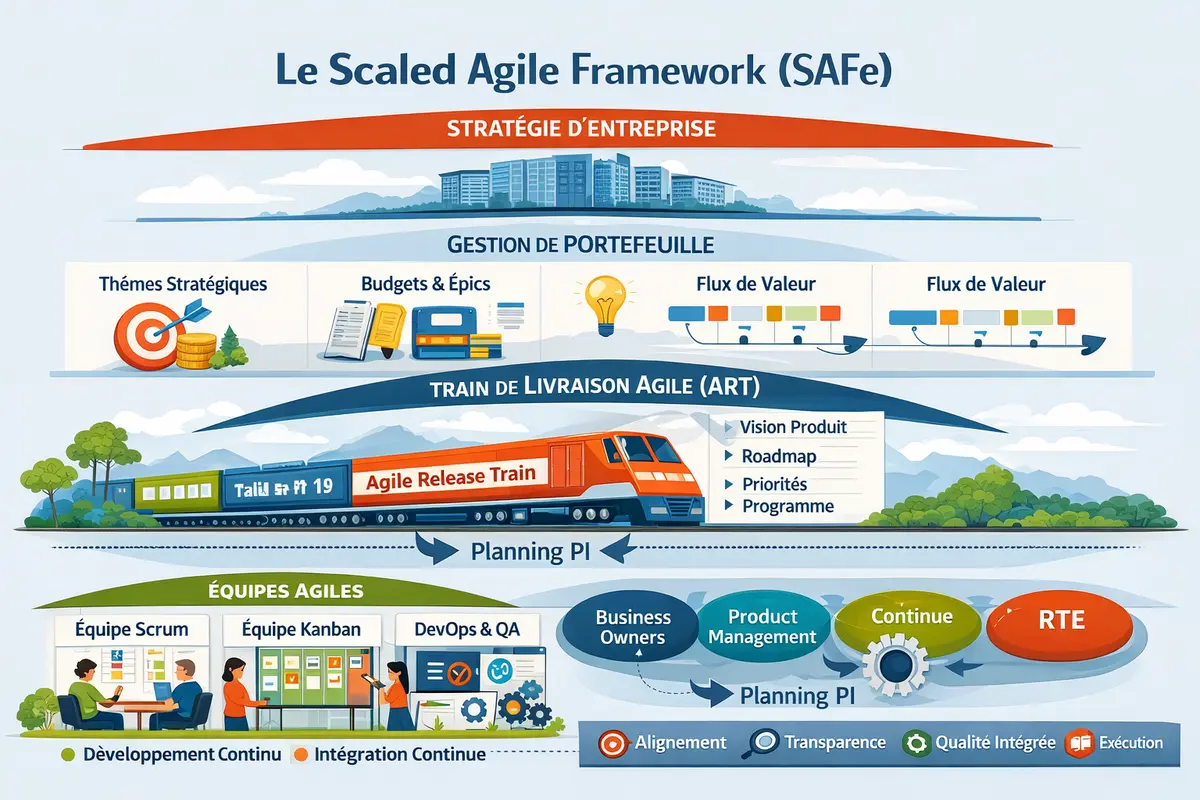
The Scrum Master serves the team, the Product Owner, and the organization simultaneously, which defines the systemic nature of the role. When serving the team, the Scrum Master facilitates collaboration, removes impediments, and protects the Sprint from external disruptions that could threaten the Sprint Goal. When serving the Product Owner, the Scrum Master supports Product Backlog refinement, clarifies the Product Goal, and strengthens stakeholder collaboration. At the organizational level, the Scrum Master promotes agile adoption, coaches leaders in empirical thinking, and helps remove systemic barriers that slow value delivery. This triple accountability requires influence, diplomacy, and a deep understanding of organizational dynamics.
Core Responsibilities of a Scrum Master in Daily Practice
Working on a similar project?
In practical terms, the Scrum Master structures and safeguards the entire Sprint cycle. The role ensures that Scrum events are properly timeboxed, outcome-oriented, and focused on value creation rather than ritual compliance. The Scrum Master identifies dependencies, supports conflict resolution, and ensures continuous improvement through effective retrospectives. The position also involves diagnosing team dysfunctions, clarifying responsibilities, and reducing interruptions that affect productivity. The true impact of a Scrum Master can be observed through stable Sprint Goals, improved flow efficiency, and higher collaboration maturity.
Facilitating Scrum Events Effectively
The Scrum Master ensures the quality and effectiveness of the five formal Scrum events: Sprint Planning, Daily Scrum, Sprint Review, Sprint Retrospective, and the Sprint itself. The goal is not to dominate discussions but to foster collective ownership and participation. During Sprint Planning, the Scrum Master helps the team define a clear, realistic Sprint Goal aligned with actual capacity. In the Daily Scrum, the Scrum Master prevents the conversation from becoming a status report to management, keeping the focus on progress toward the Sprint Goal. During the Retrospective, the Scrum Master builds psychological safety to enable honest feedback and measurable improvement actions.
Removing Impediments and Driving Continuous Improvement
One of the most critical markers of an experienced Scrum Master is the ability to identify and remove impediments effectively. Obstacles may be technical, organizational, relational, or linked to cross-team dependencies that require escalation. The Scrum Master investigates root causes, engages relevant stakeholders, and ensures that the issue is fully resolved rather than temporarily bypassed. Retrospective outcomes are translated into concrete improvement experiments with clear accountability and measurable impact. Over time, this structured approach increases velocity stability, delivery predictability, and product quality.
Scrum Master vs Project Manager: Key Differences
The confusion between a Scrum Master and a Project Manager remains common, although their responsibilities differ significantly. A Project Manager typically oversees scope, timeline, and budget using predictive planning and hierarchical authority. In contrast, a Scrum Master does not control the project scope or manage individual performance. Instead, the Scrum Master focuses on team effectiveness, framework adherence, and value delivery through iterative cycles. Understanding this distinction prevents role misalignment and protects team autonomy within agile environments.
Structured Comparison of Roles
- Project Manager: accountable for scope, budget, and timeline.
- Scrum Master: accountable for Scrum effectiveness and team performance.
- Project Manager: predictive planning approach.
- Scrum Master: empirical, adaptive approach.
- Project Manager: hierarchical authority.
- Scrum Master: servant leadership and facilitation.
This differentiation aligns with common search intent around role comparison and clarifies professional positioning. A Scrum Master does not replace the Product Owner and does not assume executive authority. The role is deeply anchored in the Scrum values of commitment, courage, focus, openness, and respect. In 2026, organizations that blur these distinctions often experience reduced team autonomy and lower engagement levels. Clear role definition remains a structural enabler of agile performance.
| Skill area | Key skills | Mastery signals |
|---|---|---|
| Facilitation | Run daily, sprint planning, retro, review | Team produces clear results without SM as bottleneck |
| Agile coaching | Individual and group coaching, structured feedback | Team self-organizes and resolves its own blockers |
| Impediment management | Identify, escalate and remove obstacles | Blockers resolved in under 24h on average |
| Scrum knowledge | Mastery of Scrum Guide, ceremonies, artifacts, roles | Able to explain and defend each Scrum practice |
| Relational intelligence | Active listening, conflict management, empathy | Team expresses tensions constructively |
| Agile culture | Agile values, continuous improvement, growth mindset | Organization evolves toward more agility beyond the team |
Essential Scrum Master Skills in 2026
The skill set of a Scrum Master extends beyond theoretical knowledge of the Scrum framework. It combines advanced soft skills, systems thinking, facilitation expertise, and performance optimization capabilities. Strong communication, active listening, and conflict mediation are central competencies. In addition, the Scrum Master must understand workflow metrics such as cycle time, lead time, throughput, and sprint predictability to support data-informed improvement. In 2026, organizations prioritize professionals who can operate at both the team level and the strategic transformation level.
Critical Soft Skills for High-Performance Scrum Masters
A high-performing Scrum Master masters facilitation techniques and creates an environment of psychological safety. The ability to ask powerful questions, encourage reflection, and reframe challenges constructively enables team growth. Stress management and emotional intelligence are essential in fast-paced delivery environments. Servant leadership means empowering others rather than centralizing decision-making authority. This posture strengthens long-term team resilience and collective accountability.
How to Become a Scrum Master in 2026
There is no single academic path to becoming a Scrum Master, but a combination of practical experience and formal training significantly enhances employability. Many Scrum Masters transition from software development, business analysis, project management, or consulting backgrounds. Recognized certifications such as Professional Scrum Master (PSM) or Certified ScrumMaster (CSM) improve credibility in competitive job markets. In 2026, the median annual salary for a mid-level Scrum Master in Europe ranges between €55,000 and €70,000, with senior profiles exceeding €80,000 depending on complexity and scale. Market demand continues to grow in industries undergoing digital transformation.
Structured Steps to Enter the Profession
- Develop deep understanding of the Scrum framework and its artifacts.
- Gain hands-on experience facilitating agile teams.
- Obtain an internationally recognized Scrum certification.
- Build coaching and organizational facilitation capabilities.
- Expand experience into multi-team or scaled agile environments.
Continuous learning and field experience remain the strongest differentiators in 2026. Employers increasingly value demonstrated impact over theoretical credentials alone. Experience in complex delivery environments, cross-functional collaboration, and large-scale agile transformations provides a competitive advantage. Professionals who combine facilitation expertise with measurable performance improvement outcomes progress faster into advanced roles. Career evolution may include positions such as Agile Coach, Delivery Lead, or transformation consultant.
SEO-Optimized FAQ About the Scrum Master Role
What is the main responsibility of a Scrum Master?
The primary responsibility of a Scrum Master is to ensure the effectiveness of the Scrum Team by enabling proper application of the Scrum framework. The Scrum Master facilitates events, removes impediments, and protects the team from disruptions that threaten the Sprint Goal. The role also includes coaching the Product Owner and supporting organizational agility. Its ultimate objective is sustainable team performance improvement. This accountability goes far beyond organizing meetings.
Can a Scrum Master support multiple teams?
Yes, an experienced Scrum Master can support multiple teams, provided that their agile maturity allows it. However, effectiveness depends on available time for facilitation, impediment removal, and stakeholder alignment. In 2026, best practice often recommends limiting support to two teams to maintain impact quality. Supporting too many teams reduces the depth of coaching and strategic involvement. Sustainable performance should always outweigh capacity maximization.
What is the difference between a Scrum Master and an Agile Coach?
A Scrum Master primarily operates at the team level, ensuring effective implementation of Scrum within one or more teams. An Agile Coach typically works at the organizational level, guiding leadership, shaping transformation strategy, and scaling agile practices. While both roles share facilitation and coaching competencies, their scope differs significantly. The Scrum Master focuses on operational excellence within Scrum Teams. The Agile Coach focuses on systemic change and enterprise agility.
Related Articles
- Agile Ceremonies: Complete 2026 Guide to Scrum Events and Timeboxes
- Product Owner: Role, Responsibilities, and Skills
- Scrum Agile Method: Complete Project Management Guide
Read also: Scrum Velocity.
Take the next step
Discover how LUCKiwi can transform your project management.