Agile Ceremonies: The Complete 2026 Guide to Scrum Events, Objectives, Structure, Timeboxes, and Best Practices
Agile ceremonies structure the work of teams operating under Scrum or broader Agile frameworks, creating a predictable rhythm that drives alignment, transparency, and continuous improvement. These events are not ordinary meetings; they are formal inspection and adaptation mechanisms designed to protect product value and team performance. In 2026, more than 87% of digital product teams in Europe report using at least four structured Agile rituals in their delivery cycle, reflecting the widespread adoption of iterative frameworks across industries. However, many organizations still struggle with ineffective ceremonies that feel time-consuming and repetitive because they lack clarity around purpose, timeboxes, and measurable outcomes. Mastering the structure, intent, and optimization of Scrum events transforms these rituals into high-leverage performance drivers rather than administrative overhead.
What Agile Ceremonies Really Mean in 2026
The term Agile ceremonies commonly refers to the structured events defined within Scrum, though it is often used more broadly across Agile methodologies. Officially, Scrum defines five events, including the Sprint as the container event that encompasses the other four meetings. Many online resources mention only four ceremonies because they focus exclusively on meeting-based rituals, which creates confusion for practitioners new to the framework. In 2026, clarity between “event,” “ceremony,” and “meeting” is critical to maintaining methodological integrity and avoiding diluted Agile practices. Organizations that understand these distinctions implement Agile at a deeper, more strategic level.
The 5 Official Scrum Events
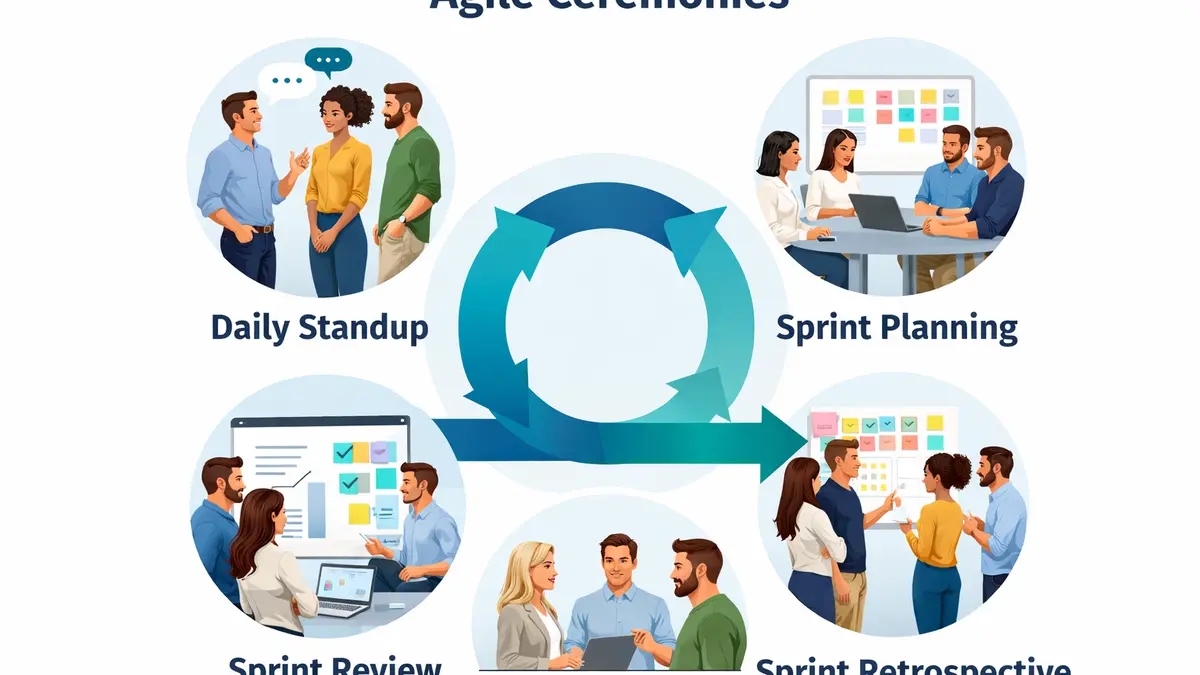
Scrum defines five formal events that operate within a continuous cycle of inspection and adaptation. The Sprint is a fixed-length iteration, typically between one and four weeks, during which all other events occur. The four core meetings inside the Sprint are Sprint Planning, Daily Scrum, Sprint Review, and Sprint Retrospective, each with a defined purpose, timebox, and expected outcome. Together, these events create a closed feedback loop that aligns strategy, execution, stakeholder validation, and process improvement. This structure distinguishes Scrum from traditional linear project management approaches.
Scrum Ceremonies vs. Broader Agile Rituals
Beyond official Scrum events, many teams implement additional practices such as Backlog Refinement, discovery workshops, or roadmap alignment sessions. While not mandatory within Scrum, these practices enhance backlog clarity and reduce planning inefficiencies. Other frameworks like Kanban introduce ceremonies such as replenishment meetings or service delivery reviews, expanding the scope of Agile rituals beyond Sprint-based iterations. Understanding the difference between core Scrum events and complementary Agile rituals enables teams to adapt intelligently without compromising structural coherence. This distinction is essential for scaling Agile effectively across organizations.
The Sprint: Strategic Cadence and Structural Foundation
The Sprint forms the structural backbone of all Agile ceremonies by imposing a consistent time boundary that drives focus and predictability. A Sprint cannot exceed one month, though two-week cycles remain the most common configuration in product organizations. During the Sprint, the team commits to achieving a clearly defined Sprint Goal, which anchors daily decisions and prioritization trade-offs. In 2026, teams that maintain a stable Sprint duration for at least six consecutive months report an average 23% improvement in commitment reliability, based on aggregated industry benchmarking data. A stable cadence enhances transparency and reduces volatility in delivery forecasts.
The Strategic Purpose of the Sprint
The Sprint exists to produce a potentially releasable Increment that delivers measurable business value. It protects the team from constant scope changes by creating a fixed commitment window aligned with prioritized backlog items. The Sprint Goal provides strategic direction, enabling the team to self-organize effectively while maintaining coherence. This timeboxed structure also supports risk mitigation by limiting exposure to uncertainty within shorter cycles. A clearly articulated Sprint Goal significantly improves cross-functional collaboration and outcome alignment.
Sprint Planning: Defining Commitment and Direction
Sprint Planning formally launches each Sprint and establishes what the team will deliver and how it intends to accomplish that work. The event brings together the Product Owner, Scrum Master, and Development Team to align priorities with capacity. The recommended timebox is roughly one hour per week of Sprint duration, meaning a two-week Sprint typically requires about two hours of planning. By the end of the session, the team defines a Sprint Goal and creates a coherent Sprint Backlog composed of selected backlog items and an execution strategy. This alignment ensures shared accountability and realistic commitments.
Roles and Responsibilities
The Product Owner presents prioritized backlog items and clarifies expected value, while the Development Team evaluates feasibility and technical considerations. The Scrum Master facilitates discussions, enforces time constraints, and ensures focus remains on the Sprint Goal. Each team member contributes to estimation and task breakdown, strengthening collective ownership. This shared responsibility reduces misunderstandings and limits mid-Sprint renegotiations. Clear role accountability significantly improves planning efficiency and outcome predictability.
Recommended Sprint Planning Structure
An effective Sprint Planning session typically unfolds in two phases: defining “what” and determining “how.” During the first phase, the team reviews prioritized items, clarifies acceptance criteria, and confirms alignment with the Sprint Goal. In the second phase, the team decomposes selected items into actionable tasks, identifies risks, and estimates workload using techniques such as story points or planning poker. Maintaining this structure prevents scope drift and ensures balanced discussions. Structured planning supports data-driven commitment rather than optimistic guesswork.
Common Pitfalls and Corrections
One frequent mistake is turning Sprint Planning into excessive technical analysis, which consumes valuable time and reduces engagement. Another issue arises when teams overcommit due to external pressure or unrealistic optimism. To correct these problems, teams should rely on historical velocity data and avoid detailed design discussions better suited for execution phases. Maintaining focus on achievable scope improves commitment consistency. Discipline in planning directly correlates with Sprint success rates.
Daily Scrum: Operational Synchronization
The Daily Scrum is a 15-minute event held every working day of the Sprint to synchronize efforts and inspect progress toward the Sprint Goal. It is not a status report to management but an internal coordination mechanism for the Development Team. The Scrum Master ensures the event occurs and remains aligned with its purpose, though only developers are required participants. Holding the Daily Scrum at the same time and location, whether physical or virtual, reinforces consistency and discipline. Short, focused daily synchronization minimizes misalignment and accelerates obstacle resolution.
Effective Daily Scrum Structure
While many teams use the traditional three questions format, the true objective is inspecting progress toward the Sprint Goal. Team members briefly share progress updates, outline immediate next steps, and identify impediments. Detailed problem-solving discussions should occur immediately after the meeting with relevant participants only. This structure protects the timebox and maintains engagement. Clear focus prevents the Daily Scrum from becoming a routine reporting session.
Measuring Daily Scrum Effectiveness
Indicators of a high-performing Daily Scrum include strict adherence to the 15-minute limit, clarity of daily priorities, and rapid visibility of blockers. In 2026, organizations tracking ceremony performance found that teams respecting the timebox more than 95% of the time experienced greater Sprint Goal stability. Visual management tools such as digital Kanban boards enhance transparency and collective understanding. When Daily Scrums regularly exceed their timebox, it signals structural inefficiencies that require adjustment.
Sprint Review: Validating Value with Stakeholders
The Sprint Review occurs at the end of the Sprint to inspect the Increment and gather stakeholder feedback. It is a collaborative working session rather than a formal presentation, emphasizing dialogue about product value and future direction. The Product Owner contextualizes progress against the broader roadmap while the Development Team demonstrates completed functionality. Feedback collected during the Review informs backlog adjustments and strategic prioritization. This external inspection ensures product alignment with evolving market needs.
Participants and Expected Outcomes
The entire Scrum Team participates in the Sprint Review, along with relevant stakeholders such as users, sponsors, or domain experts. The Increment presented must meet the Definition of Done to enable meaningful feedback. By the end of the session, the Product Backlog may be updated to reflect insights and changing priorities. This iterative recalibration supports adaptive product strategy. Effective Reviews strengthen stakeholder trust and product-market alignment.
Maximizing Sprint Review Impact
To maximize value, teams should frame demonstrations around user benefits rather than technical complexity. Encouraging open dialogue and documenting actionable feedback enhances strategic clarity. Depending on Sprint length, Reviews typically range from one to four hours to ensure sufficient discussion depth. A dynamic, interactive format increases engagement and shared understanding. Strong facilitation turns Reviews into powerful alignment events rather than passive demonstrations.
Sprint Retrospective: Driving Continuous Improvement
The Sprint Retrospective provides a structured opportunity for the Scrum Team to reflect on processes, collaboration, and tools. Unlike the Review, which focuses on product value, the Retrospective examines internal dynamics and operational effectiveness. The Scrum Master facilitates open discussion in a psychologically safe environment. The objective is to identify concrete improvement actions for the next Sprint. Continuous refinement of working methods is central to Agile maturity.
Structured Retrospective Format
An effective Retrospective typically includes reviewing facts, analyzing root causes, generating improvement ideas, and selecting prioritized actions. Formats such as Start-Stop-Continue or the 4Ls keep sessions engaging and productive. Limiting selected actions ensures focus and realistic implementation. Documenting and revisiting commitments in subsequent Sprints strengthens accountability. Structured reflection prevents repetitive discussion without measurable progress.
Measuring Retrospective Impact
Retrospective success depends on execution of agreed improvements rather than discussion volume. Teams can track action completion rates, reduction in recurring blockers, or improvements in delivery predictability. Some organizations set quantitative targets, such as reducing internal issue resolution time by 15% within two Sprints. This data-driven approach elevates Retrospectives from informal conversations to performance optimization mechanisms. Continuous measurement reinforces long-term Agile discipline.
Backlog Refinement: Essential but Not Official
Backlog Refinement is not a formal Scrum event but remains critical for maintaining a ready and prioritized Product Backlog. During this session, the team clarifies user stories, defines acceptance criteria, and estimates complexity before Sprint Planning. Allocating approximately 5–10% of Sprint capacity to refinement prevents overload during planning. A well-maintained backlog reduces ambiguity and enhances commitment reliability. Mature teams treat refinement as a strategic investment rather than optional overhead.
Kanban Rituals Compared
In Kanban, ceremonies differ because work flows continuously rather than in fixed Sprints. Teams often conduct replenishment meetings, service delivery reviews, and operations reviews to analyze throughput and optimize flow. While the cadence varies, the underlying principles of transparency and improvement remain consistent with Agile philosophy. Hybrid models frequently combine Scrum’s structured cadence with Kanban’s flow-based optimization. Selecting the right combination depends on organizational context and product complexity.
Global Best Practices for High-Performance Agile Ceremonies
High-performing Agile ceremonies rely on discipline, clarity of purpose, and continuous adaptation. Teams must respect timeboxes, define clear expected outcomes, and differentiate strategic decisions from operational coordination. A culture of openness and accountability enhances the impact of each event. When ceremonies are treated as value-creation mechanisms rather than routine obligations, performance metrics improve measurably. Strong facilitation ensures alignment without unnecessary complexity.
- Strict timebox enforcement to maintain focus and energy.
- Clear objectives defined before each ceremony.
- Documented decisions and measurable action tracking.
- Active participation from all required roles.
- Continuous adaptation based on team maturity and metrics.
FAQ: Agile Ceremonies in Scrum
How many Agile ceremonies exist in Scrum?
Scrum defines five events: the Sprint, Sprint Planning, Daily Scrum, Sprint Review, and Sprint Retrospective. Many sources mention only four because they exclude the Sprint as a meeting. Official Scrum guidance includes all five as essential structural elements. Understanding this distinction is critical for methodological accuracy in 2026.
What is the ideal Sprint length?
A Sprint cannot exceed one month, but two-week iterations are most common in product development teams. The optimal duration depends on product complexity and feedback cycles. Consistency in Sprint length improves performance measurement and forecasting reliability. Frequent changes to Sprint duration disrupt velocity tracking and long-term optimization.
Is Backlog Refinement mandatory?
Backlog Refinement is not mandatory within Scrum’s formal framework, but it is strongly recommended. Without refinement, Sprint Planning often becomes inefficient and overloaded. Regular backlog grooming ensures clarity, estimation accuracy, and smoother planning cycles. Mature Agile teams incorporate refinement as a standard practice.
Related Articles
- Scrum Master: Role, Skills, and Career Guide 2026
- Product Owner: Role, Responsibilities, and Skills
- Sprint Retrospective: Complete Guide for Continuous Improvement
- Sprint Backlog: Structure, Ownership, and Best Practices
Read also: Sprint Planning.