Product Owner: Role, Responsibilities, Skills and Performance Levers in 2026
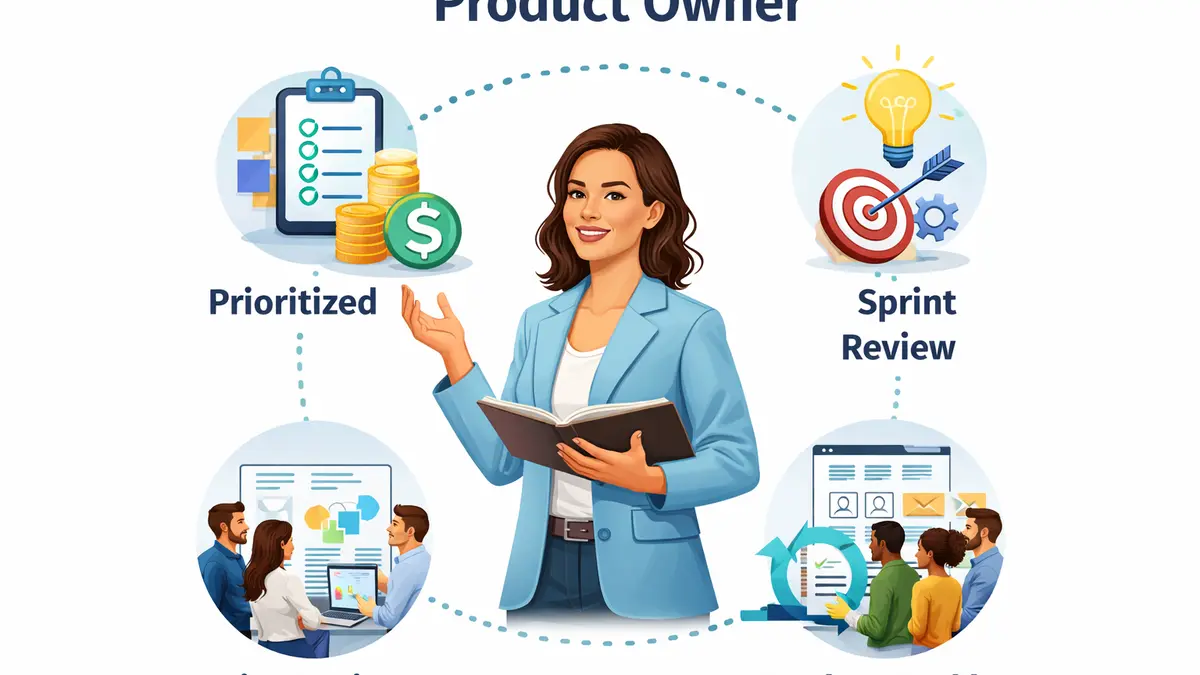
The Product Owner plays a central role in modern agile organizations, operating at the intersection of product strategy, value creation, and operational execution. In 2026, as digital transformation accelerates and delivery cycles become increasingly compressed, companies actively seek professionals capable of aligning vision, prioritization, and measurable outcomes. According to a 2026 global Digital Product Workforce report, 68% of organizations that clearly define and empower the Product Owner role report a significant improvement in time-to-market, with an average delivery cycle reduction of 27% over twelve months. These figures confirm that the Product Owner is far more than a backlog manager; the role directly influences business performance, customer satisfaction, and competitive positioning. Understanding the scope, responsibilities, decision frameworks, and optimization levers of this role has become a strategic necessity for product-driven organizations.
Product Owner Definition and Positioning in the Agile Ecosystem
The Product Owner is accountable for maximizing the value of the product resulting from the work of the development team, particularly within a Scrum framework. This accountability centers around ownership of the Product Backlog, including defining a clear Product Goal, ordering backlog items by value, and ensuring transparency and shared understanding. While certain tasks may be delegated, responsibility for product-related decisions remains fully with the Product Owner. The role requires decisiveness, clarity, and alignment with broader business objectives, as unclear ownership often leads to diluted strategy and inefficient delivery. In mature organizations, the Product Owner functions as the single voice of value within the delivery system.
Value Maximization as the Core Accountability
Maximizing value requires translating strategic objectives into incremental product improvements that generate measurable impact for users and the business. The Product Owner evaluates initiatives based on quantitative metrics such as revenue impact, user engagement, retention rate, and cost of delay. This value-driven mindset ensures that prioritization decisions align with business outcomes rather than internal preferences or political pressure. In 2026, leading organizations evaluate Product Owner performance primarily through measurable product impact rather than output volume. Delivering fewer high-impact features consistently outperforms delivering many low-impact enhancements.
Distinction Between Product Owner, Scrum Master, and Product Manager
The Product Owner should not be confused with the Scrum Master, whose responsibility lies in facilitating the agile framework and removing organizational impediments. Nor should the role be conflated with the Product Manager, who typically defines product vision, market positioning, and long-term strategic direction. The Product Owner translates strategic direction into prioritized, executable backlog items and works closely with development teams to ensure value delivery. Some organizations combine Product Owner and Product Manager responsibilities, but doing so requires strong clarity in strategic versus tactical decision-making. Clear role boundaries significantly reduce friction and improve product coherence.
Core Responsibilities of the Product Owner in 2026
The responsibilities of the Product Owner extend beyond writing user stories and attending sprint ceremonies. The role demands continuous alignment between business strategy, customer needs, and technical feasibility while ensuring rapid and consistent value delivery. Modern Product Owners operate as decision hubs within cross-functional teams, maintaining focus on outcomes rather than outputs. Each responsibility functions as a performance lever capable of accelerating or constraining business growth. Organizations that empower Product Owners with authority and data access consistently outperform those that treat the role as purely administrative.
Defining and Maintaining a Clear Product Vision
A strong Product Owner articulates a clear and compelling product vision aligned with measurable business goals. This vision is grounded in validated hypotheses, customer research, competitive analysis, and market insights rather than abstract aspirations. By connecting the vision to a structured Product Goal, the Product Owner creates a reference point for prioritization and iteration decisions. Without a coherent vision, backlog items become fragmented and disconnected from strategic objectives. Vision clarity directly influences team focus, stakeholder alignment, and long-term product sustainability.
Managing and Prioritizing the Product Backlog
The Product Backlog serves as the operational backbone of product delivery, and its quality reflects the effectiveness of the Product Owner. Backlog items must be clearly defined, testable, and ordered according to measurable value contribution. Structured prioritization frameworks such as RICE, WSJF, or MoSCoW provide objective criteria for decision-making and reduce subjective bias. A poorly managed backlog increases technical debt, inflates development costs, and weakens strategic alignment. Continuous refinement ensures adaptability without sacrificing focus.
Stakeholder Alignment and Communication
The Product Owner operates at the intersection of multiple stakeholders, including executives, marketing teams, sales departments, developers, and end users. Effective communication ensures that expectations remain realistic and aligned with product capacity and strategic priorities. The ability to say no, supported by data and value-based reasoning, protects the product from scope creep and misaligned initiatives. Strong negotiation skills are essential when balancing competing interests and limited resources. Transparency in decision-making builds trust and reinforces credibility across the organization.
Essential Skills of a High-Performing Product Owner
Success as a Product Owner requires a balanced combination of analytical thinking, leadership capability, business acumen, and technical understanding. In 2026, the increasing complexity of digital ecosystems demands data literacy and comfort with experimentation-driven development. Organizations prioritize candidates who can interpret product analytics, understand user behavior, and translate insights into actionable backlog items. Leadership in this role does not rely on formal authority but on clarity, decisiveness, and influence. The Product Owner must create alignment without direct hierarchical control.
- Strategic thinking and market awareness
- Advanced prioritization frameworks knowledge
- Data-driven decision-making capability
- Strong communication and negotiation skills
- Technical literacy and systems thinking
- Outcome-oriented leadership
Data-Driven Product Leadership
Modern Product Owners rely heavily on analytics platforms, experimentation frameworks, and behavioral metrics to inform their decisions. Key performance indicators such as activation rate, churn rate, net revenue retention, and feature adoption guide prioritization and roadmap adjustments. Running structured A/B tests and interpreting statistically significant results reduce uncertainty and improve capital allocation. A data-driven Product Owner systematically validates assumptions before scaling initiatives. This analytical rigor differentiates high-impact product organizations from intuition-based decision cultures.
Advanced Prioritization Methods and Practical Application
Prioritization directly determines the sequence in which value is delivered, making it one of the most critical competencies of a Product Owner. Objective frameworks enhance transparency and reduce internal friction during decision-making processes. Combining quantitative scoring models with strategic alignment criteria produces balanced and defensible prioritization outcomes. A structured approach improves predictability and increases stakeholder confidence. Effective prioritization can create substantial performance differentials over annual planning cycles.
Applying the RICE Framework in Practice
The RICE model evaluates initiatives based on Reach, Impact, Confidence, and Effort, generating a numerical score that supports objective comparison. For example, a feature reaching 5,000 monthly users, with an estimated impact score of 3, confidence level of 80%, and effort rating of 10 story points produces a calculable prioritization index. This structured calculation clarifies trade-offs and enables transparent communication with stakeholders. When consistently applied, RICE strengthens strategic discipline and reduces emotionally driven prioritization. Quantitative evaluation enhances backlog coherence and delivery focus.
Common Anti-Patterns and Strategic Corrections
One frequent anti-pattern involves reducing the Product Owner to a ticket writer, stripping the role of strategic influence and value ownership. Another common issue arises when decision authority becomes distributed across committees, slowing execution and diluting accountability. A Product Owner without genuine decision power cannot effectively maximize product value. Misalignment between vision and backlog often results from insufficient stakeholder engagement or weak data analysis. Correcting these issues requires explicit organizational support and clear governance structures.
Career Path, Compensation, and Evolution in 2026
The Product Owner role attracts professionals from diverse backgrounds, including marketing, engineering, UX design, and business analysis, reflecting its cross-functional nature. In 2026, the average annual salary of a mid-level Product Owner in Western markets reaches approximately $95,000, with senior profiles exceeding six figures depending on product complexity and organizational scale. Career progression often leads toward positions such as Senior Product Owner, Lead Product Owner, Head of Product, or Product Director. Demonstrated impact on measurable business outcomes significantly accelerates advancement opportunities. Organizations increasingly evaluate career growth through outcome-based performance rather than tenure alone.
FAQ – Product Owner Frequently Asked Questions
Does a Product Owner have to write all user stories?
The Product Owner is responsible for ensuring clarity and coherence of backlog items, but collaborative refinement with the development team often improves quality and shared understanding. The focus should remain on value articulation and acceptance criteria rather than authorship. Shared ownership of clarity increases efficiency and reduces misunderstandings during development. Final accountability for backlog quality still belongs to the Product Owner.
Can one person be both Product Owner and Product Manager?
Some organizations combine both roles, particularly in smaller companies or early-stage startups. However, strategic visioning and operational prioritization require distinct mindsets and time allocation. Combining roles demands strong discipline to prevent strategic neglect or tactical overload. Clear definition of responsibilities remains essential for maintaining product coherence and performance. Role clarity ensures sustainable growth and focused execution.
How many teams can a Product Owner effectively support?
A highly experienced Product Owner may support multiple teams when product complexity remains manageable and strong alignment mechanisms exist. However, expanding scope increases cognitive load and risks reducing prioritization quality. Sustainable value maximization requires realistic capacity assessment and organizational support. Excessive scope fragmentation undermines strategic focus and delivery effectiveness. Balanced allocation of responsibility protects both product quality and business impact.
Related Articles
- Scrum Master: Role, Skills, Salary and Career Guide 2026
- Agile Ceremonies: Complete 2026 Guide to Scrum Events
- Sprint Backlog: Structure, Ownership, and Best Practices
Read also: Structure your Product Backlog with Luckiwi.