Stakeholder Management: Complete Guide to Strategies, Tools, and Best Practices in 2026
Stakeholder management has become one of the most decisive disciplines for the success of modern organizations, strategic initiatives, and complex projects. Every company operates within a network of stakeholders that includes executives, employees, investors, partners, customers, regulators, and communities. Each of these actors holds expectations, interests, and varying levels of influence that can accelerate or obstruct decision-making processes. Effective stakeholder management transforms these interactions into a strategic advantage by aligning interests, reducing friction, and strengthening organizational trust. In 2026, the growing complexity of digital ecosystems, global collaboration, and cross-functional initiatives makes this capability essential for leaders, project managers, and transformation teams.
Managing stakeholders goes far beyond sending updates or persuading individuals to support a project. The discipline relies on a structured process that combines stakeholder identification, influence analysis, prioritization, engagement strategy, and continuous monitoring. Organizations that master this approach treat stakeholder management as an operational governance system linking communication, leadership, risk management, and strategic execution. By understanding how power, expectations, and relationships shape decision environments, organizations can anticipate resistance, mobilize support, and sustain momentum throughout the lifecycle of a project or initiative.
The increasing importance of this discipline is reflected in recent research. According to a 2026 Project Management Institute study, organizations that implement formal stakeholder management practices improve the success rate of strategic initiatives by 27% compared with those that rely on informal communication alone. This statistic highlights how stakeholder alignment directly affects performance, decision speed, and organizational stability. As business environments become more interconnected and transparent, companies that actively manage relationships with stakeholders are better positioned to sustain growth and manage transformation.
Definition of Stakeholder Management and Its Strategic Role
Stakeholder management refers to the structured process of identifying, analyzing, and engaging individuals or groups who can influence or be affected by an organization’s activities. A stakeholder may include internal actors such as executives, employees, or project teams, as well as external actors like customers, suppliers, investors, regulators, and community representatives. The core objective of stakeholder management is to align expectations and influence relationships so that strategic initiatives can be executed with minimal resistance and maximum collaboration.
Effective stakeholder management requires organizations to deeply understand the motivations, priorities, and influence levels of each stakeholder group. This analysis allows leaders to anticipate reactions to strategic decisions and adapt communication strategies accordingly. For example, executives may focus on financial performance and strategic positioning, while operational teams may prioritize resource allocation, workload distribution, and operational feasibility. Understanding these distinct perspectives enables organizations to design communication strategies that resonate with each stakeholder group.
Contrary to common misconceptions, stakeholder management is not about manipulating people to achieve predefined outcomes. Instead, it is a discipline rooted in transparency, trust building, and long-term relationship management. Organizations that embrace this perspective cultivate stronger collaboration across departments and external partners. Over time, this relational capital becomes a competitive advantage, enabling organizations to execute complex initiatives with greater agility and resilience.
Why Stakeholder Management Is Critical in 2026
The modern business environment is defined by complexity, rapid innovation cycles, and global collaboration networks. Projects frequently involve cross-functional teams, international partners, digital platforms, and regulatory oversight. In such environments, misalignment between stakeholders can quickly derail strategic initiatives. Structured stakeholder management helps organizations maintain clarity around goals, responsibilities, and expectations, reducing the likelihood of delays and conflicts.
The proliferation of digital communication platforms has also changed the dynamics of organizational interaction. Stakeholders now have immediate access to information and can influence decision processes in real time. Internal collaboration tools, social platforms, and digital ecosystems amplify both support and criticism within organizations. Leaders must therefore adopt proactive stakeholder engagement strategies that manage information flow while maintaining transparency and clarity.
Another defining factor in 2026 is the increased visibility of corporate actions. Decisions made by organizations are scrutinized by investors, regulators, and the public through digital channels and global media. Poor stakeholder management can lead to reputational damage, regulatory obstacles, and loss of strategic partnerships. Consequently, organizations that integrate stakeholder management into their governance frameworks gain greater resilience and adaptability in volatile business environments.
Main Types of Stakeholders in Organizations
Stakeholders can be classified in several ways depending on their relationship with the organization and their level of influence. One of the most common distinctions separates internal stakeholders from external stakeholders. Internal stakeholders include executives, project managers, employees, and operational departments. These actors directly contribute to project execution and organizational performance. External stakeholders include customers, suppliers, partners, investors, and regulatory institutions that interact with the organization from outside its internal structure.
Each stakeholder group brings different priorities and expectations to a project or strategic initiative. Senior executives typically focus on long-term value creation and strategic outcomes, while operational teams prioritize feasibility, workload management, and process efficiency. External stakeholders such as clients or partners evaluate the tangible value generated by the organization’s initiatives and their impact on broader ecosystems. Understanding these differences allows organizations to design targeted engagement strategies that address the specific needs of each stakeholder group.
Examples of Stakeholders in Strategic Projects
Consider a digital transformation initiative within a large organization. In such a scenario, the executive leadership team acts as the strategic sponsor responsible for defining objectives and allocating resources. Technology teams manage system architecture, integration, and cybersecurity requirements, while operational departments evaluate how new systems affect workflows and productivity. Customers and external partners represent critical stakeholders as well, since their adoption and feedback ultimately determine the success of the transformation initiative.
- Executives and sponsors: define strategic direction and allocate resources.
- Operational teams: implement project activities and manage daily execution.
- Technology partners: provide platforms, expertise, and technical infrastructure.
- Customers and end users: evaluate the practical value delivered by the project.
- Regulators and institutions: ensure compliance with laws and industry standards.
The Stakeholder Management Process
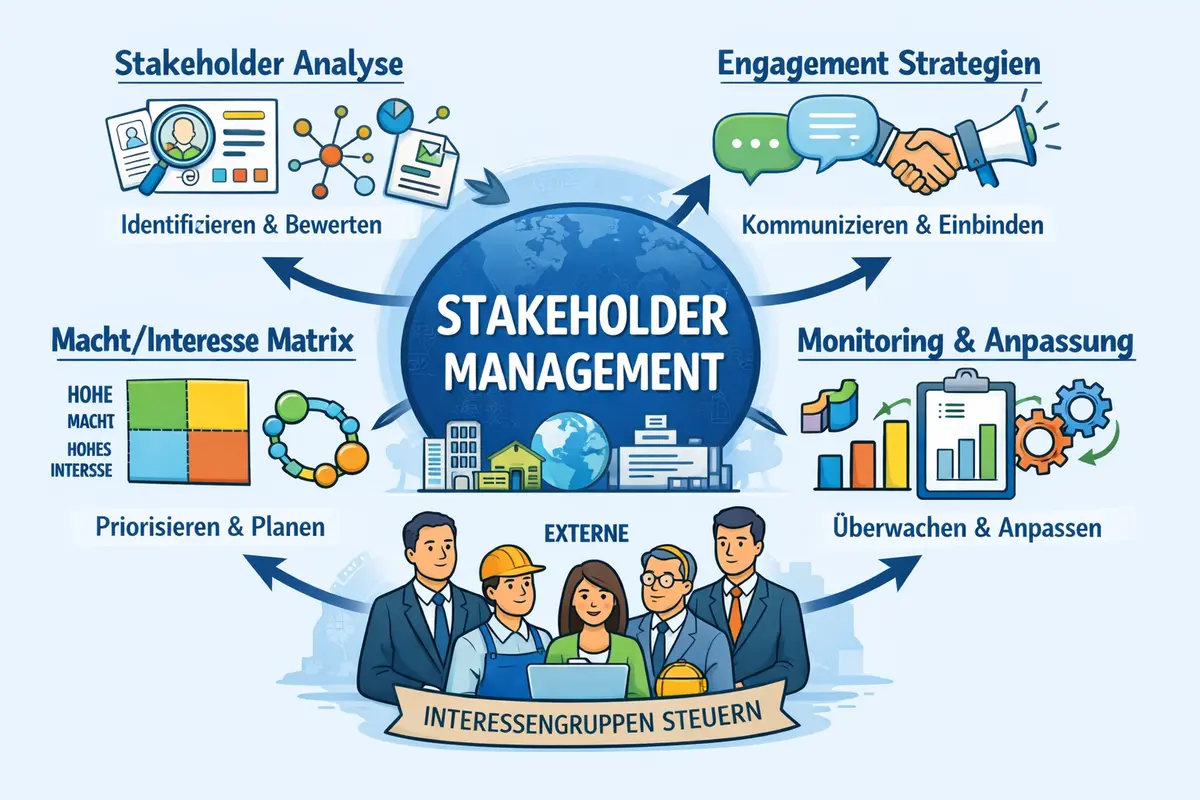
A robust stakeholder management strategy follows a structured process that combines analysis, planning, and continuous relationship monitoring. Organizations that successfully implement stakeholder management treat it as an ongoing cycle rather than a one-time exercise. The process begins with identifying stakeholders, followed by analyzing their influence and expectations. This analysis informs engagement strategies that guide communication and collaboration throughout the project lifecycle.
Many organizations adopt a four-phase framework aligned with widely recognized project management methodologies. This approach ensures that stakeholder considerations are integrated into planning, communication, and risk management activities. By embedding stakeholder management into core project processes, organizations create a systematic way to align human dynamics with strategic objectives.
- Identify stakeholders
- Analyze influence and expectations
- Develop engagement strategies
- Monitor and adapt relationships
Identifying Stakeholders
The first stage of stakeholder management involves identifying all individuals or groups that may influence or be affected by a project. Organizations often create a stakeholder register, a structured document that records stakeholder roles, interests, influence levels, and communication preferences. This register becomes a central reference for project teams and helps maintain consistency in stakeholder interactions throughout the project lifecycle.
Effective identification requires looking beyond obvious stakeholders such as executives or team members. Influential actors may include informal leaders, external advisors, industry associations, or regulatory authorities. Ignoring these stakeholders can lead to unexpected resistance later in the project. A comprehensive identification process ensures that no critical voice is overlooked and that engagement strategies are inclusive and proactive.
Analyzing Influence and Expectations
Once stakeholders are identified, the next step involves evaluating their level of influence and interest in the project. One of the most widely used analytical tools for this purpose is the Power-Interest Grid. This matrix categorizes stakeholders based on their decision power and their degree of interest in the initiative. By mapping stakeholders into different quadrants, organizations can prioritize engagement efforts and allocate communication resources more effectively.
The matrix typically divides stakeholders into four categories. Actors with high power and high interest require close management and active participation in decision processes. Stakeholders with high power but low interest should be kept satisfied to prevent potential opposition. Those with high interest but limited influence should receive regular information to maintain engagement. Stakeholders with low influence and low interest require minimal monitoring, ensuring efficient use of organizational resources.
Developing Engagement Strategies
After analyzing stakeholder dynamics, organizations must define how they will interact with each stakeholder group. Engagement strategies outline communication channels, key messages, meeting formats, and reporting frequency. These strategies also specify internal responsibilities to ensure that stakeholders receive consistent information and that relationships are managed professionally.
Different stakeholders require different engagement approaches. Executive sponsors may participate in steering committees and strategic reviews, while operational teams benefit from collaborative workshops and working sessions. External stakeholders may prefer formal reports, partnership meetings, or digital communication platforms. Tailoring engagement strategies to each stakeholder’s role enhances trust and increases the likelihood of successful collaboration.
Monitoring and Adapting Stakeholder Relationships
Stakeholder management is an ongoing activity that continues throughout the lifecycle of a project. Stakeholder expectations, priorities, and influence levels may change as projects evolve. Continuous monitoring enables organizations to detect emerging risks, respond to stakeholder concerns, and maintain alignment between strategic objectives and stakeholder expectations.
Advanced organizations use dashboards and performance indicators to evaluate the quality of stakeholder relationships. These metrics may include participation rates in governance meetings, decision-making speed, feedback quality, and stakeholder satisfaction levels. Continuous monitoring allows leaders to detect early warning signals and adjust engagement strategies before conflicts escalate or strategic momentum is lost.
Essential Tools for Stakeholder Management
Effective stakeholder management relies on a set of analytical and operational tools that help organizations structure stakeholder information and manage interactions systematically. These tools support the identification, analysis, and engagement phases of stakeholder management while ensuring transparency across teams. When combined with digital collaboration platforms, these tools create a comprehensive framework for managing stakeholder relationships.
The stakeholder map is one of the most widely used visualization tools in stakeholder analysis. This graphical representation illustrates relationships, influence levels, and communication pathways between different stakeholders. By mapping these interactions visually, project teams can quickly identify key influencers, understand potential alliances, and anticipate areas where conflicts may emerge.
Modern project management platforms increasingly integrate stakeholder management functionalities. These systems allow organizations to centralize stakeholder data, document interactions, and track communication history. Digital tools also support collaboration by enabling shared access to stakeholder registers, engagement plans, and progress reports. This integration improves transparency and ensures that teams maintain consistent communication with all stakeholders involved.
Measuring Stakeholder Management Performance
Evaluating the effectiveness of stakeholder management helps organizations refine their strategies and demonstrate the tangible impact of relationship management on project outcomes. Performance measurement provides insights into stakeholder engagement levels, communication effectiveness, and the overall quality of stakeholder relationships. Organizations that integrate these metrics into their governance frameworks gain better visibility into the human factors that influence project success.
Common metrics used in stakeholder management include stakeholder engagement levels, decision-making speed, and alignment with project objectives. Organizations may also measure participation in meetings, response times to communication, and the frequency of change requests initiated by stakeholders. These indicators help project leaders understand how stakeholder interactions influence operational performance and project stability.
Advanced organizations incorporate stakeholder management metrics into executive dashboards that link relational dynamics with financial and operational outcomes. By analyzing correlations between stakeholder engagement and project performance, leaders gain valuable insights into how relationships influence strategic execution. This data-driven approach reinforces the role of stakeholder management as a critical component of organizational performance.
Best Practices for Effective Stakeholder Management
Organizations that consistently maintain strong stakeholder relationships follow a set of proven best practices rooted in communication, transparency, and strategic foresight. These practices help leaders build trust, align expectations, and sustain collaboration across complex networks of stakeholders. A structured approach to stakeholder engagement also strengthens organizational resilience during periods of transformation or uncertainty.
Clear and consistent communication is one of the most important principles of effective stakeholder management. Leaders must tailor messages to the priorities and perspectives of different stakeholder groups while ensuring that information remains accurate and transparent. Regular updates, collaborative discussions, and structured reporting mechanisms reduce uncertainty and strengthen stakeholder confidence in the organization’s strategy.
Another critical practice involves proactive relationship management. Rather than reacting to problems as they arise, effective leaders anticipate potential concerns and address them early through dialogue and collaboration. This proactive mindset allows organizations to maintain momentum in complex initiatives and fosters a culture of openness and mutual accountability among stakeholders.
FAQ: Frequently Asked Questions About Stakeholder Management
What is the difference between stakeholder management and stakeholder engagement
Stakeholder management refers to the overall process of identifying, analyzing, planning, and monitoring relationships with stakeholders. It encompasses the strategic framework used to manage stakeholder interactions. Stakeholder engagement, on the other hand, refers specifically to the actions taken to involve stakeholders in decision processes, communication activities, and collaborative initiatives. Engagement is therefore a key component within the broader stakeholder management framework.
How can organizations manage conflicts between stakeholders
Conflicts between stakeholders often arise when different groups pursue competing objectives or hold divergent perspectives about project outcomes. Effective conflict management begins with understanding the motivations and constraints of each stakeholder group. Leaders can then facilitate structured discussions, identify common interests, and develop compromise solutions that align with the overall strategic objectives of the organization.
Which indicators measure the success of stakeholder management
Organizations typically evaluate stakeholder management success through metrics such as engagement levels, stakeholder satisfaction, and the speed of strategic decision-making. Additional indicators may include the number of project changes requested by stakeholders, participation in governance meetings, and feedback quality from key actors. These metrics provide actionable insights that help organizations refine their stakeholder engagement strategies and strengthen long-term relationships.